


Published: July 8, 2026
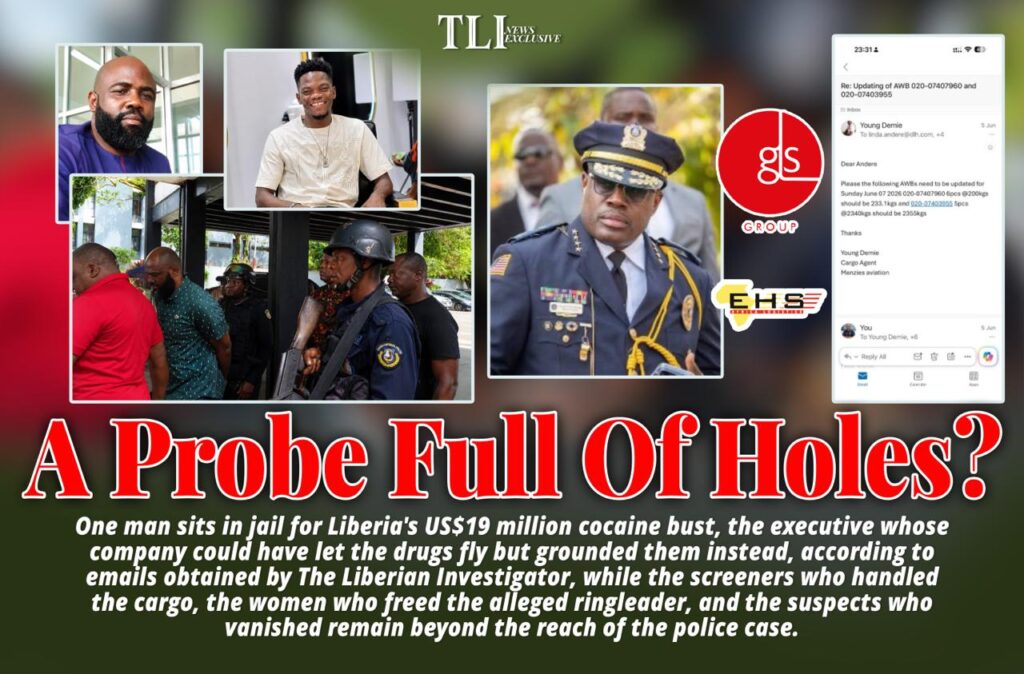
MONROVIA — Nearly a month after the cocaine seizure at the Roberts International Airport, the only man behind bars is the cargo executive whose own company grounded the shipment, while the airport screeners who handled it, the two women who freed the alleged ringleader from prison, and the question of how key suspects slipped out of the country remain unexamined, unnamed and unexplained.
Paul J. King was formally charged Saturday alongside Michael U.S. Browne, the fugitive whose 2024 prison release the Senate has ordered investigated, and three other men in the June 8 seizure of roughly 237.6 kilograms of cocaine, valued above US$19 million, that police say moved through Roberts International Airport disguised as Maggi cubes and lappas. Browne, also known as Rahim or Raheem Bah, and the three others were charged in absentia. King, who was in the United States throughout the shipment and the bust and flew home to surrender on June 21, remains the only defendant in custody.
Yet emails obtained by The Liberian Investigator show it was the cargo operation King helps run that flagged the shipment’s suspicious weight and refused to let it fly, three days before officers found the drugs, a paper trail that has raised questions about why anyone with a stake in the cargo would ground it over a weight discrepancy.
On June 5, a GLS Menzies cargo agent contacted Lufthansa Cargo to request corrections for air waybills booked on a Brussels Airlines flight. A shipment declared at 200 kilograms across six pieces had registered 233.1 kilograms on the handler’s scale, an unexplained excess of 33.1 kilograms. The same day, country manager Kenneth Bainomugisha told the airline the newly delivered shipment would not move, complaining that last-minute deliveries were putting his staff “on unnecessary pressure that results in errors.”
“The team has been advised to wait on acceptance until this is rectified,” Bainomugisha wrote.
The cargo was expected to depart June 7 after the weight correction. The hold sent the boxes to mandatory X-ray screening, where, according to the police charge sheet dated July 6, security officer Ruth Gbapaywhea observed dark, blurry images inconsistent with the declared contents. The shipment was isolated, and because revised documentation arrived after the flight’s deadline, it stayed on the ground. When officers and GLS Menzies representatives opened the boxes on June 7, the first one gave up a white powdery substance the Liberia Drug Enforcement Agency later confirmed as cocaine: 198 plates.
“A handler with a vested interest in the shipment needed only to accept the cargo at its declared weight and let it board. Instead, the operation put the discrepancy in writing to an international airline, copied multiple officials and froze the consignment on its own tarmac, the chain of events that led directly to the seizure,” a source close to the operations told The Liberian Investigator.
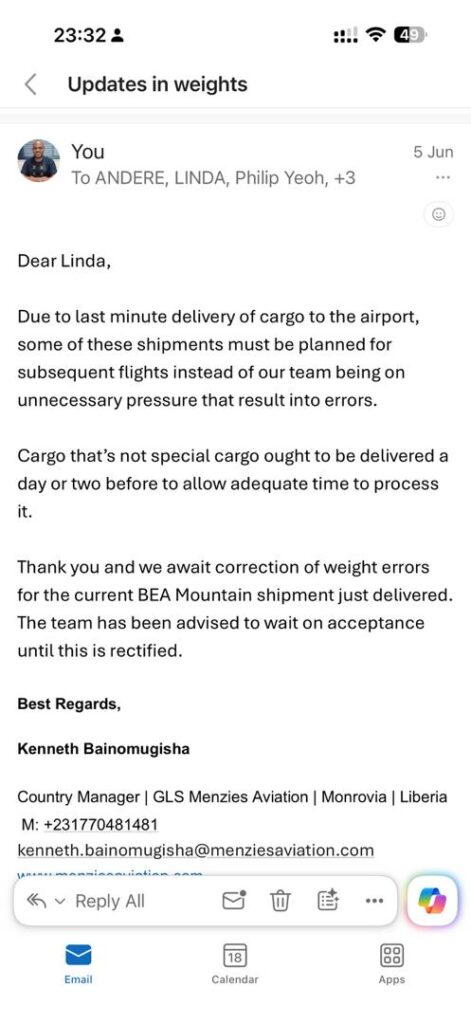
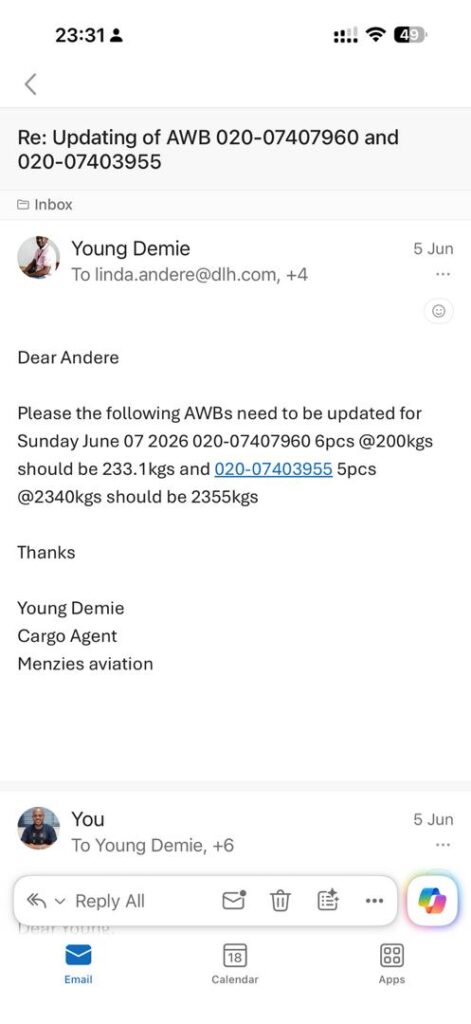
screenshots of emails from GLS Menzies to Lufthansa Cargo informing them of the discrepancy in the weight of the cargo
That contradiction sits at the center of what sources close to the investigation describe as unanswered questions in the police case. The sources question why the airport agents responsible for scanning and inspecting the cargo, the same checkpoint that caught the June 5 shipment, have not themselves been examined as potential accomplices, given how much of the case against King rests on decisions made inside that same handling chain. They also question how police concluded that Browne and Emmanuel Kpah have fled the country, saying authorities have not detailed what evidence supports that determination. And they ask why the two women who signed the Statement of Guarantee that secured Browne’s release from Kakata Central Prison, his fiancée and his sister, have not been named persons of interest, given their central role in freeing a man police now allege ran a drug shipment through the airport.
Sources close to the investigation told The Liberian Investigator that on June 5, after being contacted by Browne, King asked his housemaid to receive the cargo and deliver it to Express Handling Services the same day. EHS was paid $2,150 for the cargo service, and the boxes were handed to Arthur Nyafor, who, along with Kpah, transported the shipment to the airport and delivered it to the GLS Menzies terminal for processing, the same terminal that would flag and hold it.
Express Handling Services is a logistics and freight forwarding company that moves cargo into and out of Liberia by air and sea, providing customs clearance, cargo handling, warehousing and supply chain coordination. It acts as an intermediary between international shippers, airlines, customs authorities and cargo owners.
According to the police, photographs of the narcotics were sent to King through Philip Yeoh Jr. of GLS Menzies after the discovery, and King instructed Yeoh to engage airport security in an effort to secure the shipment’s release. Authorities further allege King sent Yeoh two mobile phone numbers identifying the cargo’s alleged owner, then admitted during questioning that he deleted those numbers from their WhatsApp conversation.
Inspector General of Police Col. Gregory Coleman, announcing the charges in a statement late Saturday, rejected any innocent reading of the shipment.
“This was not a paperwork error. This was not a routine cargo discrepancy. This was not an innocent shipment gone wrong,” Coleman said. “This was a serious transnational cocaine trafficking operation using Liberia’s aviation and logistics system as a channel for organized crime.”
Coleman said the Joint National Security Investigation, ordered by President Joseph Nyuma Boakai and supervised by the Ministry of Justice, traced the cargo trail, the money trail, communications data and digital evidence, and established “deliberate efforts by operating cells of the cartel to bribe security personnel, retrieve the shipment, and interfere with the seizure.” Investigators also uncovered an earlier consignment moved on May 22 under the same false description and linked to the same network, Coleman said. That shipment was scanned and cleared by Oscar J. Browne, who later made repeated calls seeking the seized cargo’s release. Kpah delivered the shipment and the cash tied to the transaction, Coleman said, while Usman Ali was named as the consignee in the United Kingdom. The charge sheet alleges the drugs moved through front entities identified as Mr. Bah Group of Companies, EMRE Venn Group of Companies and Aisha Group of Companies.
The suspects were charged under the Amended Controlled Drugs and Substances Act of 2023 and Chapter 10 of the Revised Penal Code, with counts including unlicensed exportation of controlled drugs, unlicensed transportation and trading in transit, unlicensed possession, illicit trafficking and criminal conspiracy. King was arrested July 4 by Deputy Commissioner of Police Raffell A. Wilson.
At a special July 1 session called after Bomi County Sen. Edwin Melvin Snowe Jr. and Gbarpolu County Sen. Amara M. Konneh demanded an independent probe, Senate Pro Tempore Nyonblee Karnga-Lawrence ordered the Judiciary Committee to investigate Browne’s release from Kakata Central Prison. Court files obtained by The Liberian Investigator show Browne was indicted in 2024 for trafficking 10 kilograms of Kush, a first-degree felony the drug law declares non-bailable, then released on a Statement of Guarantee signed by his fiancée and his sister after the prison superintendent wrote directly to the judge. The file contains no written ruling granting bail and three conflicting accounts of the injury that justified Browne’s transfer out of custody.





Discussion about this post