


Published: September 16, 2026
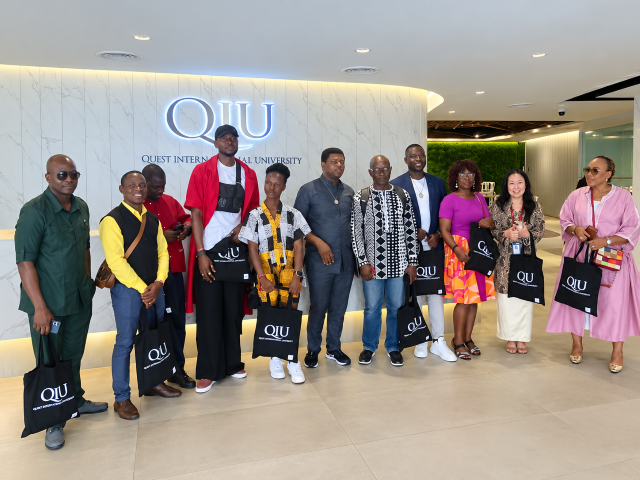
IPOH, Malaysia — A delegation of senior West African journalists covering activities of QNET and the QI Group in Malaysia has visited Quest International University (QIU) in Ipoh, Perak, where the institution’s leadership outlined its focus on industry-driven education, practical research, artificial intelligence and stronger academic collaboration with Africa.
The journalists visited the university on Monday, Sept. 14, and met with Nicholas Goh, CEO of the holding company behind QIU, who said universities must move beyond simply awarding degrees and ensure students acquire practical skills relevant to changing labor-market demands.
“If you don’t talk about employability and industry-fit graduates, you’re not saying enough” Goh told the journalists, stressing that universities have a responsibility to prepare students for meaningful careers.
During the visit, the journalists toured the university’s facilities, including its faculty lounge, science laboratories and well-equipped classrooms. They also inspected ongoing classroom renovation works and interacted with professors and other university personnel about teaching, research and student development.
Goh said QIU was established in 2008 in partnership with the state government of Perak and began classes in 2011. Starting with 98 students, the university has grown to about 2,300 students, offering programs across business and management, computing and engineering, integrated life sciences, medicine, pharmacy and social sciences, along with postgraduate studies and research.
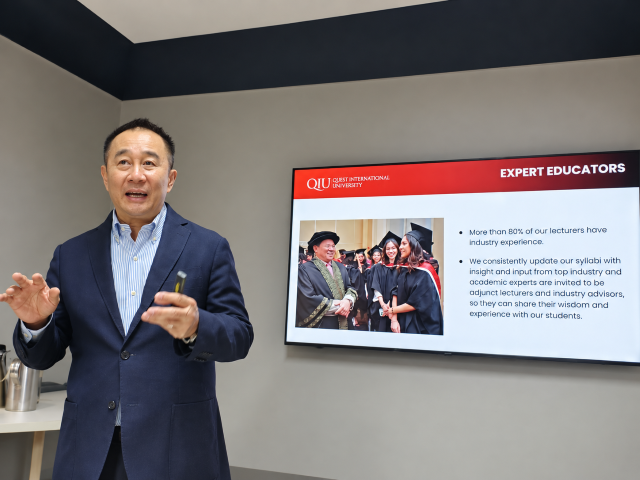
Nicholas Goh, CEO of the holding company behind Quest International University (QIU) in a media engagement with African Journalists
He said students from 54 countries are represented at QIU, while the institution is working to attract more international students, including from Africa.
Goh said about 80% of QIU’s professors and lecturers come from industry backgrounds, while 95% of its graduates secure employment within six months.
“This is how the future of a university should be,” he said, stressing the importance of connecting universities with industries and emerging technologies.
He also highlighted QIU’s growing focus on artificial intelligence and practical research, saying academic research should address real-world challenges rather than being conducted merely for publication.
“We have very limited resources. I don’t allow you to go and do a research that cannot be impactful to the society, research should mean more than just publishing academic papers,” Goh said.
Goh also emphasized opportunities for stronger Africa-Asia educational and research partnerships, arguing that academic programs should respond to countries’ development needs.
“We should be addressing the need, not your interest — the needs of the nation,” he said.
Encouraging African students and institutions to consider Asia for educational partnerships, Goh added: “Be proud of your heritage. Our land is in our hands.”






Discussion about this post