


Published: August 21, 2026
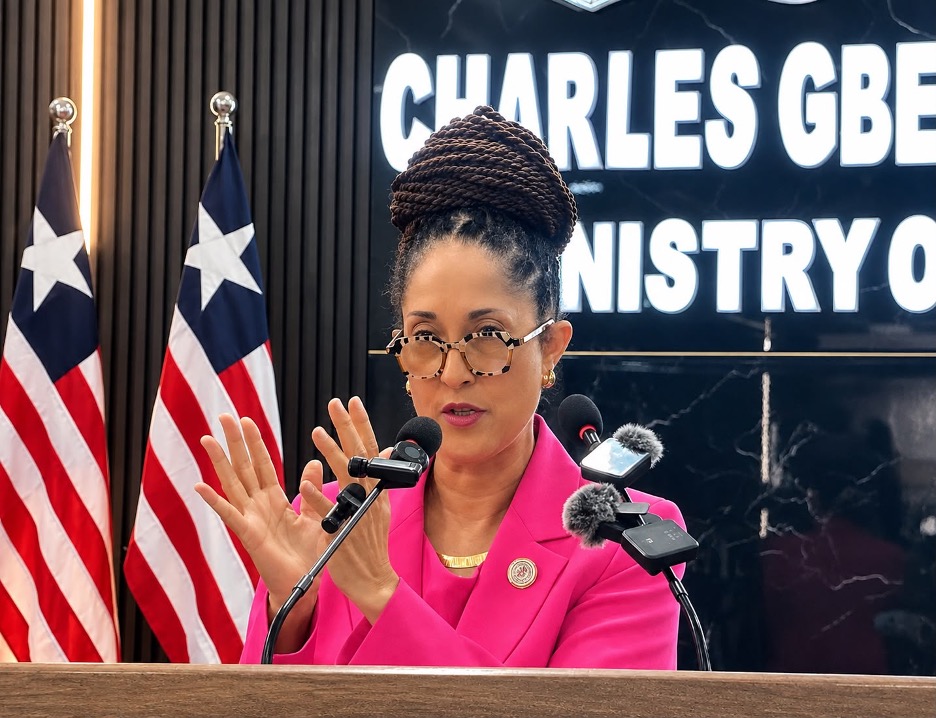
MONROVIA — Only 19% of the University of Liberia’s full-time faculty hold doctorates or other terminal degrees, about 150 of 800, and UL President Dr. Layli Maparyan said Thursday that raising that share is central to her bid to put the university among Africa’s top 300 within a framework she says covers more than 20 measures of institutional performance.
Speaking at the Ministry of Information’s regular press briefing, Dr. Maparyan tied the ranking goal to President Joseph Boakai’s ARREST Agenda for Inclusive Development and said it functions less as a number than as a checklist the university can work against, covering how fast students graduate, what qualifications the faculty hold and what condition the buildings are in.
“Since becoming President of the University of Liberia, my administration has been focused on a specific goal within the ARREST Agenda for Inclusive Development: becoming a Top 300 in Africa university,” Maparyan said.
On faculty, she said most of the 650 or so without terminal degrees hold master’s degrees, and that the university is moving people through doctoral programs abroad on other institutions’ money. Three UL personnel have gone to the University of Delhi on fully funded Indian government scholarships. Three more, all women, are expected at the University of Botswana on scholarships funded by that university’s vice chancellor. One more woman is on a funded doctorate at Duke University. More than 15 people are already on study leave under a program written into UL’s bylaws, either pursuing doctorates or preparing to return. Maparyan said UL has added Université Cheikh Anta Diop in Dakar to the institutions that can host its faculty, and credited Liberia’s ambassador to Senegal, Ali Sylla, with brokering it.
She said she wants the growth in doctorates to shift the gender balance of the professoriate as well as its size, which is why women feature in the placements.
On graduation times, Dr. Maparyan said international benchmarks expect undergraduates to finish in four to six years and that the academic calendar is the lever UL controls directly. The Joint Faculty Senate and Academic Coordinating Committee approved a regularized calendar in February 2025, and the university has since run three regular terms with one vacation school, which she said lets students clear required courses without long interruptions.
“Ultimately, this is a success not just for UL, but for the nation,” she said.
On buildings, Maparyan said the US$6.3 million appropriated to UL for renovation in the 2026 fiscal year budget is being spent in three phases: emergencies first, including leaking roofs and nonfunctioning bathrooms; then temporary swing spaces so classes can continue during construction; then full renovation. She credited Boakai and the Legislature for the allocation and said the work is moving on all three fronts at once. She did not say Thursday how much of the money UL has actually received.
“Renovation is more than zinc and paint,” she said. “It is ‘making things new again.'”
She said UL recently hosted a representative of PHYWE/LN Education Group, which supplies laboratory equipment, to begin a plan for modernizing science, technology, engineering and mathematics laboratories, and that laboratory work has to be sequenced with building renovation so the electrical and energy systems can carry the equipment.
At Fendell, the Solar Oasis Student Utility Park is nearing completion. It is to provide 26 bathrooms and a student center with 24-hour device charging and internet, running entirely on solar power. Maparyan said it is meant as a demonstration of what a fully solar-powered UL would look like.
She defended the green wooden armchairs donated by Voices of the Elders RL, a group of Liberians who raised money for classroom seating after the shortage drew attention on social media, saying they met an immediate need and that UL will move to modern furniture as buildings are renovated. On the CPAV building, where videos circulated showing rain coming into classrooms after a renovation she called lite, Maparyan said the building was never designed as a classroom block but that enrollment pressure made it necessary as swing space, and that a multistory classroom building will eventually go up on the site.
“Modernization takes time, and this UL administration is committed to it for the long haul,” she said.
Dr. Maparyan said talks with the leadership of the University of Liberia Faculty and Staff Association were productive and that she is awaiting the outcome of the association’s General Assembly. Preparations are under way for course registration through the ePortal, orientation for new students and the resumption of student ID issuance.







Discussion about this post