


Published: June 5, 2026
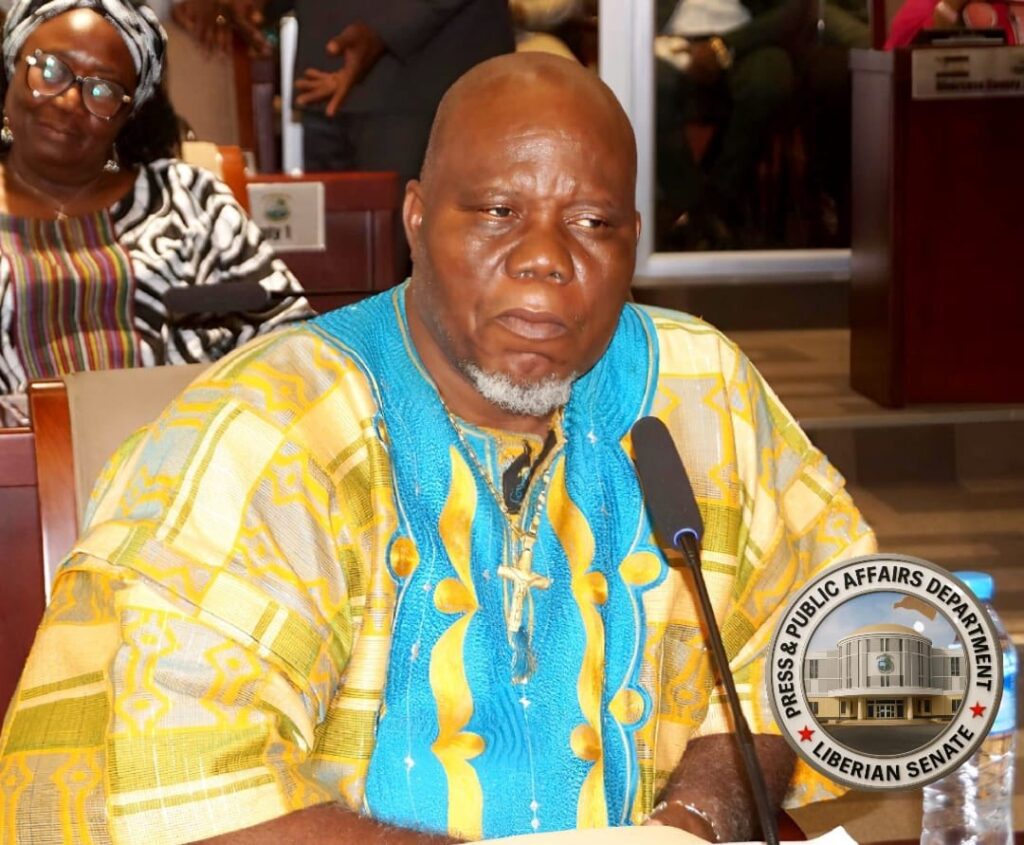
CAPITOL HILL, Monrovia — A long-running fight over who gets to compete in Liberia’s elections has returned to the Senate, where River Cess County Sen. Bill T. Twehway has introduced legislation to scrap a law that critics say can lock smaller parties and independent candidates out of the ballot for years.
The proposed Democratic Pluralism and Electoral Inclusion Amendment Act was formally submitted Thursday, setting up what could become one of the most consequential electoral reform debates ahead of future elections.
If enacted, the bill would permanently repeal provisions of Liberia’s 2014 Amended Elections Law that bar political parties and independent candidates from contesting two successive election cycles if they fail to win at least 2 percent of the national vote.
The proposal comes amid mounting criticism from opposition politicians, legal experts and civil society actors who argue the measure undermines democratic participation and stifles political competition.
In a communication dated June 2 to Senate President Pro Tempore Nyonblee Karnga-Lawrence, Twehway said the bill is meant to correct what he called “historical and structural imbalances” in Liberia’s electoral framework.
“I have the distinct honor and privilege to present to this august body a critical piece of reform legislation aimed at fortifying our peace, expanding our democratic space, and safeguarding the fundamental constitutional rights of all Liberians,” he wrote, adding that the amendment “seeks to permanently repeal the highly restrictive 2% vote-threshold penalty introduced in Chapter 5A of the 2014 Amended Elections Law.”
The senator said the current law amounts to a political “death sentence” for parties and candidates that fall short of the threshold, who can then be barred from nominating candidates for two successive cycles.
“Such a provision does not protect democracy; it limits it,” he said. “It creates an artificial political monopoly for established parties, silences regional, minority, and emerging voices, and forces ordinary Liberians to vote out of fear of wasting their ballots rather than true ideological conviction.”
He said the bill would establish ballot access as “a permanent, inalienable constitutional right that cannot be revoked by historical numerical metrics or immediate electoral underperformance.”
The issue gained renewed attention during the Senate confirmation hearing of National Elections Commission Chairman-designate Jonathan Weedor, when Montserrado County Sen. Abraham Darius Dillon asked whether he would enforce the threshold if confirmed.
Dillon asked whether Weedor, under the existing law, would uphold the bar on candidates who failed to reach the required share of the presidential vote. “To the fullest, senator,” Weedor replied, emphasizing that the commission would enforce the law as written.
The debate quickly spilled into the political arena, with Alternative National Congress Political Leader Alexander B. Cummings dismissing suggestions that his party could be hurt by the law and accusing Dillon of playing politics.
“Just to clear the air. I think Dillon knew this, but he was playing politics,” Cummings said on Sky FM’s 50-50 Talk Show. He noted that the Collaborating Political Parties polled less than 2 percent but still won several legislative seats, including senators and representatives.
“The ANC was not on the ballot. CPP was on the ballot. The law applies to the institution and not the individual,” he said. “They were playing politics. This was meant to be political. It was meant to be a distraction. And we will play politics with Dillon, too, in 2029.”
Twehway’s proposal is not the only attempt to repeal the provision. Nimba County District No. 7 Rep. Musa Hassan Bility recently introduced the Political Inclusion and Democratic Participation Amendment Act of 2026 in the House, seeking to repeal Section 5.1(A) and related provisions that allow parties to be suspended, deregistered, excluded or disqualified over poor electoral performance.
“This proposal is rooted in a simple democratic principle: the people, not the government, should decide which political parties survive and which political parties disappear,” Bility wrote. “The role of election laws is to facilitate political participation, not to restrict it.”
Among the most vocal critics is human rights lawyer and former presidential candidate Cllr. Tiawan Saye Gongloe, who argued that Liberia’s history shows the dangers of political exclusion.
“Liberia’s history teaches us that exclusion is dangerous, while inclusion strengthens peace, national unity, and democratic stability,” Gongloe wrote. He said the framers of the 1986 Constitution sought to expand, not reduce, political participation.
“The true test of a democracy is not how it treats dominant political parties,” he said. “The true test is how it treats minority voices, emerging movements, and citizens whose political views may not presently command majority support.” He warned that Liberia “must be careful not to institutionalize exclusion in its laws,” adding, “Our nation has already paid too high a price for exclusion.”
Dillon maintained that his comments were not aimed at any party or candidate but at ensuring compliance with the law.
“It is simply about enforcing the law without fear or favor,” he wrote on social media, saying he had read Gongloe’s arguments but disagreed that the law is anti-democratic. “The LAW is the LAW,” he emphasized, adding that it was Gongloe who first impressed the maxim on him.
Beyond repealing the threshold, Twehway’s bill seeks to strengthen transparency by expanding the rights of party and candidate observers. It would amend Chapter 4, Section 4.10 of the elections law to guarantee accredited observers greater access inside polling places, including physical proximity, protection against arbitrary expulsion and the right to digitally record and verify tally sheets.
“By empowering observers inside the polling rooms, we build absolute transparency, restore public trust in the ballot box, and transition political grievances away from the streets and into peaceful, verifiable, and rule-based systems,” he said.
After the communication was read, River Cess County Sen. Wellington Geevon Smith moved that the measure be treated as its first reading. The Senate received the bill and scheduled it for second reading Tuesday.
As lawmakers prepare to debate, the proposal is expected to sharpen the national argument over whether Liberia’s electoral laws should prioritize competitiveness and administrative efficiency or broaden participation by lowering the barriers facing smaller parties and independent candidates.







Discussion about this post