


Published: May 11, 2026
MONROVIA — When the jury at Criminal Court ‘C’ returned its verdicts on May 8, the result was not merely a legal defeat for the government. It was a public reckoning.
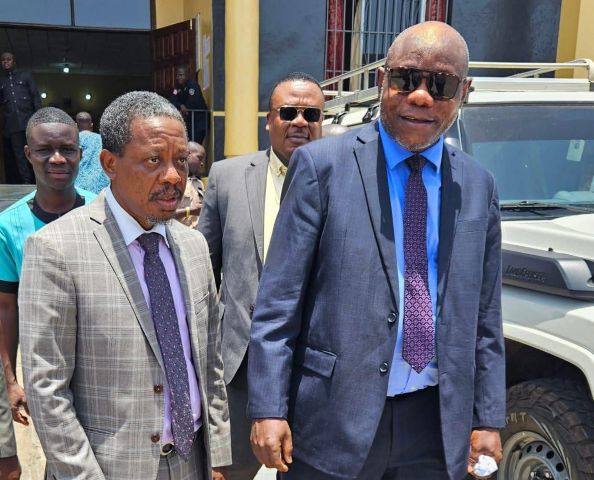
Former Finance and Development Planning Minister Samuel D. Tweah Jr., the man prosecutors had spent months portraying as the principal architect of a brazen scheme to loot over L$1 billion and US$500,000 in government security funds, walked out of the Temple of Justice a free man last Friday. So did G. Moses P. Cooper, former comptroller of the Financial Intelligence Agency. Not guilty on every count. Discharged by Judge Ousman Feika without condition.
In a country where anti-corruption prosecutions have long been promised and rarely delivered, the Boakai administration had staked considerable political capital on this case. The collapse of that case, on its most important targets and most serious charges, now raises questions that will not be easily silenced: Was the evidence ever strong enough to justify the prosecution? And if not, what was really driving it?
What the Government Alleged
The indictment against Tweah and his co-defendants was sweeping in its ambition. Prosecutors charged that Tweah, in his capacity as Finance Minister and member of the National Security Council under former President George Weah, had orchestrated the unlawful diversion of protected security funds into FIA operational accounts, effectively, according to the state, running a secret slush fund under the cover of national security classification.
The charges were economic sabotage, theft of property, money laundering, criminal conspiracy, criminal facilitation, and misuse of public funds. The total figure prosecutors attached to the alleged scheme, US$6.2 million, was large enough to command public attention and to frame the case as a defining test of the Boakai administration’s pledge to hold the Weah government accountable.
A January 2023 letter from then-National Security Adviser Jefferson Karmoh, referencing a Joint Security Committee and FIA’s entry into what was described as a “security architecture,” was among the central pieces of evidence prosecutors cited to substantiate the alleged funding network. Tweah’s authority over budgeting and oversight of the comptroller’s office was framed as the mechanism through which unauthorized payments were approved.
It was, on paper, a compelling narrative. In the courtroom, it did not hold.
Where the Case Fell Apart
The defense’s strategy was consistent throughout the trial: the funds in question were legitimately allocated to election-related security operations under the National Security Act’s confidential funding provisions, and neither Tweah nor Cooper personally benefited by a single dollar.
That argument found traction in unexpected places. Karmoh himself, testifying as a witness, undercut the prosecution’s premise by clarifying that “National Joint Security” was an informal administrative term and that the security spending in question had received approval from the National Security Council. Defense witnesses noted the absence of any forensic audit directly linking the disbursed funds to illicit personal enrichment. The US$6.2 million figure, they argued, was an aggregate estimate rather than a documented trail of misuse.
Tweah took the stand and testified that every disbursement complied with government mandates and existing budget lines, and that no funds had been concealed for personal use. The jury, after weighing months of contested testimony, believed him.
The acquittals were total. On economic sabotage, theft of property, money laundering, criminal facilitation, and criminal conspiracy, not guilty on every count for both principal defendants.
For a prosecution presented to the public as a cornerstone of the government’s anti-corruption agenda, the verdict was not a demolition.
The Partial Convictions: A Complicated Picture
The outcome was not a complete vindication for all defendants. Three co-defendants faced a more complicated reckoning.
Jefferson Karmoh, the former National Security Adviser, was found guilty of criminal facilitation and criminal conspiracy, though jurors deadlocked on the theft of property count, triggering a court-ordered retrial on that charge. Former Solicitor General Nyanti Tuan was found guilty of theft of property, criminal facilitation, and criminal conspiracy, with hung verdicts on economic sabotage and money laundering sending those counts back for retrial. Stanley S. Ford, former head of the FIA, was found guilty of criminal facilitation and criminal conspiracy, with hung verdicts on theft of property and money laundering also resulting in retrials.
Those partial convictions mean the government retains a foothold in the case. Retrials on the deadlocked counts are expected later this year, and prosecutors will argue that the conspiracy findings against Karmoh, Tuan, and Ford validate the core of their theory that an illicit funding network existed, even if its alleged ringleader walked free.
But that argument has a key problem. If the jury agrees that a criminal conspiracy existed and finds three participants guilty, it also finds that the man prosecutors say was the main architect of the conspiracy is not guilty of being involved. That verdict is hard to reconcile and will make future retrials more complicated.
The Political Fallout
The courtroom is one arena. The political arena is another, and in Liberia the two are rarely fully separate.
The Tweah prosecution was initiated under the Boakai administration based on findings from government auditors, and it was prosecuted with a level of visibility suggesting its architects expected a conviction. When that conviction did not come, the political costs were immediate.
Weah’s spokesman Sekou Kalasco declared the verdict a vindication of the former president’s administration, saying it exonerated Weah from corruption claims that had shadowed his presidency. Opposition voices moved quickly to frame the acquittal as evidence that the Boakai government had weaponized the judiciary against political rivals.
The timing compounds the government’s difficulty. The Tweah verdict arrives as the Unity Party is already managing a separate institutional crisis, the April 2026 expulsion of Rep. Yekeh Kolubah in defiance of a Supreme Court order, and as prominent loyalists, including Gbarpolu County Sen. Amara Konneh and former Bomi County Sen. Sando Dazzo Johnson, have gone public with allegations of political marginalization within the party itself.
The Deeper Question: Was This Case Ready for Trial?
A prosecution built on the premise that a Finance Minister diverted security funds for illicit purposes should, at minimum, be able to produce forensic evidence that the funds were diverted and that someone benefited. The defense’s central argument, that no such evidence existed, was apparently persuasive enough to produce not guilty verdicts on all principal charges against the two most senior defendants.
This does not necessarily mean Tweah and Cooper are innocent in any broader sense. Juries acquit for reasons that do not always track the full complexity of the evidence, and confidential security expenditures are, by their nature, difficult to audit transparently. But in a court of law, the standard is proof beyond reasonable doubt, and the state failed to meet it.
That failure has consequences beyond this case. Liberia’s development partners, the United States, the European Union, and the World Bank, have consistently tied budget support and institutional assistance to demonstrable progress on the rule of law and anti-corruption. A flagship prosecution that ends in full acquittal of its primary targets does not demonstrate progress. It raises questions about whether prosecutorial resources are being deployed strategically or politically, and whether the institutions overseeing them are genuinely independent.
Tweah and Cooper are legally free, and Liberian law’s double jeopardy protections mean the state cannot retry them on the acquitted charges. Whatever evidence the prosecution believed it had is now exhausted on those counts.
The retrials of Karmoh, Tuan, and Ford on the deadlocked charges will proceed, likely later in 2026.




Discussion about this post