


Published: May 11, 2026
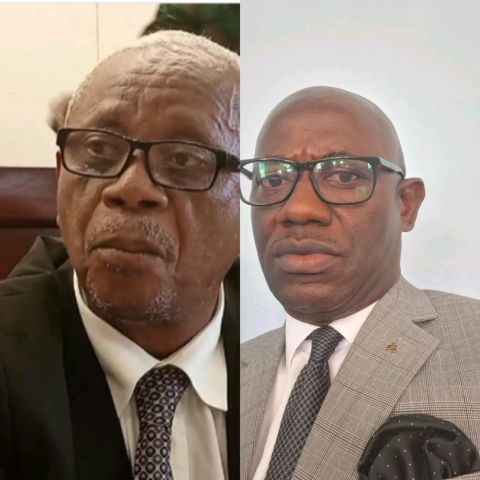
MONROVIA — Lawyers representing former Acting Justice Minister and Solicitor General Cllr. Nyenati Tuan and former National Security Advisor Jefferson S. Karmoh have filed a motion for a new trial before Criminal Court “C,” challenging the jury’s mixed verdicts in the high-profile US$6.2 million economic sabotage case that has dominated national attention for months.
The motion, now before Judge Ousman F. Feika, follows last Friday’s dramatic ruling in which former Finance Minister Samuel D. Tweah Jr. and former Financial Intelligence Agency Comptroller D. Moses P. Cooper were acquitted of all charges, while other defendants received a combination of guilty findings and hung verdicts.
The case, prosecuted by the Liberia Anti-Corruption Commission and the Ministry of Justice, centers on allegations involving the handling of more than US$6.2 million and L$1 billion in national security-related funds during the administration of former President George Weah.
Prosecutors accused the defendants of economic sabotage, theft of property, money laundering, criminal facilitation, conspiracy, fraud against the internal revenue of Liberia and misuse of public money.
Defense Challenges Jury Verdict
In the motion, defense lawyers argued that the guilty verdicts returned against Tuan and Karmoh were “manifestly contrary to the weight of the evidence” and unsupported by proof beyond a reasonable doubt.
According to the defense, prosecutors failed to present credible evidence showing that either defendant personally stole, converted, concealed or benefited from any public funds allegedly diverted through the Financial Intelligence Agency.
The filing contends that the prosecution relied heavily on assumptions, inferences and official communications rather than direct proof of criminal conduct.
A key aspect of the motion challenges the prosecution’s interpretation of a Sept. 5, 2023 letter written by Tuan in his official capacity as acting justice minister and chairman of the Joint Security apparatus.
Defense lawyers argued that the communication merely informed the FIA that Joint Security funding had been secured and identified the FIA as the channel through which the funds would pass for national security operations.
“No evidence proved that Cllr. Tuan personally received, possessed, concealed, or converted any portion of the funds,” the motion states.
The defense further argued that theft of property under Liberian law requires proof of unlawful taking and intent to deprive the government of its property — elements they say prosecutors failed to establish during trial.
Defense Says Acquittals Undermine Prosecution’s Theory
One of the central arguments raised by the defense focuses on the acquittals of Samuel Tweah and Moses Cooper.
Defense lawyers argued that those acquittals fundamentally weaken the prosecution’s claims of conspiracy and criminal facilitation against Tuan and Karmoh.
“The jury’s acquittal of Samuel D. Tweah Jr. of all crimes likewise destroys the factual foundation of the convictions for conspiracy and facilitation,” the motion argued.
According to the filing, prosecutors repeatedly portrayed Tweah as the “central actor” in the alleged conspiracy involving the authorization and transfer of security funds.
The defense argued that once jurors rejected claims that Tweah committed a criminal act, it became legally inconsistent to convict others for conspiracy tied to the same transactions.
Lawyers also pointed to the acquittal of Cooper — whom prosecutors accused of physically withdrawing FIA cheques — arguing that the guilty verdict against Tuan could not reasonably stand without separate evidence directly linking him to theft.
Questions Raised Over Jury Instructions
The motion also challenges the court’s instructions to jurors during deliberations.
Defense lawyers claimed the jury may have been improperly guided to apply a “preponderance of evidence” standard instead of the constitutionally required criminal standard of “proof beyond a reasonable doubt.”
According to the defense, such an instruction would amount to a major legal error because criminal convictions require proof beyond a reasonable doubt for every essential element of an offense.
The lawyers argued that the alleged instructional error materially prejudiced the defendants and compromised the integrity of the deliberations.
“The verdict reflects confusion, compromise, misunderstanding of the elements of conspiracy and facilitation, or improper application of a lesser burden of proof,” the filing states.
Case Sparks Political and Legal Debate
The economic sabotage trial has become one of Liberia’s most politically divisive and legally scrutinized cases in recent years.
Last Friday’s verdict triggered celebrations among supporters of the opposition Congress for Democratic Change, who described Tweah’s acquittal as vindication for the former Weah administration.
Jurors acquitted Tweah and Cooper on all counts, including economic sabotage, money laundering, theft of property, conspiracy and criminal facilitation.
However, the court entered guilty verdicts against Tuan on charges including theft of property, criminal facilitation and conspiracy, while Karmoh was convicted on criminal facilitation and conspiracy charges.
Some counts against both men resulted in hung verdicts, prompting retrial orders on unresolved charges.
Former FIA Director General Stanley S. Ford also received mixed outcomes, including hung verdicts on several charges.
Divided Jury Revealed Sharp Splits
The verdicts, delivered during the 72nd day of jury proceedings at the February 2026 Term of Court, exposed deep divisions among the 12 jurors over several major charges.
For both Tuan and Tweah, jurors initially returned majority guilty votes on theft of property, criminal facilitation and criminal conspiracy charges, while largely rejecting the more severe allegations of economic sabotage and money laundering.
Tuan received nine guilty votes and three not guilty votes on theft of property, criminal facilitation and conspiracy charges. On economic sabotage and money laundering, jurors voted 8-4 in favor of acquittal.
Tweah also received a 9-3 split on theft of property, criminal facilitation and conspiracy, while jurors voted 9-3 for acquittal on economic sabotage and money laundering charges.
Moses Cooper emerged as the strongest beneficiary of the jury’s findings, receiving overwhelming not guilty votes on nearly all counts, including a unanimous 12-0 acquittal on money laundering.
Jefferson Karmoh faced divided outcomes, including a 6-6 split on theft of property, while Stanley Ford received a 7-5 guilty split on some charges.
Following the reading of the verdicts, the court individually polled jurors, each of whom confirmed their positions before the court.
The filing of the motion for a new trial now places the next phase of the case squarely before Judge Feika, who must determine whether the convictions against Tuan and Karmoh should stand or whether a new trial will be granted.
The case has fueled wider national debate over accountability, political prosecution, evidentiary standards and the handling of confidential government security expenditures.






Discussion about this post