

Published: July 15, 2026
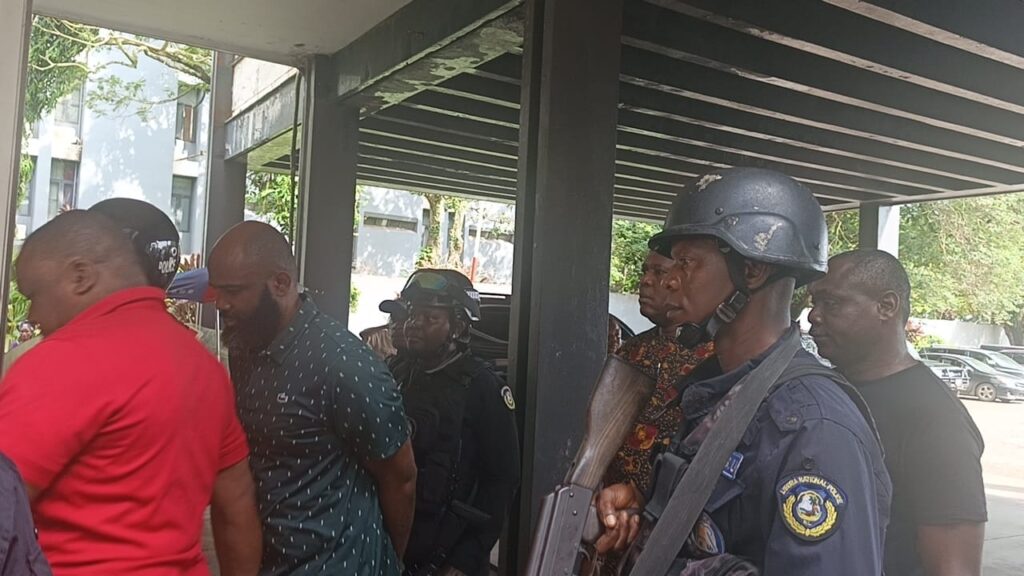
MONROVIA – Paul Jamaal King and six co-defendants will stand trial for allegedly shipping 237.6 kilograms of cocaine out of Roberts International Airport, after the Monrovia City Court ruled Wednesday that prosecutors produced enough evidence to send the US$19 million case to Criminal Court ‘C’.
The ruling ends the preliminary examination King requested through his lawyers under Chapter 12, Sections 12.1 to 12.3 of Liberia’s Criminal Procedure Law, and clears the way for the country’s largest alleged international drug trafficking prosecution to proceed to a full trial.
King and his co-defendants, Michael U.S. Brown, Rahim Bah, Ousman Ali, Oscar Brown and Emmanuel Kpeh, face charges of unlicensed exportation, importation, sale, trading in and transportation of controlled substances, unlicensed possession of controlled drugs, criminal conspiracy, criminal facilitation and criminal solicitation.
The charges were brought under Sections 14.83, 14.84, 14.85, 14.89, 14.93, 10.2, 10.3 and 10.4 of the Penal Law, along with provisions of the Drug Law of 2023.
Prosecutors called two witnesses at the hearing.
The first, Col. Moses L. Meah, chief investigator of the Liberia Drug Enforcement Agency, testified that the investigation uncovered an international trafficking network moving 237.6 kilograms of cocaine with an estimated street value above US$19 million.
Meah said the operation began June 5, when King allegedly arranged for six boxes to be shipped from Liberia to England on false shipping declarations. The boxes were declared as containing Maggi cubes and lappa, investigators said, but airport screening later found cocaine concealed inside.
Meah testified that the shipment was intercepted at Roberts International Airport on June 7 after scanners flagged suspicious images in the cargo. A physical inspection confirmed the cocaine, he said.
King, identified as operations manager of Global Logistics Services, allegedly coordinated the shipment through a network of false documentation and fictitious business entities, according to the prosecution.
Meah testified that King contacted Arthur Abdullah, chief executive officer of Express Handling Services, and asked him to prepare an air waybill listing the fictitious shipper “EM Van Group of Companies” and naming Ousman Ali as consignee.
The six boxes were first delivered to King’s residence by associates including Emmanuel Kpeh, investigators alleged. King’s cook, Marie Gbardiah, received US$2,150 from Kpeh as processing fees before the cargo moved to the airport, the court heard.
Meah said witness statements from Gbardiah and others linked the shipment directly to King. Gbardiah told investigators that King instructed her to take delivery of the cargo and the cash and to see that the consignment reached the airport, he said.
Prosecutors further alleged that King tried to recover the shipment after the seizure. Meah testified that King contacted Philip Young, a GLS Menzies supervisor, and asked him to negotiate with airport security officers, and that King attempted to offer money to security personnel to retrieve the cargo. Young later confirmed that King approached him after the seizure, Meah said.
Meah also identified Michael U.S. Brown, who allegedly used the aliases Raheem Bah and Polo, as an active member of the network. Brown had previously been investigated and imprisoned for drug offenses before his release under what Meah described as questionable circumstances.
Global Logistics Services and GLS Menzies operate as sister companies, investigators told the court, an arrangement they said created openings for the shipment to move through airport cargo procedures.
The second witness, Supt. Joseph M. Kaiffa of the Liberia National Police Anti-Narcotics Unit, largely corroborated Meah’s account. Kaiffa testified that King ordered the preparation of the air waybill and that the shipment originated from King’s residence.
Screening at the airport revealed significant discrepancies between the declared contents and the actual weight of the cargo, Kaiffa said, prompting the inspection that turned up the cocaine. He also testified that King tried to negotiate retrieval of the shipment after it was confiscated.
Prosecutors introduced documentary exhibits including the police charge sheet, air waybills, financial receipts, photographs of the seized boxes and samples of the narcotics.
King’s defense team challenged the case on several grounds, questioning inconsistencies in the custody status of co-defendant Michael Brown, criticizing investigative methods, challenging the handling of physical evidence and raising procedural objections. The defense also cited two United States Supreme Court cases, United States v. Burr (1807) and Plessy v. Ferguson (1896), on questions of procedural fairness and evidentiary standards.
The court found those authorities of limited relevance to Liberian criminal procedure and said they did not undermine the prosecution’s evidence at the preliminary stage.
A preliminary examination does not determine guilt or innocence, the court said, but only whether enough evidence exists to justify a trial. Citing the Supreme Court’s decision in Wolo v. Republic of Liberia, 33 LLR 3 (1986), the court noted that probable cause requires only facts sufficient to lead a prudent person to believe an accused may have committed the offense, not proof beyond a reasonable doubt.
The testimonies of Meah and Kaiffa were consistent and substantially corroborated by air waybills, receipts, witness statements and photographs, the court found. It concluded that prosecutors established reasonable grounds to believe King and his associates took part in a coordinated scheme to traffic cocaine worth about US$19 million through the airport.
The court ordered the defendants bound over to Criminal Court ‘C’ on all charges under the Penal Law and the Drug Law of 2023, and instructed the clerk of court to give the ruling immediate effect.




Discussion about this post