


Published: October 16, 2026
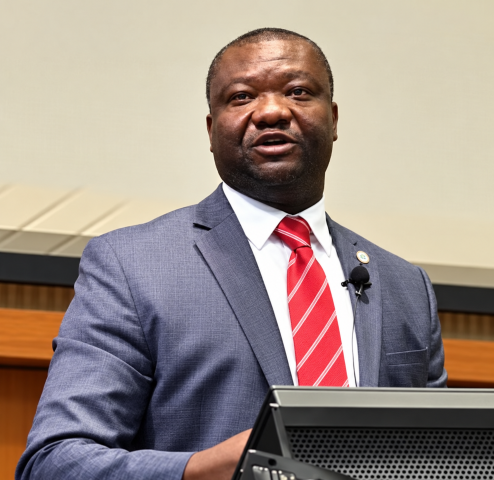
MONROVIA — Former National Public Health Institute of Liberia (NPHIL) Director General Cllr. Dr. Tolbert G. Nyenswah has outlined five priority actions for strengthening Liberia’s health security, urging the government to increase domestic financing, invest in Liberian scientists, establish a national research fund and ensure that scientific findings influence public health policies.
Nyenswah, now a senior executive at the Africa Centres for Disease Control and Prevention (Africa CDC), said Liberia must strengthen NPHIL, expand scientific education and workforce development, establish transparent research financing, translate scientific evidence into national policies and build stronger regional and international partnerships.
The former national Ebola response coordinator made the recommendations Thursday, Oct. 15, while addressing the Fifth Emmet A. Dennis National Scientific Conference virtually from Addis Ababa, Ethiopia.
The conference, held under the theme “Strengthening Health Security in Liberia Through Research and Innovation,” brought together scientists, researchers, healthcare professionals, policymakers, academic institutions and development partners to examine Liberia’s public health research and preparedness systems.
Nyenswah, who serves as director of the Africa CDC Center for Public Health Emergencies Management and leads the institution’s work in South Sudan, said the five priorities require financial commitments from the government and coordinated action involving NPHIL, universities and development partners.
Outlining his first priority, Nyenswah called for stronger institutional support for NPHIL through predictable government financing, qualified leadership and sustained investments in disease surveillance, laboratory services and emergency preparedness.
He said the government must ensure that NPHIL has the resources and operational capacity to perform its statutory responsibilities beyond periods of major disease outbreaks.
“Preparedness cannot depend on the arrival of the next epidemic—or the next donor grant,” Nyenswah told participants.
His second recommendation centered on scientific education and workforce development, including expanded support for Liberia’s Master of Public Health, doctoral and field epidemiology training programs.
Nyenswah urged the government and academic institutions to provide scholarships, research opportunities, mentorship and professional development programs for young Liberians pursuing careers in public health and scientific research.
He identified epidemiology, biostatistics, genomic surveillance, bioinformatics, digital health and laboratory sciences as priority disciplines requiring investment.
As his third priority, Nyenswah proposed establishing transparent financing arrangements for scientific research and innovation, including a National Public Health Research and Innovation Fund.
He explained that such a fund could provide competitive grants to young scientists, universities and research institutions conducting studies on Liberia’s public health challenges.
His fourth recommendation called for stronger integration of scientific evidence into government policies, particularly decisions involving healthcare financing, disease prevention, public health preparedness and service delivery.
Nyenswah said research findings should be used to guide national planning and the allocation of resources to health institutions.
The fifth priority focused on strengthening regional and international scientific partnerships that promote technology transfer, institutional development and Liberian leadership in research.
He urged Liberia to pursue partnerships that provide lasting benefits, including functioning laboratories, trained personnel, improved research systems and opportunities for local scientists to lead investigations.
Nyenswah also challenged conference organizers to measure the gathering’s long-term impact through the number of young scientists receiving grants, scientific publications produced, research findings incorporated into government policies and domestic resources committed to research.
Beyond the five recommendations, Nyenswah expressed concern about the dependence of public health institutions on external financial assistance.
He said governments and international partners often mobilize substantial funding during disease outbreaks, but resources frequently decline when emergencies end.
According to him, that pattern creates difficulties for institutions responsible for maintaining laboratories, surveillance systems, emergency operations and research programs.
He called for increased national budgetary allocations to NPHIL, laboratory services, disease surveillance, scientific research and healthcare workers’ salaries.
Nyenswah also encouraged national discussions on innovative healthcare financing mechanisms, including national health insurance and universal health coverage, to reduce the cost of medical treatment for Liberian families.
He maintained that international assistance remains important but should complement domestic government financing rather than replace it.
The former NPHIL director general further urged the government to address gaps in basic healthcare delivery, particularly in rural communities.
He said investments in advanced laboratories and emergency operations centers should be accompanied by improvements in health facilities, including adequate staffing, essential medicines, electricity, functioning equipment and operational funding.
“A child in rural Liberia deserves treatment before a disease becomes an emergency. A pregnant woman deserves skilled care without facing financial ruin,” he declared.
Nyenswah called for greater attention to healthcare workers’ salaries, medicine procurement, facility maintenance and equitable access to essential health services.
Reflecting on Liberia’s experience during the 2014-2016 Ebola epidemic, Nyenswah recalled the contributions of healthcare workers, surveillance officers, laboratory scientists, contact tracers, ambulance drivers, burial teams and community leaders.
As Liberia’s national Ebola incident manager, he helped coordinate the country’s response to the outbreak before becoming the founding director general of NPHIL.
He explained that the institute was established to provide permanent national capacity for disease surveillance, laboratory diagnostics, emergency management, research and workforce development.
During his leadership, NPHIL undertook initiatives to strengthen emergency operations and incident management across Liberia’s 15 counties, expand field epidemiology training and improve disease surveillance.
The institution also pursued improvements in laboratory and biomedical research capacity at the former Liberia Institute for Biomedical Research.
“NPHIL was never meant to be an institution that becomes active only when an epidemic begins. It was established to protect Liberia every day,” Nyenswah emphasized.
He urged continued investment in the institute’s scientific leadership, institutional capacity and operational independence within its national mandate.
Nyenswah also called for expanded investment in Liberia’s universities and research institutions to develop a qualified national scientific workforce.
He recalled that during his tenure at NPHIL, the institution collaborated with the University of Liberia, Emory University, the African Field Epidemiology Network, the U.S. Centers for Disease Control and Prevention, the World Health Organization and other partners to support curriculum development for the University of Liberia’s first Master of Public Health program.
He also highlighted contributions to the development of Liberia’s first doctoral program, recalling his participation as keynote speaker at its official launch.
According to Nyenswah, those initiatives were intended to create opportunities for Liberians to pursue advanced scientific education and conduct research addressing the country’s health priorities.
“A country that wants to lead in science must be able to educate its own scientists, support its own faculty and investigate its own health problems,” he stated.
He called on the government, NPHIL, universities and development partners to provide scholarships, competitive research grants, mentorship opportunities, laboratory infrastructure and professional career pathways for young scientists.
Nyenswah encouraged Liberian researchers to document and publish their findings to contribute to national policymaking and international scientific knowledge.
Drawing on his professional experience, Nyenswah encouraged students and young researchers to pursue scientific careers with discipline and determination.
He recalled beginning his career as a cadet in Liberia’s health sector before assuming responsibilities in disease prevention, emergency management and national public health leadership.
During his earlier work with Liberia’s National Malaria Control Program, he contributed to policy reforms that replaced chloroquine-based malaria treatment with artemisinin-based combination therapies.
He also participated in efforts to expand malaria prevention and control interventions.
Nyenswah cited national malaria prevalence estimates showing a decline from approximately 66% in 2004 to 28% in 2011, attributing the progress to combined efforts involving the government, healthcare workers, communities and development partners.
Following his service in Liberia, Nyenswah pursued advanced academic and research work at Johns Hopkins University and the U.S. National Institutes of Health.
He earned Master of Public Health and Doctor of Public Health degrees from the Johns Hopkins Bloomberg School of Public Health.
According to his professional record presented during the address, he has contributed to 108 peer-reviewed scientific publications and co-authored Collapse and Resiliency, published by Johns Hopkins University Press.
The book documents leadership decisions, challenges and lessons from Liberia’s Ebola epidemic.
Nyenswah also reflected on the establishment of the Emmet A. Dennis National Scientific Conference, recalling his involvement in organizing its inaugural edition in 2018 while serving as NPHIL’s founding director general.
The first conference was held under the theme “Fostering the Culture of Evidence-Based Public Health Practice and Research in Liberia.”
He said the conference’s continued organization provides opportunities for researchers and policymakers to discuss scientific findings and their application to public health.
Nyenswah paid tribute to the late Dr. Emmet A. Dennis for his contributions to biomedical research, the University of Liberia and the development of national scientific institutions.
He recalled that Dennis served as a founding member of NPHIL’s board and that the molecular biology laboratory at the former Liberia Institute for Biomedical Research was named in his honor.
Nyenswah also highlighted Liberia’s participation in international research initiatives, including the Partnership for Research on Ebola Vaccines in Liberia, commonly known as PREVAIL, and programs supporting Lassa fever research and vaccine development.
He urged international research partners to prioritize technology transfer, laboratory development, scientific training and opportunities for Liberians to lead research activities.
Addressing regional health security, Nyenswah called for closer cooperation among African countries in responding to infectious disease threats.
He cited Africa CDC’s work with African Union member states on disease surveillance, emergency preparedness, laboratory systems, rapid response and cross-border coordination.
Referring to the Bundibugyo ebolavirus disease outbreak he said was affecting the Democratic Republic of the Congo and surrounding region, Nyenswah said Africa CDC had been supporting preparedness and readiness activities in 11 high-risk countries.
He urged Liberia to strengthen cooperation with Guinea, Sierra Leone and Côte d’Ivoire through shared disease surveillance, cross-border alerts, laboratory referral arrangements and coordinated emergency response mechanisms.
According to him, agreements among neighboring countries should be supported by practical operational arrangements before disease outbreaks occur.
Nyenswah concluded by urging the Liberian government, NPHIL, academic institutions and development partners to prioritize the five recommended actions and establish measurable targets for implementation.
He thanked NPHIL Interim Director General Dr. Sia Wata Camanor, the conference organizing committee, participating scientists and academic institutions for sustaining the event and preserving the legacy of Dr. Emmet A. Dennis.
The Africa CDC executive maintained that strengthening Liberia’s health security requires sustained investments in healthcare institutions, scientific education, research financing and the application of evidence in national decision-making.





Discussion about this post