


Published: November 6, 2026
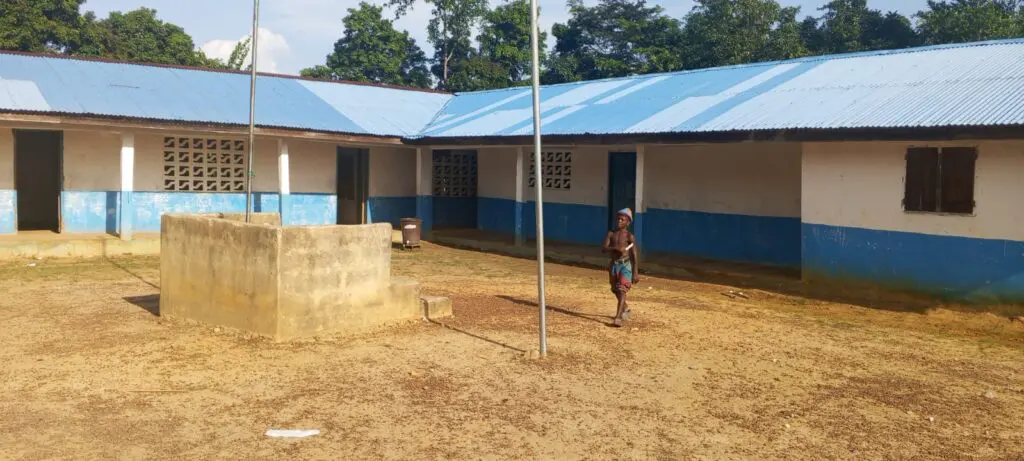
MANAKPOLOR, Bong County — Children at Manakpolor’s only elementary school now go to class four days a week. Fridays are set aside for their volunteer teachers to work their farms, and parents clear and harvest those farms as payment, because the government’s free education policy ended the fees that once kept the teachers in the classroom.
Two of the school’s six teachers are on the government payroll. The other four are volunteers, and before the 2026/2027 academic year opened, they warned they would leave unless the community supported them. Their departure would put the education of more than 200 students at risk.
“Before this academic year could start, the volunteers said if we would not cater to them, they would leave the school, so we were forced to do what we are doing. And the children here are very serious about school,” said Arthur Deyeh, who heads the school’s Parent-Teacher Association.
Ahead of the academic year, the government announced that registration fees would be abolished in public elementary schools across Liberia under its compulsory free education policy. The policy is meant to remove financial barriers to schooling. But some public schools had relied on those fees to pay incentives to volunteer teachers who were waiting to be hired by the government.
In Manakpolor, in Bong County’s Electoral District 1, parents now refuse to pay anything, Deyeh said.
“Volunteer teachers are really helping the school. But when you ask any parents to pay, they will say they listened to the radio that government said we should not pay money,” he said.
Deyeh said the volunteers have received no financial support from the Ministry of Education. The school was built by former Bong County Sen. Henry Yallah and later turned over to the government.
Labor in place of pay
With no money available, the association called parents to a daylong meeting and proposed that residents farm for the teachers instead. Residents have since worked on the farms of all four volunteers, Deyeh said.
Under the arrangement, residents work on each teacher’s farm four times during the farming season, clearing, cleaning and harvesting rice.
“We can work on each of the teachers’ farms four times. We can bush, clean the farm and harvest the rice,” Deyeh said.
In a community that lives largely off farming, the work comes at a cost.
“Some parents say going on the teachers’ farms cannot allow them the time to go on their own farms,” he said.
Deyeh said the community still will not let the volunteers go.
“We cannot allow the volunteers to go because we know the importance of education. It will help our children to learn and change our condition in the future,” he said.
He wants the government to hire the volunteers or set up a lasting way to pay them, and he warned that the free education policy will be hard to carry out where schools depend on unpaid teachers.
“We want government to employ the volunteer teachers to end this suffering once and for all,” Deyeh said.
He also called for the school to be upgraded to a junior or senior high school, so students can continue their education without leaving the community.
Felicia Cooper, one of the volunteers, said the teachers appreciate the parents’ help and remain committed to the children, but they need formal employment.
“We are praying for government to put us on payroll because we too need money,” Cooper said.
A countywide shortage
Shelor Namue, the human resource officer at the Bong County Education Office, said poor teacher recruitment is a serious problem for public schools across the county.
Namue said that during its six years in office, the administration of former President George Manneh Weah and former Vice President Jewel Howard-Taylor retired more than 350 classroom teachers in Bong County through the Civil Service Agency and hired only 30 replacements. He said the Boakai-Koung administration has put more than 119 qualified volunteer teachers on the payroll, but that this has not been enough to fill the gaps the retirements left. He called the failure to replace retired teachers an embarrassment to the county’s education sector.





Discussion about this post