


Published: July 28, 2026
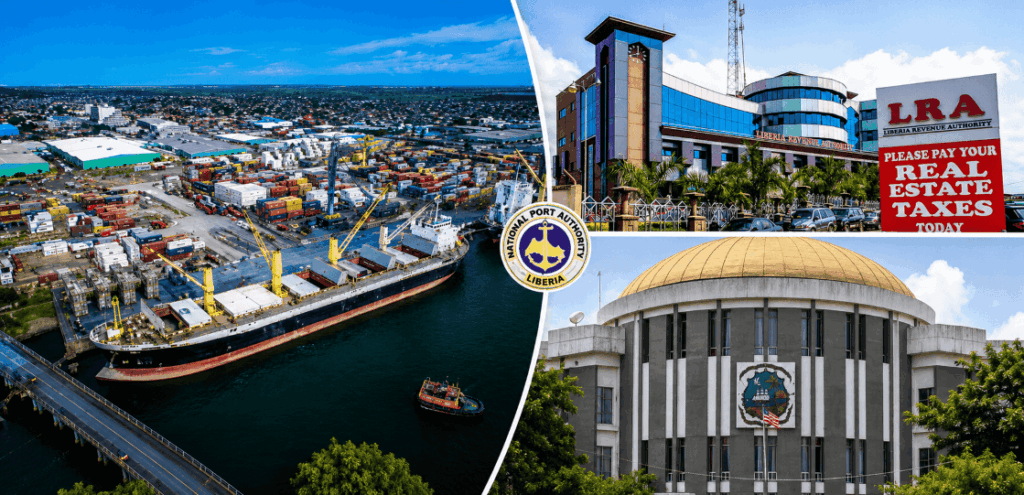
MONROVIA — Liberia’s new port laws would let ports be created, licensed and opened to foreign cargo without ever coming under customs authority, opening what the Liberia Revenue Authority calls a legal pathway for goods to arrive at officially established ports where customs has no power to clear them.
The gap runs through the legislation three times, according to a legal analysis the LRA has sent to the Ministry of Justice. Autonomous ports would be created by legislative act and given territorial limits with no requirement that they be designated customs ports of entry. The new National Ports Regulatory Commission could issue an operating license without checking whether a port holds that designation or has customs infrastructure. And private ports would be authorized under a provision that carries no customs entry requirement at all.
On the strength of that analysis, LRA Commissioner General James Dorbor Jallah has asked President Joseph Nyuma Boakai to veto the package a second time. In a July 17 letter to Justice Minister and Attorney General Cllr. Oswald N. Tweh, obtained by The Liberian Investigator, Jallah wrote that the Liberia Sea and Inland Ports Autonomy and Modernization Act of 2025 and the act establishing the National Ports Regulatory Commission create “fourteen (14) areas of conflict, overlap, or ambiguity with established customs functions under the Revenue Code.”
Commissioner Jallah wrote that the Committee on Maritime invited the LRA to a public hearing on July 1 at 10 a.m. and sent copies of the bills “barely a day before the scheduled hearing.” The hearing collapsed for want of a quorum and because the authority needed a closer reading of the drafts, he wrote, and was reset for July 16. The House concurred with the Senate on July 14, two days before that date.
“However, prior to the scheduled hearing and to our amazement, we have gathered that the draft legislation has already been passed by the legislature,” Jallah wrote in the letter, which carries the reference LRA/JDJ/CG/0367-0500/26/RL.
Two lawmakers had raised the same objection on the floor that day and lost. Grand Bassa County District No. 5 Rep. Thomas A. Goshua II said House Maritime Committee Chairman Austin B. Taylor had assured him a hearing would precede any report. “It beats my imagination that today a report is on the floor concerning this very important matter without the public hearing,” Goshua said, before declaring himself unready to vote. Rep. Musa Hassan Bility, recalling a promised follow-up hearing with the National Port Authority, the Liberia Maritime Authority and the LRA that never took place, also declined to vote.
House Speaker Richard Nagbe Koon said the committee system had done the work. “The fact that the committee prepared a report, signed it and recommended it means they have exhausted all the procedures,” he said. The House adopted the joint committee report over a minority objection.
The analysis attached to Jallah’s letter is a legal analysis memorandum dated July 2026 that measures both bills against Part V of the Revenue Code, the Modernized Customs Code, chapters 12 through 17 as amended in 2020. It sets out the 14 conflicts in a summary table against the competing section numbers and recommends a fix for each.
By its own ranking, most structural finding turns on Section 1213 of the Revenue Code, which gives the LRA exclusive authority to designate ports of entry and provides that no port may lawfully receive imported goods unless designated. Because the Port Autonomy Act creates ports without requiring that step, the memorandum says, a port could be legally constituted, licensed and operating while sitting outside the customs framework entirely. It calls that a fundamental structural gap and, in the licensing and private ports provisions, a revenue leakage and anti-smuggling risk.
The four measures the LRA Commissioner names as priorities would each enlarge the authority’s standing relative to the bodies the bills create: a savings and supremacy clause making the Revenue Code prevail on customs, tariff and duty matters; mandatory LRA representation on the port boards and on the commission, which the memorandum describes as three presidential appointees; customs conditions attached to commission licensing; and a carve-out reserving customs offenses to the LRA alone. Those four, Commissioner Jallah wrote, “would resolve the greatest number of identified conflicts with the least legislative intervention.” The letter says the authority “is not in opposition to port decentralization as a significant step to achieving a modernized port governance framework,” and the memorandum calls the two bills a commendable step toward modernizing port governance.
The memorandum also concedes a limit that supports the Legislature’s likely answer. It says it cites specific section numbers from the bills where available and identifies provisions by subject matter where bill sections were not fully available, meaning the LRA analyzed a text it may not have had in complete form, which is what its own account of the aborted hearing would predict.
The remaining conflicts fall into two groups. On enforcement, the memorandum says the same conduct inside a port could be pursued at once by the LRA under the Revenue Code and by the port authority under its own offenses section, with no primacy rule or referral duty in either bill. It cites unlawful unlading under Section 1716, carrying penalties to a minimum of US$1 million for prohibited goods; manifest discrepancies under Section 1715, penalized at 100 percent of the value of the goods for a first offense, 200 percent for a second and 300 percent thereafter; and ship stores violations under Section 1717, at US$5,000. It warns of overlapping proceedings, inconsistent outcomes and potential double jeopardy.
On costs, it says goods held in a customs-controlled area could attract storage charges under Section 1333 of the Revenue Code and again under the port’s commercial powers, with no rule on which prevails and the burden falling on importers, and that carriers holding an LRA bonded licence could be required to obtain a second authorization from the port.
The package now sits with President Boakai a year after he vetoed an earlier version on July 15, 2025, citing legal conflicts, overlapping mandates with the Liberia Maritime Authority, structural inconsistencies and the absence of a transition plan. Under Article 35 of the Constitution, a bill becomes law without the president’s signature if he does not return it with his objections within 20 days of its being laid before him.





Discussion about this post