


Published: January 28, 2026
Last updated: January 29, 2026
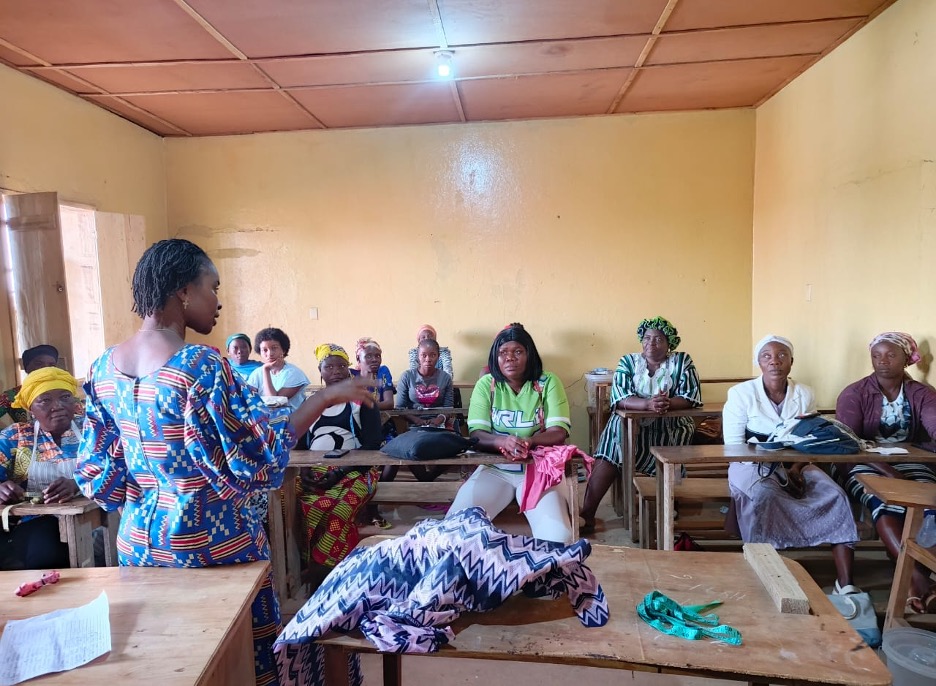
GBARNGA, Bounty County – In a brightly lit room at the Liberia Opportunity Industrialization Center (LOIC) in Gbarnga, women and young girls are learning to operate sewing machines, each dreaming of a better future for themselves and their families. The room radiates with energy, determination, and gratitude as participants of a unique empowerment program, led by LOIC in partnership with Eco Energy, take their first steps toward financial independence.
“I came to learn sewing because I think it will help me support my husband,” said Olive Cammue. “Every time I take my clothes to a tailor, it costs me plenty money.”
Olive recalled a frustrating experience that strengthened her resolve to acquire the skill herself. She explained that a tailor she had paid to sew clothes for an important occasion delayed the work until the last minute and eventually failed to sew the outfit at all. As a result, she was forced to rush to another tailoring shop, where she paid an additional 2,000 Liberian dollars just to have the clothes prepared in time to attend the event.
“That experience really motivated me,” Olive said. “I told myself I cannot continue depending on tailors who may disappoint me. If I learn this skill, I can save money, earn for myself, and help my family. That is why I searched for a slot in the free Eco Energy and LOIC training program.”
Breaking Barriers: A Partnership for Change
The initiative, spearheaded by Eco Energy in partnership with LOIC, seeks to dismantle long-standing gender barriers in Gbarnga, where women have often struggled to be recognized as contributors to household income.
“Some men feel that if a woman is not providing at home, she becomes a liability. We are here to change that,” explained David S.K. Dangale, Monitoring and Evaluation Officer at Eco Energy.
Modern Tools for Practical Skills
To commence the training, Eco Energy initially provided four sewing machines to enable practical demonstrations and hands-on learning. According to Dangale, an additional 46 solar-powered sewing machines will be supplied to complete the total of 50 machines, ensuring that each of the first 50 beneficiaries has access to modern equipment.
“These machines can produce over 60 different designs,” Dangale said. “This is not just training. After three months of classroom instruction, participants will move into a factory setting for nine months of practical work. We provide all materials, training fees, and graduation certificates free of charge.”
The program operates in two daily sessions,25 participants in the morning and 25 in the afternoon, from Monday to Friday. Attendance and discipline are closely monitored, with replacements made for prolonged absenteeism to ensure fairness.
From Classroom to Factory
After completing the three-month classroom phase, beneficiaries will transition into factory-based training, producing school uniforms and other garments under real working conditions. Earnings from this phase will contribute toward eventually owning their sewing machines.
“This approach ensures that women gain both skills and real work experience,” said Rachel Paye, Program Manager at LOIC. “It gives them confidence and a pathway to independence.”
She added: “It is very painful for a woman to be in a home and not provide for herself. You feel useless. That is why we are grateful to Eco Energy for pushing this empowerment initiative.”
LOIC’s Operational Challenges and Appeal for Support
While celebrating the impact of the program, Paye drew attention to the serious operational challenges facing LOIC, particularly the lack of mobility.
“Our only institutional vehicle has broken down, and repairing it requires a huge amount that we currently cannot afford,” Paye disclosed. “This has made our work extremely difficult.”
She explained that she struggle to move around to supervise training activities, monitor students, and carry out daily institutional duties especially during the rainy season, when road conditions worsen.
Manager Rachel Paye briefing journalist in her office
“Sometimes getting to work or moving around to execute our activities becomes a real hardship,” she said. “We are appealing to goodwill individuals, partners, and humanitarian organizations to help provide mobility support for LOIC so we can effectively serve our students and community.”
Despite these challenges, Paye said the institution remains committed to ensuring participants attend classes safely and remain focused, with parents and guardians engaged to ensure accountability during practical training.
Voices from the Beneficiaries
Victoria G. McGill, a nursing student at Phebe University, said learning tailoring has given her a sense of independence. “I can earn money for transport, support my tuition, and sustain myself without relying entirely on my family. I encourage young women to learn a trade while studying.”
Janet Sumo from Palala, Kpaii District, shared: “I had started tailoring before but had to stop because of school. This program gives me a chance to complete my training and use it to support my family. Now I see a future where I am self-reliant.”

Beneficiary Janet Sumo in the training room
Another participant added: “Every trade you learn before graduation is a foundation. Tailoring is my stepping stone to independence.”
A Vision for the Future
By offering free training, structured learning pathways, and access to modern equipment, LOIC and Eco Energy are redefining women’s empowerment in Gbarnga. Beyond skills acquisition, the program promotes dignity, confidence, and economic self-reliance.
“This is a project nobody will take lightly,” Dangale concluded. “If these women succeed, the entire system benefits. That is why focus, discipline, and community support are essential. Our women will rise.”




Discussion about this post