


Published: April 27, 2026
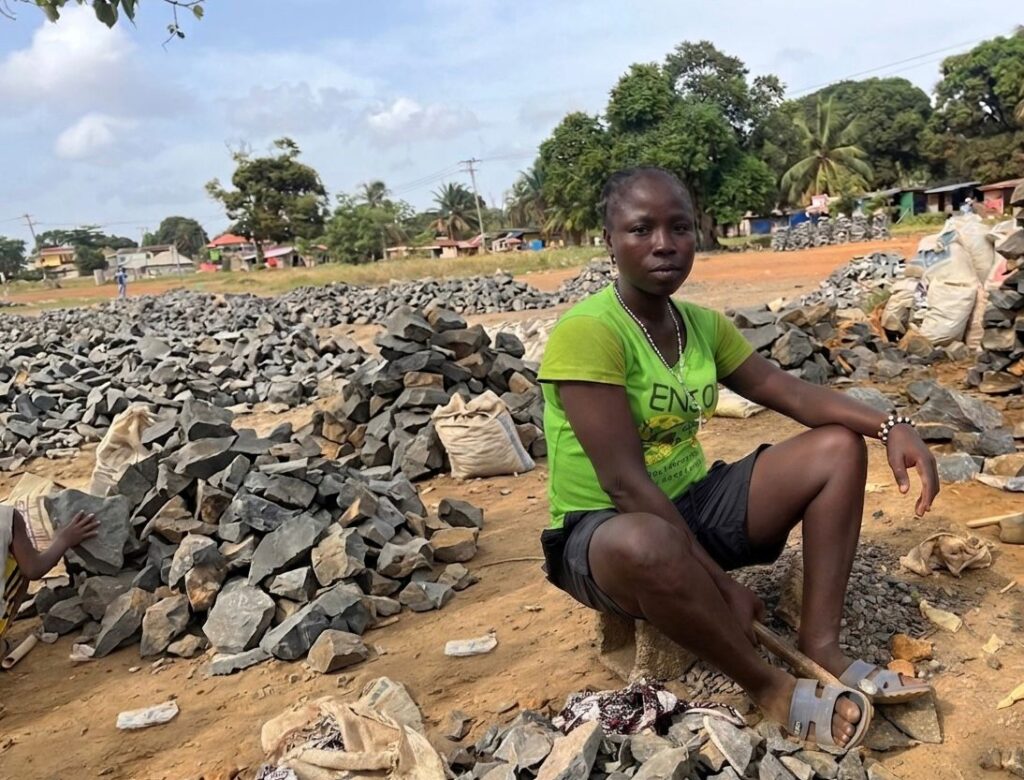
“Life brought me here, so I decided to do it. I am not educated, and this has been my only business,” Yarr Moore
The work begins before the city wakes.
In the dim hours of morning, women gather along the rocky outskirts of Monrovia, arrange their tools and stake out ground on patches of gravel and dust. By the time the sun rises fully over the Liberian capital, their hammers are already falling, a rhythmic percussion that has defined their days for years, sometimes decades.
They are rock crushers. And almost no one is paying attention.
Within Liberia’s vast informal economy, itself the primary engine of survival for thousands of families, visibility is distributed unevenly. Women in organized market halls and petty trading corridors are counted, occasionally supported, and sometimes reached by government programs or NGO interventions. But the women who work the rocky fringes of the city exist in a different category entirely: essential to the construction trade, invisible to the institutions that might help them, and protected by nothing except their own endurance.
They crush stone by hand. The aggregate they produce goes into roads, foundations and walls across Monrovia. Their labor is embedded in the city’s built environment. Their names appear in no registry.
“If We Don’t Break Rocks, We Won’t Eat”
Fatu Moore traces her arrival at this work to a single rupture: the death of her husband in Gbarnga, Bong County, in the Liberian interior.
“Since we came here, this is the work I have been doing,” she says. “I have been doing this work for six years.”
Before widowhood, Moore ran a trading business — buying foodstuffs from rural communities and selling them in town, a livelihood that kept her household stable and her children in school. That life ended when her husband died. She relocated to Monrovia with her children and two grandchildren, eight dependents in total, and found that rock crushing was what the city offered her.
“I have six children and two grandchildren. I am the one taking care of them. Two are out of school because of fees. Only three of my children are in school. It’s what I can afford.”
The economics of rock crushing offer little relief. Moore sells her product for as little as 200 to 300 Liberian dollars per load, less than $2 at current exchange rates. The market has grown harder as mechanized production from Chinese-owned quarry operations has displaced manual crushers among buyers who can afford volume.
“Many people bypass us, who crush rocks manually, and go to Chinese companies producing rocks, so we rarely get big buyers,” she says.
Her rent runs $25 a month. Some days she cannot cover it.
“Sometimes I have to force myself to come here just to earn money to buy food for my family.”
The physical cost accumulates in ways that are harder to measure. Years of hammering in the open sun, without eye protection, have left her with persistent head pain and an exposed mole on her scalp. She continues anyway. There is no alternative she can afford.
“This is the only work I have. It’s hard. Sometimes I want to leave it, but it’s my only source of income, and I don’t have enough money to start another business.”
She is aware of the social perception of her work and addresses it with a directness that requires no dramatization.
“People have looked down on me for the kind of work I do. People may laugh at me, but I will continue to do my work. It is better to break my rocks than to sit idle.”
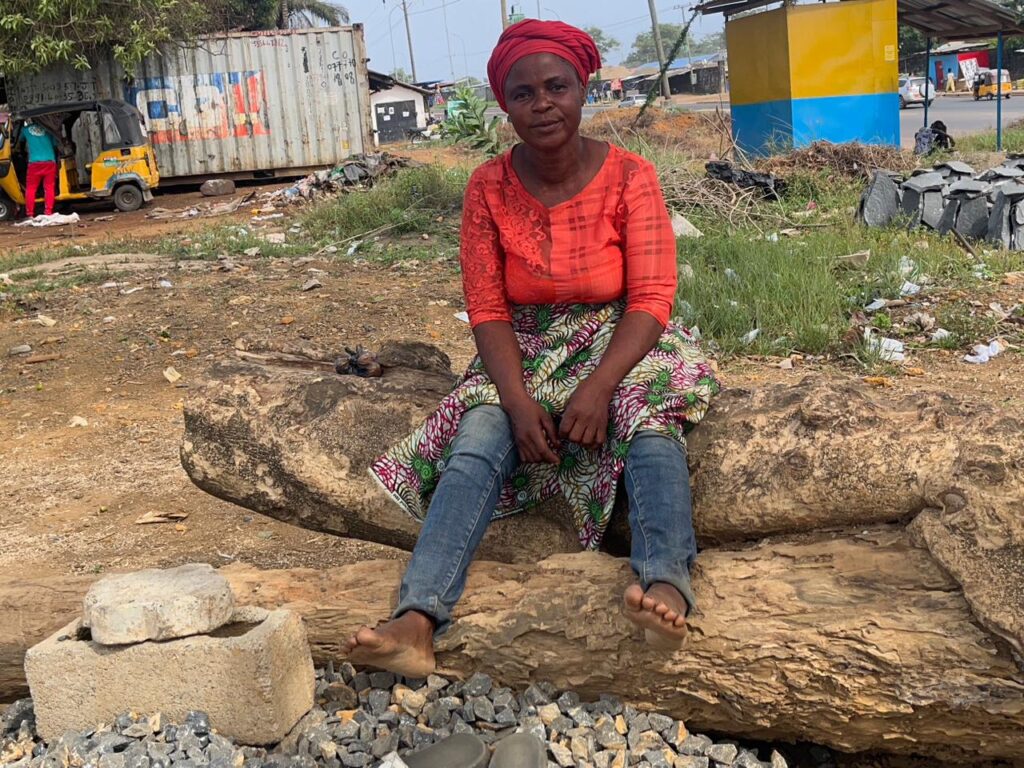
I have six children and two grandchildren. I am the one taking care of them. Two are out of school because of fees. Only three of my children are in school. It’s what I can afford.” – Fatu Moore
“I Am Playing the Role of Both Parents”
Yarr Moore, no relation to Fatu, has been breaking rocks since she was 16. She is a widow from Montserrado County. She did not finish school. Rock crushing was not a crisis response for her; it was the option that presented itself when she came of age with few others.
“Life brought me here, so I decided to do it. I am not educated, and this has been my only business,” she says.
She now supports four biological children and two relatives’ children. Her husband, a security guard, died after being poisoned. She has not remarried. The household is hers to hold together, and the weight of that is not metaphorical.
“I am playing the role of both parents in the home. It is too much for me.”
Her body shows the accumulated cost. The hardest part of the work, she explains, is the initial blasting, breaking boulders down into manageable pieces before the finer crushing can begin. The percussion travels through her back, into her joints.
“Sometimes my bones can lock, but I still force myself to come to work because if I stay home, no one will feed my children.”
Her eyes are failing. She uses drops regularly but has not seen a doctor. She has no eye protection while working.
“My eyes are giving me problems, and I constantly use eye drops without going for a proper check-up,” she says. “I want people to understand that women who do this work are suffering.”
Some days she earns nothing. When buyers don’t come, she doesn’t eat, and neither does her family.
“Some days, I can’t even take money home. Sometimes I have to beg for money to buy food for my family. Other times, when someone offers to buy me a drink, I ask for the money instead.”
She has been mocked publicly for her occupation. She recounts people calling out to her in the street with taunts referencing her work. She absorbs it, and she keeps going.
“I am proud of doing this work because everyone has their own area, and this is mine.”
Beyond the Margins
What both women articulate, plainly and without self-pity, is structural exclusion from labor protections, from government programs, from the attention of institutions that claim to serve Liberia’s most vulnerable.
“We, the rock-crushing women, have not received any help from the government like the women in the market halls do,” Fatu Moore says. “Sometimes we pray for them to notice us.”
No union represents them. No formal channel exists through which they might access credit, healthcare or training. The women who are organized into market associations have a constituency structure that can be approached, consulted, mobilized. Rock crushers have none of that. They work in small clusters, dispersed across the city’s perimeter, largely invisible to the social infrastructure that might otherwise find them.
Their requests, when stated, are modest. Fatu Moore asks for business loans or startup capital to transition into other work. Yarr Moore’s appeal is more elemental.
“I would like to tell the government to help me, to rescue me. It is not easy.”
Neither woman has ever received a bulk order from a formal company. Their buyers are individuals, small-scale builders, homeowners, and contractors who need a wheelbarrow load, not a truckful. The Chinese quarry operations that have expanded across Liberia’s construction supply chain in recent years have effectively priced them out of the upper market without displacing the need for the work entirely. They occupy the narrowest economic band: too small for institutional buyers, too ambitious to give up.
Each strike of the hammer, for Fatu Moore and Yarr Moore, is rent and school fees and a meal that may or may not materialize by nightfall. It is dignity, self-defined, held against ridicule. It is the daily arithmetic of a household that has no margin for rest.
Their work is in the roads. It is in the walls. It is in the city that Monrovia is building, piece by broken piece.
They are asking, quietly, to be counted in it.






Discussion about this post