


Published: September 9, 2026
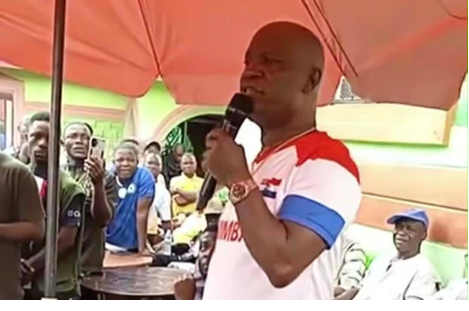
GANTA, Nimba County — Nimba County’s legislative caucus, for years the most organized bloc in the Legislature resisting a war and economic crimes court, is now prepared to help establish it, Sen. Samuel G. Kogar said, a reversal he attributed directly to the death of Sen. Prince Y. Johnson.
By David Menjor
“The Nimba Legislative Caucus was against it,” Kogar said. “Now we have realized that this War Crimes Court was meant for Prince Johnson, no other person.”
Kogar spoke over the weekend in Ganta after joining opposition figures at a roundtable convened by former President George Weah, who returned to the country last week. He said the drive to seat the court has slackened since Johnson died in November 2024. “Since he died, we are slow on the War Crimes Court,” he said.
He said senators from the county would now work to establish the court and allow it to do the work it is supposed to do.
The claim that the court targeted a single man goes to the motive behind an institution the government has presented as a national accountability mechanism, and Kogar offered no evidence beyond his own reading of the politics. Neither the Ministry of Justice nor the office the government created to prepare for the court has responded to the claim.
Johnson, who died in office as senior senator for Nimba, spent most of two decades arguing that Liberia should pursue reconciliation rather than prosecutions. Kogar said that campaign began under former President Ellen Johnson Sirleaf, as international pressure built for Liberia to prosecute those accused of atrocities during its civil wars, and that Sirleaf declined to act because she judged that a fragile peace could not absorb the political and social rupture prosecutions would bring. “That time passed,” Kogar said.
Johnson’s position was not merely political, Kogar suggested. It was personal. He led the Independent National Patriotic Front of Liberia during the first civil war, and his fighters captured President Samuel K. Doe in September 1990. Doe died in Johnson’s custody after being tortured, in an episode Johnson’s men recorded on video. Johnson later went into exile in Nigeria before returning to contest and win a Senate seat in Nimba.
Kogar said Johnson delivered Nimba for Sirleaf and sustained her politically. “Senator Prince Johnson has been very instrumental,” he said. “He begged the people of Nimba to vote for her and ensured she remained President for 12 years.”
Under Weah, Kogar said Johnson secured an assurance that the question would stay closed. “Ambassador Weah said it is true, but I made a commitment to Senator Johnson,” Kogar said, recounting the former president’s words at the roundtable. He quoted Weah as having told Johnson: “Senator Johnson, for the fact that I made a commitment to you, we will look for reconciliation and ensure that let bygone be bygone.”
That calculation collapsed after the 2023 election. Johnson had backed President Joseph Nyuma Boakai against Weah, and Kogar said Johnson believed the incoming government would leave the court alone. “This government, the Rescue government, Senator Johnson was overwhelmingly convinced by this government that he will not even worry about what is called War Crimes Court,” Kogar said. Instead, he said, the announcement came at once. “From the onset, on the very first day, War Crimes Court was announced,” he said.
Kogar described what followed for Johnson in clinical terms. “The trauma from the announcement, establishment, and enforcement of the War Crimes Court, I believe, psychologically, it can play on anyone,” he said. He put the point more directly a moment later: “You who know yourself that when you talk the world listens to you, they tell you we coming put you in some kind of jail. Would you not be frustrated?”
Johnson died before the court could begin work, and his death removed the loudest legislative voice against it. It also removed, in Kogar’s telling, the reason his colleagues were opposing it at all.
What Kogar did not address is what the shift means for the roughly two dozen other men named in the 2009 report of the Truth and Reconciliation Commission, which recommended a range of wartime figures for prosecution, several of whom hold or have held public office. If the caucus opposed the court to protect one senator, its members have not said what they now expect it to do about the rest.
Supporters of the court have argued for years that a durable peace requires justice for victims of the two civil wars. Opponents have warned that prosecutions would deepen political division and unsettle the settlement that ended the fighting. Sirleaf did not act. Weah, by Kogar’s account, gave a private undertaking not to. Boakai’s government moved toward establishment. And the lawmakers who stood with Johnson are, by their own account, no longer standing in the way.






Discussion about this post