


Published: February 23, 2026
Last updated: March 1, 2026

MONROVIA — Liberia’s media sector is no longer fighting primarily for press freedom or professional recognition. It is fighting for economic survival.
That stark assessment dominated the Integrity Media Forum 2026 in Monrovia, where editors, academics, cabinet officials and international partners converged to confront what many described as a structural breakdown of the business model sustaining Liberian journalism.
The forum, organized by Integrity Media Inc., publisher of The Liberian Investigator, and held Feb. 19 at Monrovia City Hall, unfolded under the theme “Marketing the Truth: Media Sustainability in the Age of Social Media and Declining Revenues.” It coincided with the newspaper’s first anniversary celebration — a milestone speakers framed not simply as a celebration but as a reflection on whether independent journalism can remain financially viable in Liberia’s fragile economy.
Keep up with the latest headlines on WhatsApp | Facebook
From Professional Crisis to Economic Crisis

Media Development Specialist Jefferson Togba Massah
“The media economy in Liberia is in crisis,” said media development specialist Jefferson Togba Massah. “This is global, but our local conditions make it worse.”
Massah argued that Liberia’s challenge is no longer primarily about training reporters or improving newsroom ethics, long-standing reform priorities, but about sustaining the institutions that employ journalists.
Massah: “Are we expanding our income streams beyond traditional journalism? Are we adapting quickly enough to digital realities? While revenue decline and delayed government advertising are often cited as causes of the crisis, we must also ask how effectively we are responding to digital transformation.
“Media proliferation and politically driven ownership structures pose additional risks. How are we addressing the growing number of outlets in a limited market? Not everyone can be a manager, and not every outlet can survive in an oversupplied economy.
“In basic economic terms, when supply increases without corresponding demand, market pressure intensifies. Liberia now has more than 250 radio stations nationwide and over 35 newspapers operating in Monrovia alone, yet the media economy remains small.
“This reality demands innovation and a fundamental update of the business model. The industry cannot afford to remain stagnant. The question is whether media institutions are prepared to confront these structural challenges directly.”
Panelists agreed that the sector is not experiencing a temporary downturn but a structural shift in which traditional revenue streams, print sales, and advertising are steadily eroding without sufficient digital replacement.
Trust Becomes the Product
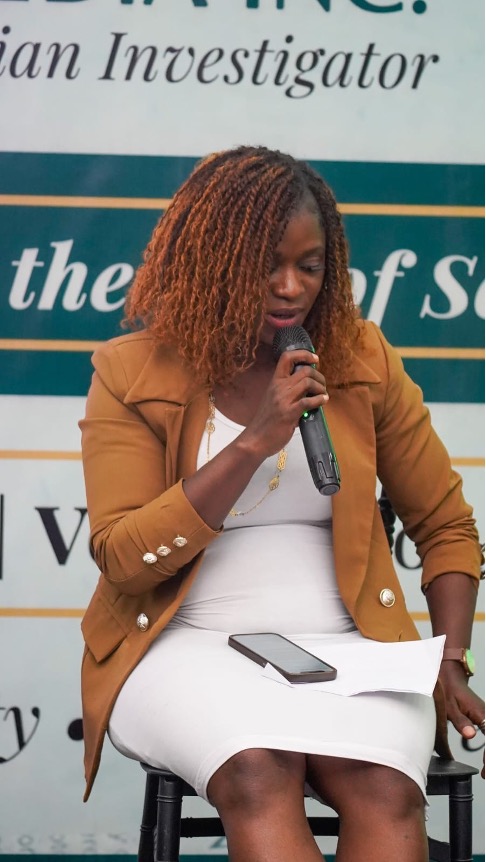
University of Liberia communication lecturer Whinell T. Shasha
University of Liberia communication lecturer Whinell T. Shasha said the digital transformation has fundamentally altered journalism’s value proposition.
Mrs. Shasah: “The media must reposition itself as a brand anchored in trust, not merely as a producer of content. Trust is a co-created value that provides a distinct competitive advantage in an increasingly saturated information environment.
“One of the primary ways to build trust is through institutional discipline. Media organizations must adopt clear editorial policies, ensure responsible data use, and practice ethical engagement. These elements are critical to strengthening credibility and deepening confidence among stakeholders.
“Trust is foundational because it drives loyalty. When audiences trust a media institution, they remain committed to it. That loyalty, in turn, translates into subscription support and sustained engagement.
“Long-term sustainability, therefore, requires a diversified revenue model. This includes subscriptions, events, training programs, consultancy services and other complementary initiatives. Diversification is not optional; it is a structural necessity for media survival in the current economic landscape.”
The shift, she argued, means credibility — not reach — will determine which outlets survive.
Afrobarometer data referenced during the forum show radio remains Liberia’s dominant news source, used regularly by roughly 87% of adults, while only 16% regularly consume newspapers. About 38% report getting news online or through social media.
Economic Fragility and Editorial Risk

Veteran journalist and advocate John H. T. Stewart
Veteran journalist John H. T. Stewart warned that financial instability increasingly shapes editorial decisions.
Mr. Stewart: “The journalists generally are underpaid and operate in a very constricted economic environment. There are very few opportunities for media institutions to access resources and professional support for growth. As a result, many outlets resort to advertorials in place of editorials. Editorials are supposed to reflect the opinion of the newspaper. Instead, what we often see is an advertorial — the opinion of the person who is paying for that space.
“If media institutions are not credible, they will not be sustainable,” Stewart said. “People will not buy, they will not read, they will not listen.”
He recalled a time when newspaper vendors prepaid for editions based on reputation alone.
“There was a time vendors lined up before production and paid in advance because of credibility,” he said.
Today, he argued, economic pressure risks substituting editorial judgment with paid influence.
He cautioned that technological innovation cannot compensate for eroded trust.
“No matter how much digital innovation you do, without credibility, you cannot sustain.”
Speakers acknowledged that low pay and irregular salaries create vulnerabilities. Several referenced assessments indicating many journalists earn modest monthly wages, increasing exposure to inducements and “brown envelope” practices.
“When a journalist is hungry, truth can start to look like a luxury item,” keynote speaker Elias Shoniyin told the audience. “But truth is not luxury. Truth should be the meal.”
Government: Media Is Governance Infrastructure

Deputy Minister of Finance for Economic Development Dehpue Y. Zuo
Deputy Minister of Finance for Economic Development Dehpue Y. Zuo reframed the debate as a governance issue rather than a private-sector problem.
“The ecosystem cannot function effectively without financial support,” he said.
Public institutions depend on professional media to communicate policy, public health guidance and development programs. Payment for media services, he said, should be understood as an exchange for professional communication, not a subsidy.
“The state cannot communicate with citizens all alone by itself,” Minister Zuo said. “You cannot hold back whatever work media have done and not pay them.”
He described journalism as a hybrid institution: both public information infrastructure and private enterprise. Without predictable compensation, he warned, that infrastructure weakens.
Min. Zuo: “In our development implementation and policy framework, development information must be integrated into our monitoring and evaluation processes. As we assess the work we do, access to reliable information becomes a central component of effective oversight and accountability.
“From a policy perspective, it is therefore essential to establish a framework that enables the media not only to operate freely but also to generate sustainable income. Media institutions cannot fulfill their public mandate if they lack the economic capacity to survive.
“Beyond institutional sustainability, our policies should also create space for journalists to see themselves as active participants in the broader economy. Journalism is not merely a civic function; it is also an economic activity that contributes value.
“Consequently, we must emphasize value creation and value exchange. Information has value, and when it is provided, there should be a fair and mutually beneficial exchange. Supporting such an ecosystem ensures both the sustainability of the media and the integrity of the information environment.”
‘Govt Is Committed to The Media’

Information Minister Jerolinmek Matthew
Information Minister Jerolinmek Matthew, who served as the guest of honor at the forum, used the forum to reaffirm the President Joseph Boakai administration’s commitment to press freedom, describing a free and independent media as central to democratic accountability. “The government will continue to broaden the space for the press to remain free and to flourish,” Piah said, emphasizing that media institutions operating within ethical and professional standards will continue to receive full government support. He pointed to a January decision by the Ministry of Finance and Development Planning, in collaboration with the Ministry of Information, to begin settling debts owed to media institutions by previous administrations. “We are a responsible government and will always live up to our commitment to the grand media,” he said, adding that Liberia’s media currently operates without censorship or intimidation — a climate he described as worthy of recognition.
Turning to the forum’s focus on sustainability in the digital age, Minister Piah acknowledged the structural pressures confronting traditional media. “Liberia, like most African countries, is still struggling to keep up with the fast-moving pace of technological innovations that affect media institutions,” he said. Still, he identified what he called two “low-hanging fruits” for survival and growth: capacity building and accelerated digital adoption, including artificial intelligence and technology-driven content systems. “By leveraging these two, the media will surmount the challenges of drought in revenue as advantages in traditional media have significantly decreased,” he added.
He pledged closer coordination between the Ministry of Information and the Ministry of Posts and Telecommunications to strengthen technological advancement across the sector, arguing that sustainability requires joint effort. “We, the government, and the media jointly can achieve these two once we are focused on collaborating,” he said, before committing to “intentional and targeted efforts to make the media in Liberia feel prosperous but most importantly, ethical, balanced and credible.” His remarks underscored the administration’s position that a free, innovative and financially stable press remains indispensable to Liberia’s democratic trajectory.
“Trust Does Not Come From Being First”

Keynote speaker Elias Shoniyin
Keynote speaker Elias Shoniyin warned that Liberia’s media cannot afford to chase speed at the expense of accuracy, arguing that credibility, not immediacy, will determine which institutions survive the digital disruption. “Trust does not come from being first,” he told the audience, trust comes from being right, and being humble enough to correct yourself when you are wrong.”
In an era where rumors can cross counties before a reporter confirms a single source, he said, newsrooms must become “more digital, but never less disciplined.”
Mr. Shoniyin painted a vivid picture of misinformation spreading across social media before journalists can verify facts, describing it as “the story of our age and time.” “Misinformation does not wait for your notebook. Disinformation does not respect your press pass,” he said, cautioning that technology now moves faster than editorial processes built for another era. The answer, he argued, is not retreat from digital platforms but institutional rigor — clear verification systems, transparent corrections and visible ethical standards.
He also placed Liberia’s media challenges within a global economic crisis facing print journalism, citing sharp declines in newspaper circulation and advertising revenue worldwide. “If the world is shaking, we cannot pretend Liberia will be stable,” he said.
“But we can decide how to build in the earthquake.” For Liberia, he stressed, adaptation means diversifying revenue, leveraging mobile distribution and responsibly adopting technologies such as artificial intelligence without surrendering editorial judgment.
Beyond economics, Shoniyin framed journalism as national infrastructure essential to governance and development. “Truth is public infrastructure,” he said.
“A country cannot develop without roads. But a country also cannot develop without reliable information.” He urged media practitioners to treat ethics not as abstract ideals but as operational systems, concluding with a call for reinvention rooted in service: “May we market the truth — not as propaganda, but as service.”
Gibson Gee, Alphanso G. Kalama contributed to this news story.






Discussion about this post