


Published: October 21, 2026
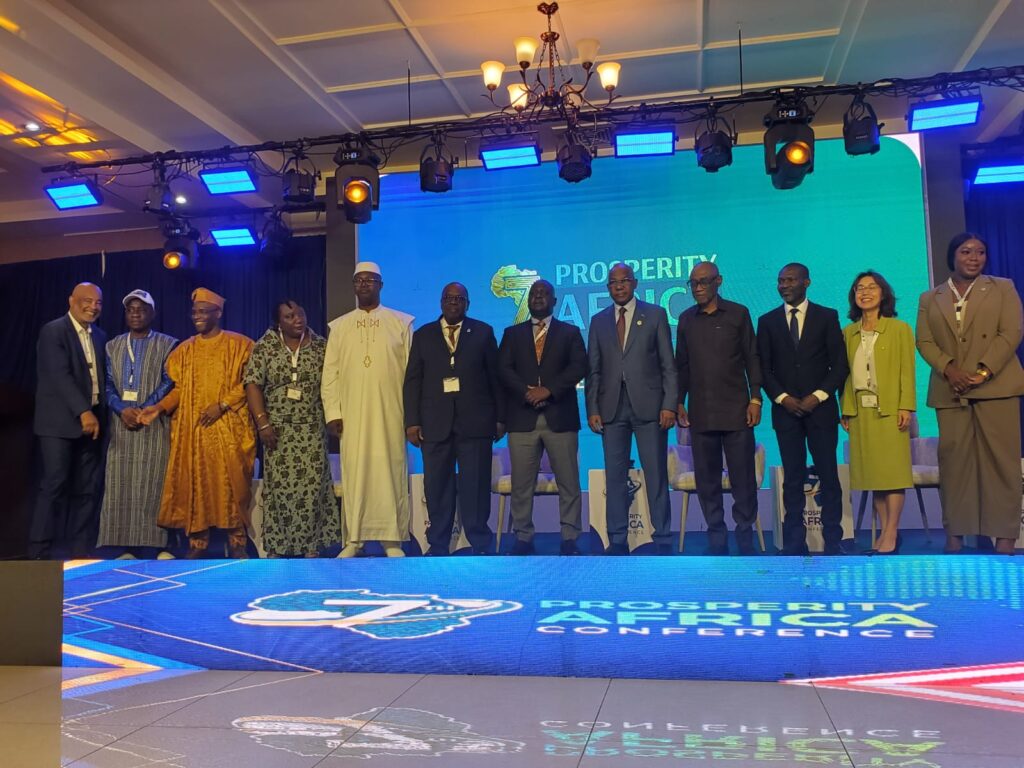
MONROVIA — Liberia will give its strongest government support to investors who process raw materials, manufacture goods, generate power and create jobs. Acting Commerce and Industry Minister Stephen M. Yekeson Jr. told African business leaders Tuesday that the country can no longer rely on exporting raw commodities.
By Blamo N. Toe
“Invest in production, not only trade. The greatest returns, and the greatest support from Government, will go to investments that process, manufacture, generate power and create jobs,” Yekeson said in the keynote address, which he delivered on behalf of President Joseph Nyuma Boakai at the 7th Biennial Prosperity Africa Conference and Liberia Investment Forum.
The conference opened at the Ellen Johnson Sirleaf Ministerial Complex under the theme “Innovation in Business Leadership and the Economics of Tomorrow.” The Liberia Chamber of Commerce and the Pan-African Chamber of Commerce and Industry co-host it, bringing together investors, development partners and policymakers from across Africa.
Yekeson said the government is working to simplify import and export procedures, digitize business registration, strengthen contract certainty and cut administrative barriers. He said the Ministry of Commerce and Industry’s 2025-2029 strategic plan prioritizes trade facilitation, competitiveness, enterprise development and transparent market regulation.
“Investors should learn of a new rule from a notice, not from an inspector,” he said.
He acknowledged that Liberia’s economic stability has not yet translated into industrial growth or jobs. Citing the International Monetary Fund, he said the economy is projected to grow 5.5% in 2026, driven largely by mining, manufacturing and construction.
“The World Bank has told us, correctly, that stability is not the same as transformation,” he said.
“The economics of tomorrow will not reward countries that only export raw materials. It will reward countries that add value, that move goods and money quickly and cheaply, and that make rules businesses can plan around,” Yekeson said.
He named agriculture and agro-processing, manufacturing and mineral value addition, and digital and financial services as priority sectors. He pointed to opportunities in rice milling, cassava processing, palm oil, gold refining, iron ore processing and timber, as well as electricity generation, transport and ports. He also listed the Monrovia and Buchanan special economic zones and the Monrovia Industrial Park as sites for industrial investment.
“Liberia is open for business. Not as a slogan, but as a commitment: to be predictable, to be fair, and to be a partner you can build with for the long term,” he said.
He presented Liberia as a production base for a market of more than 1 billion consumers under ECOWAS and the African Continental Free Trade Area.
Liberia Chamber of Commerce President O. Natty B. Davis II asked visiting investors to partner directly with Liberian businesses. He said investment must translate into jobs, financing and contracts for local firms.
“Prosperity means a growing business that can employ another young person. It means a farmer securing a reliable buyer, a woman entrepreneur obtaining finance to expand, and a local supplier winning a contract that allows that enterprise to invest, improve, and compete,” Davis said.
He said the chamber is supporting local enterprises through the Liberia Investment, Finance and Trade Project and the Youth Entrepreneurship Investment Bank initiative. The aims, he said, are to develop suppliers and connect Liberian businesses with financing and procurement opportunities. He said the chamber took part in validating the Draft Local Content Policy, and he welcomed proposed regulations to strengthen enforcement of the Liberianization policy.
“As co-hosts, our hope is that the value of this conference will be evident in the months ahead: in new commercial relationships, stronger enterprises, investment opportunities that move forward, and jobs created,” Davis said.
Mamadou Baldé, third vice president of the Federation of West African Chambers of Commerce and Industry, spoke on behalf of the federation’s president, Jani Ibrahim. Baldé, who also heads the West Africa Zone of the Pan-African Chamber of Commerce and Industry, urged governments to remove cross-border trade barriers, improve infrastructure and speed up implementation of the ECOWAS Trade Liberalization Scheme and the African Continental Free Trade Area. He said regional integration must move beyond policy talk to signed deals, investment projects and measurable results.






Discussion about this post