


Published: November 3, 2025
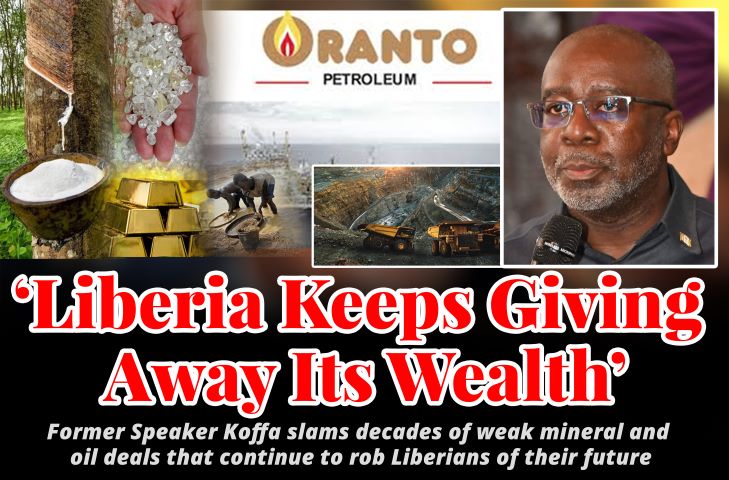
MONROVIA — Former House Speaker Cllr. J. Fonati Koffa has accused the Boakai administration of sidelining ordinary Liberians in the country’s oil wealth, describing the recent Oranto Petroleum agreement as a betrayal of both law and equity.
In a strongly worded Facebook post that has stirred national debate, Koffa alleged that the agreement between the government and Nigerian oil firm Oranto Petroleum violates the 2019 Petroleum Law, a statute that mandates Liberians’ direct participation in oil ownership. The law requires that Liberian citizens hold 5% equity in every oil block, while the National Oil Company of Liberia (NOCAL) retains 10% on behalf of the state.
Instead, Koffa charged, the new deal grants NOCAL the full 15%, effectively excluding Liberians from any direct ownership.
“The Oranto agreement says NOCAL will get the 15% and Liberians should leave their own with gor,” Koffa wrote, invoking the Liberian colloquial term for being cheated or left behind. “Is this weakness in negotiation, or is it wickedness?”
Liberia’s history of resource management is marked by unequal power dynamics and economic marginalization. Since the 1926 Firestone concession, one of Africa’s oldest foreign investment deals, Liberians have witnessed foreign corporations reap massive profits, while workers, landowners, and local communities struggle under poor working conditions.
Now, critics say, the same exclusion is unfolding in the oil sector, a domain once heralded as Liberia’s chance to redefine its economic destiny.
A History of Unequal Deals
Since the end of the civil war in 2003, Liberia has sought to rebuild its economy through foreign direct investment, particularly in the extractive sector. Iron ore, gold, diamonds, rubber, and timber have all been at the center of concession agreements meant to spur growth and create jobs. Yet, time and again, these deals have fallen short of delivering tangible benefits to the population.
Critics argue that the pattern is unmistakable, poorly negotiated contracts, limited transparency, and weak enforcement mechanisms have allowed foreign companies to profit disproportionately, while local communities remain impoverished.
The Firestone concession, signed in 1926, a period short of a year to reach a century, remains a stark reminder of this imbalance. While the company has profited immensely from Liberia’s natural rubber, local workers and communities continue to grapple with low wages and environmental degradation. Similarly, major iron ore agreements with global players like ArcelorMittal and China Union have sparked controversy over land rights, environmental compliance, and inadequate local benefits. Now, with the Oranto oil deal, many fear history is repeating itself.
The Oranto Controversy: Law vs. Practice
At the center of Koffa’s criticism lies the glaring discrepancy between Liberian law and government practice. The 2019 Petroleum Law was hailed as a major step toward greater resource nationalism — a way to ensure citizens had both symbolic and financial ownership of their country’s oil and gas potential. The 5% share for Liberians was meant not only to provide direct dividends but also to foster a sense of participation and accountability in the management of national resources.
But the Oranto agreement, Koffa insists, undermines that intent. By consolidating the entire 15% under NOCAL, the government effectively strips citizens of their legal entitlement.
“Either this is a weakness in negotiations or a form of wickedness,” Koffa declared, suggesting that the move could not be explained away by mere oversight. To him, it reflects either incompetence or a deliberate effort to sideline ordinary Liberians from their constitutional rights.
The Oranto Petroleum Company, a Nigerian firm with operations across West Africa, secured exploration rights for one of Liberia’s offshore blocks earlier this year. The deal was touted by government officials as a major milestone toward reviving Liberia’s dormant oil sector. Yet, Koffa’s remarks have cast a shadow over what was once hailed as progress, igniting public outrage and calls for legislative scrutiny.
Public Trust and the Question of Sovereignty
Koffa’s critique resonates deeply with ordinary Liberians, many of whom have grown skeptical of promises tied to resource discoveries. From gold mines in Grand Kru to oil prospects off the coast of Buchanan, the story has been the same: foreign companies come, deals are signed with fanfare, and communities remain unchanged — or worse, displaced and disillusioned.
“This is not just about oil; it’s about respect for our laws and our people,” said political analyst Emmanuel Flomo in an interview with local radio station OK FM. “When the law says citizens should benefit, and the government signs away that benefit, what message are we sending? That the law doesn’t matter?”
For Koffa, a lawyer and seasoned legislator, the issue cuts deeper than economics — it speaks to the erosion of national sovereignty. “When we allow ourselves to be shortchanged in our own contracts, we surrender a piece of our future,” he wrote.
Indeed, resource nationalism — the idea that a nation should have control and fair benefit from its natural wealth — has gained renewed traction across Africa. From Tanzania’s renegotiation of mining contracts to Ghana’s push for local participation in its oil sector, several countries have begun asserting greater control. Liberia, critics say, risks being left behind if it continues to sign away its wealth for limited returns.
Calls for Reform and Accountability
Koffa’s post has reignited calls for a comprehensive review of Liberia’s extractive contracts — not just in oil, but across the entire resource spectrum. Civil society organizations and youth groups are demanding transparency in how agreements are negotiated, ratified, and implemented.
Groups such as the Liberia Extractive Industries Transparency Initiative (LEITI) have long warned that lack of public disclosure and citizen participation in contract negotiations fuels corruption and erodes trust. “We can’t keep saying Liberia is rich while Liberians remain poor,” said LEITI’s former head, Gabriel Nyenkan, in a recent forum. “Until citizens begin to see the benefits of these resources in their schools, hospitals, and roads, every deal will be met with suspicion.”
The House of Representatives is now under mounting pressure to investigate the Oranto agreement and ensure compliance with the 2019 Petroleum Law. Lawmakers sympathetic to Koffa’s position argue that any deviation from the law’s provisions constitutes not just an administrative error but a breach of public trust.
The Larger Picture: A Nation at a Crossroads
More than two decades after the end of Liberia’s brutal civil war, the country stands at a critical juncture. While democratic governance has taken root, economic transformation remains elusive. With a youthful population hungry for opportunities, the stakes could not be higher.
Liberia’s natural wealth — from the fertile soils of Nimba to the oil-rich waters of the Atlantic — should be its greatest asset. Yet, time and again, it has become a source of contention, exploitation, and lost promise.
Koffa’s stinging critique, ending with the ironic refrain, “Think Oranto, Love Oranto, Build Oranto… See you next week,” has struck a national nerve. It encapsulates the frustration of a people who have seen their wealth traded away too easily, their laws ignored too frequently, and their future mortgaged too cheaply.
As Liberia looks ahead, one thing is clear: unless the country learns to negotiate from a position of strength, transparency, and patriotism, its vast natural riches will continue to enrich others — while Liberians are left, as Koffa put it, “with gor.”





Discussion about this post