

Published: October 19, 2026
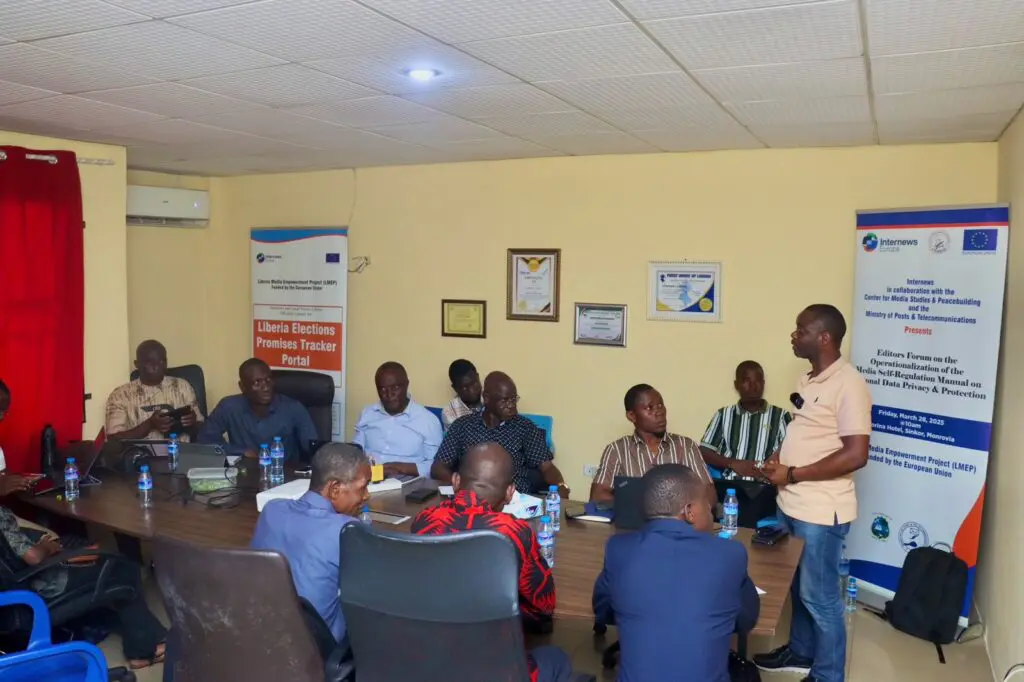
MONROVIA — Internews Europe, now trading as Informed, is concretizing steps to finally localize what it calls sustainable journalism education in Liberia. With funding from the European Union under the Liberia Media Empowerment Project (LMEP), Internews has been engaged with Liberian universities, journalism teaching schools and media development organizations to develop an investigation journalism training manual for Liberia. That dream is being realized. A draft has been in circulation and on Friday last week, journalism education stakeholders convened in Monrovia to formally review it. After the review, stakeholders overwhelmingly validated it as a vital resource material for the teaching of investigative journalism in Liberian schools.
By Blamo N. Toe
The manual, comprising more than sixteen modules that are Liberia-context specific, addresses a critical gap in journalism teaching materials in Liberian universities and schools, especially the lack of a dedicated investigative reporting book developed specifically around the country’s institutions, governance systems, laws, social realities and public accountability challenges.
It also aims to strengthen knowledge of both journalism lecturers and journalisms students, support evidence-based reporting, ethical investigations and accountability journalism across the country.
The review and validation workshop held on October 16, 2026 at the Informed office on Broad Street, Monrovia, brought together heads of university media studies and mass communication departments, mass communications student associations’ leaders, media institutions and representatives of the Reporters Association of Liberia (RAL) to review and endorse the Liberia Context-Specific Investigative Journalism Training Manual.
While journalism students and reporters have access to general textbooks and theoretical materials on investigative reporting, the new manual is designed to provide practical guidance grounded in the Liberian context, helping journalists investigate issues affecting citizens and hold public officials and other powerful actors accountable.
“This is a very good initiative because we do not have any book on investigative journalism in Liberia. This Manual will go a long way with us,” says Valentine Samuel, chairperson of the Department of Mass Communication at the African Methodist Episcopal University (AMEU).
The manual was developed through collaboration involving the University of Liberia (UL), AMEU, the United Methodist University (UMU), the Peter Quaqua School of Journalism (PQSJ) and CEMESP, with technical and financial support from Internews. The validation exercise was facilitated by lead consultant Titus W. Tokpah Sr., executive director of PQSJ.
According to the draft, the manual contains 16 training modules covering Liberia’s journalism history, investigative reporting techniques, public corruption, procurement and concession agreements, infrastructure projects, international development funding, education, health, gender issues, elections, human rights, access to justice and trafficking in persons.
It also provides practical guidance on examining national budgets, tracking government expenditures, reviewing audit reports, investigating public contracts, verifying evidence, conducting interviews and protecting confidential sources.
A central feature of the manual is its emphasis on moving beyond allegations to establish facts through documentary evidence, independent verification and fair reporting. It also stresses the importance of giving individuals and institutions accused of wrongdoing an opportunity to respond before publication.
The document addresses the growing use of digital tools and artificial intelligence in journalism, emphasizing that AI-generated information must be independently verified before it is used in published reports.
Designed for classroom instruction, newsroom training and independent learning, the manual includes practical exercises, case studies, field assignments and investigative projects intended to connect journalism education with the realities of reporting in Liberia.
David Dahn, chairperson of UMU’s Department of Mass Communication, welcomed the initiative while acknowledging the need to refine the draft before its finalization.
“I find this process to be absolutely good. This work in its current imperfect state can be enhanced to be a very useful tool to Investigative Journalism in Liberia,” Dahn said.
Bobby Tingban, executive director of the Jonathan Payelayleh School of Journalism, described the material as a practical resource that could help bridge the gap between classroom theory and professional reporting.
“I find the material to be very practical unlike the theories we teach in the classroom. I commend Internews for this initiative,” Tingban said. He added that his institution intends to begin using content from the manual and expressed hope that it would eventually be taught across journalism schools in Liberia.
“When a student of PQSJ visits students at the Jonathan Payelayleh School of Journalism, lessons relative to investigative journalism should be the same,” he said, emphasizing the need for consistency and synchronization in investigative journalism training across institutions.
During the interactive workshop, participants reviewed the draft, proposed revisions and discussed the importance of integrating investigative journalism into university mass communication programs.
Mass communication department heads committed to incorporating the manual into their curricula after the final document is completed.
“Now, therefore, be it declared and resolved that we, the undersigned participants of the validation workshop, hereby affirm our support for the adoption of the Liberia Context-Specific Investigative Journalism Training Manual, subject to the incorporation of the inputs and recommendations made during the validation process,” the declaration reads.
Internews country team lead, Samuka V. Konneh, commended the participating institutions and media stakeholders for their dedication to the process, describing their involvement as important to strengthening investigative journalism education and professional reporting standards.
“All of the recommendations are being documented and will be included into the final draft of the document,” Konneh said. “On behalf of Internews and our donor, the EU, we want to say thank you for your dedication and the collaboration.”
Broader support for journalism education
The development of the manual is part of wider support Internews is providing to strengthen journalism education and practical training as the 36-month LMEP approaches its conclusion in December this year.
In addition to supporting the participating institutions in developing the manual, Internews is providing equipment and other resources to the University of Liberia, AMEU, UMU and the Peter Quaqua School of Journalism to improve students’ access to practical learning opportunities.
The support includes the establishment of a mini production or broadcast simulation studio at UMU to give mass communication students a dedicated space to practice media production.
Mass communication departments at UL and AMEU are also receiving strong and stable Starlink internet services. All four institutions are benefiting computer laptops, digital voice recorders, smartphones, printers and other equipment to support journalism training and reporting.
The assistance is intended to help students apply classroom lessons through practical exercises, digital reporting and other forms of hands-on journalism training.
Although the initial collaboration focused on four institutions, the initiative has since attracted the participation of J.W. Harris University, Smythe Institute and the Jonathan Payelayleh School of Journalism, bringing the number of participating institutions to seven. Their participation reflects the wider interest in the manual and its potential to contribute to more consistent, context-specific investigative journalism training across Liberia.
Student reporting grants to put training into practice
Beyond the manual and institutional equipment, LMEP is also supporting student investigative reporting through grants awarded to student teams from the seven participating institutions.
Each institution is represented by a team of students receiving grant support to produce an investigative story. The initiative is designed to give students an opportunity to put the skills and knowledge acquired in the classroom into practice by developing and pursuing story ideas, gathering and verifying evidence, interviewing sources and producing publishable investigative reports.
The student reporting grants are expected to strengthen practical learning while helping emerging journalists gain experience in reporting on issues of public interest.
Together, the manual, institutional support and student reporting grants form part of a broader effort to build investigative journalism capacity in Liberia by linking classroom instruction with practical reporting, professional standards and accountability.
With recommendations from the validation workshop now being documented for incorporation into the final draft, the manual is expected to serve as a resource for journalism schools, students, practicing reporters, editors and trainers seeking to strengthen investigative reporting in Liberia.




Discussion about this post