


Published: August 10, 2026
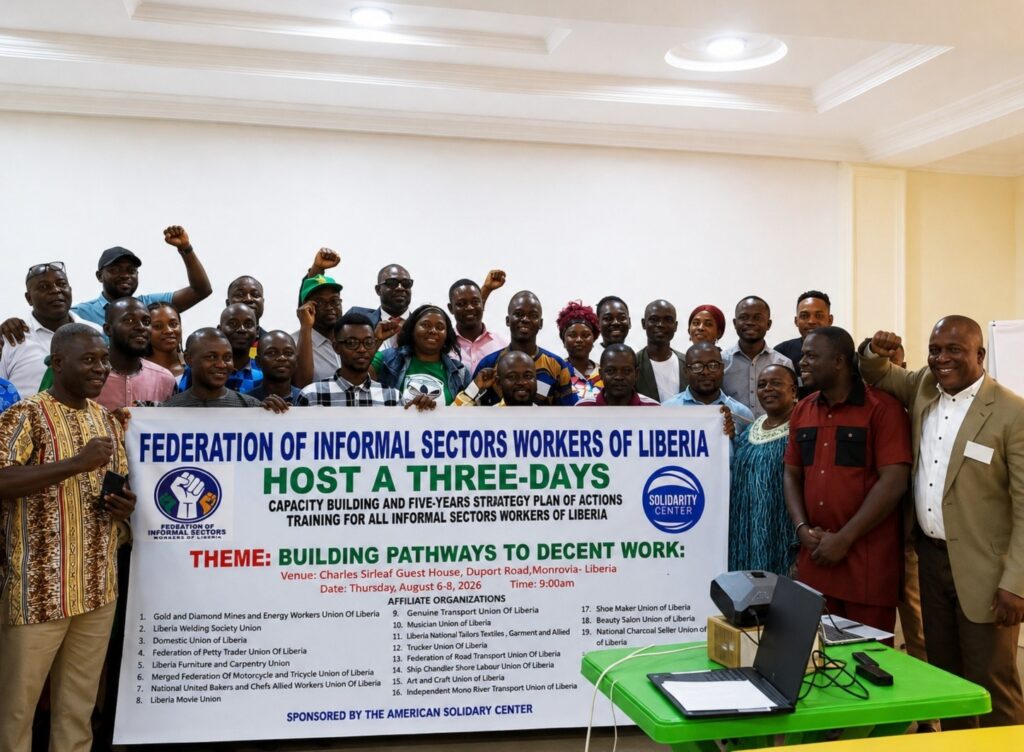
MONROVIA – Liberia’s informal workers want health benefits and a pension scheme, and they intend to bargain for them as a single bloc, the head of their federation said at the close of a three-day workshop in Paynesville.
“The primary goals include securing social protections, such as health benefits and pension schemes, to ensure workers can retire with dignity,” said Elvis A. Tamba, president of the Federation of Informal Sector Workers of Liberia.
The demand rests on a claim about scale. Tamba said informal workers account for nearly 80% of economic activity in Liberia and should be central to national development decisions.
“The ‘pathway’ starts here. It starts with us organizing, learning new skills, and demanding better. The informal sector is not a temporary place. We are 80% of Liberia’s economy. If Liberia must grow, the pathway must pass through FISWOL,” he said.
The workshop opened Thursday, Aug. 6, under the theme “Building Pathways to Decent Work,” and was held with support from the Solidarity Center. It drew petty traders, transport workers and artisans alongside representatives of the Solidarity Center, the Office of the United Nations High Commissioner for Human Rights, the Ministry of Labour, the Liberia Labour Congress, development partners and FISWOL’s leadership, and fed into the federation’s five-year strategic action plan.
Tamba said participants were trained in advocacy, negotiation and collective bargaining, in preparing advocacy briefs, and in record-keeping, savings, customer service and business growth. He said they also drew lessons from the Federation of Informal Workers of Nigeria on building out their own organization.
He said international partners have pledged continued support, including help with human rights advocacy and coming awareness campaigns, and that FISWOL intends to engage the government constructively on the rights, welfare and economic security of informal workers.
Solidarity Center Country Director Deddeh Tulay said the program, run with OHCHR, was built to strengthen organizations operating in the informal economy and gave traders and transport workers a place to compare problems and work out organizational strategies together. “It is important to emphasize the essential role informal workers play in Liberia’s economy,” she said. She said the sessions were structured as exchanges rather than lectures.
Melvin Nyanway, a human rights officer representing OHCHR Country Representative Christian Mukosa, said the U.N. human rights office remains committed to supporting FISWOL’s institutional development and the rights of informal workers.






Discussion about this post