


Published: May 22, 2026
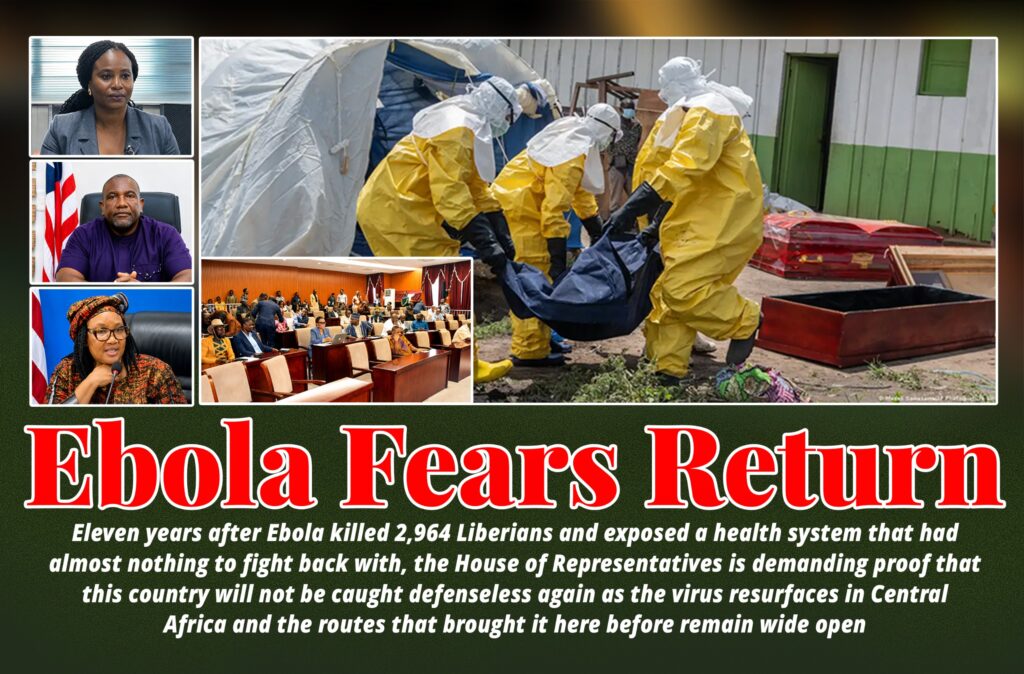
MONROVIA — The House of Representatives has ordered Liberia’s top health and border officials to appear before plenary Tuesday, May 27, demanding a full accounting of what stands between this country and Ebola as a fresh outbreak in the eastern Democratic Republic of Congo renews fears across a region that has never fully shaken the memory of what the virus did here a decade ago.
The summons covers Minister of Health Dr. Louise M. Kpoto, NPHIL Interim Director General Dr. Sia Wata Camanor, the Commissioner General of the Liberia Immigration Service, and the management of Roberts International Airport. The hearing, called through separate formal communications from Montserrado County District 16 Rep. Dixon W. Seboe and District 8 Rep. Prince A. Toles, is not an exercise in political theater. It is, in the words of the lawmakers who filed it, a reckoning.
“Mr. Speaker, in 2014, Africa recorded over 11,000 deaths from Ebola,” Seboe reminded colleagues on the House floor. “In Liberia alone, 7,069 people were infected and 2,964 people died. Even health workers were affected. Some of our best doctors and nurses died. So the issue concerning Ebola is very, very key.”
The numbers he cited underscore why the House is not waiting. Liberia’s 2014 to 2016 epidemic, which began with two positive samples from adult patients in Foya district, Lofa County, on March 30, 2014, ultimately became the worst in the country’s history. By the time WHO declared the outbreak over in June 2016, Liberia had recorded approximately 10,678 reported cases and 4,810 deaths, a case fatality rate of roughly 45 percent. At the peak in August and September 2014, the country was seeing up to 509 new cases in a single week. Montserrado County alone accounted for roughly half of all national cases. Three counties, Bomi, Margibi and Montserrado, each recorded more than 300 cases per 100,000 people. Health workers were hit especially hard: 378 confirmed infections, 192 deaths, a fatality rate among infected health care staff of more than 50 percent.
That history is what makes the current DRC outbreak impossible for Liberian lawmakers to ignore. Seboe laid out the geography with precision.
“On the west side of Congo is Angola, where ships traveling to West Africa can eventually reach Liberia,” he said. “On the east side is Rwanda, where thousands of Liberian students are studying. At any point in time, the virus could reach Liberia if we are not prepared.”
His observation is not alarmist. Liberia’s 2014 epidemic did not begin in Monrovia. It crossed a border. WHO confirmed on April 2, 2014, just three days after identifying the first cases in Lofa County, that a laboratory-confirmed Liberian case had already traveled from Foya to Monrovia and Margibi. The taxi driver and the man’s household contacts were placed under observation.
The government says it has no confirmed Ebola case in the country. The Ministry of Health and NPHIL issued a joint statement in May 2026 confirming Liberia’s current Ebola-free status while acknowledging that the country had gone on high alert, activating increased border and point-of-entry screening, rapid response and coordination measures, and public communication channels in direct response to the DRC outbreak. The U.S. Embassy and the U.S. Centers for Disease Control and Prevention are also reportedly already engaging Liberian authorities on preparedness efforts.
But lawmakers want more than reassurances. Seboe’s formal communication to House Speaker Richard Nagbe Koon specifically requests updates on Liberia’s public health infrastructure, surveillance systems, emergency response mechanisms, and public awareness campaigns. Toles, in his separate communication, pressed for detailed information on airport screening procedures, border surveillance systems, and the state of coordination between immigration and health authorities.
“Given Liberia’s painful experience with the Ebola epidemic and the devastating impact it had on our health sector, economy, and the lives of our citizens, it is imperative that this honorable body remains adequately informed about the nation’s readiness,” Toles wrote.
Liberia’s 2023 Joint External Evaluation, the internationally standardized assessment of a country’s health security capacity, found significant progress but also persistent structural weaknesses. On the positive side, the evaluation confirmed a functional national Public Health Emergency Operations Center linked to 15 county emergency operations centers, a system that can activate within 120 minutes. NPHIL reported that in 2025, Liberia’s WHO-supported surveillance system generated 29,224 alerts, of which 23,589 were verified. The CDC in Liberia page, updated in March 2026, noted more than 400 Field Epidemiology Training Program graduates, with at least one intermediate-level graduate in each of Liberia’s 15 counties and one frontline graduate in each of the country’s 93 health districts.
However, the JEE also gave Liberia a score of 2 out of 5 for early warning surveillance, a score of 1 for specimen referral and transport, a score of 1 for workforce surge during emergencies, and a score of 2 for emergency risk and readiness assessment. The evaluation highlighted weak integration between event-based and indicator-based surveillance systems, incomplete integration of laboratory results into the overall surveillance framework, donor dependence, irregular simulation exercises, and the lack of a dependable domestic contingency fund. According to the assessment, Liberia’s borders remain porous.
Liberia’s epidemic history shows that the virus rarely announces itself through official channels. It moved through a taxi, through a funeral, through a hospital that had no triage protocols and no running water. When WHO was first called in 2014, Monrovia needed 1,000 treatment beds. It had 240.
And the 2014 epidemic, it is worth remembering, did not end cleanly. After WHO declared Liberia Ebola-free on May 9, 2015, the country suffered three separate post-elimination flare-ups before the final end-of-outbreak declaration on June 9, 2016. The first involved a 17-year-old boy whose post-mortem swab tested positive in June 2015, leading to six cases and two deaths. A second flare-up in November 2015 began with a patient who developed symptoms on Nov. 14, 2015, and was later linked to viral persistence in a female survivor who transmitted the disease to three family members roughly a year after the epidemic’s main wave had been suppressed. A third reintroduction in April 2016, involving a 30-year-old woman who was exposed in Guinea and then infected her two children in Liberia, closed out the outbreak. Each of those episodes was contained quickly only because surveillance systems were operating at high alert. If the same systems are not at high alert now, the lessons of those post-elimination episodes have not been absorbed.
Seboe said the purpose of Tuesday’s hearing is to convert institutional assurances into verifiable accountability.
“It is important for us to know our degree of readiness because anything can happen,” he said. “We experienced Ebola and COVID-19. We know the effect on our economy, our health sector, and our people. We must get our house ready.”
Both lawmakers emphasized that the hearing is intended to inform, not to create panic. What they are seeking is transparency about the specific measures in place at Roberts International Airport, at land borders, at ports, and within the national surveillance system, along with a clear answer to whether those measures are funded, staffed and operational or whether they exist only on paper.
“It is important for the deputies of the people to know what measures are in place so we can communicate appropriately with our citizens,” Seboe said.






Discussion about this post