


Published: October 17, 2025
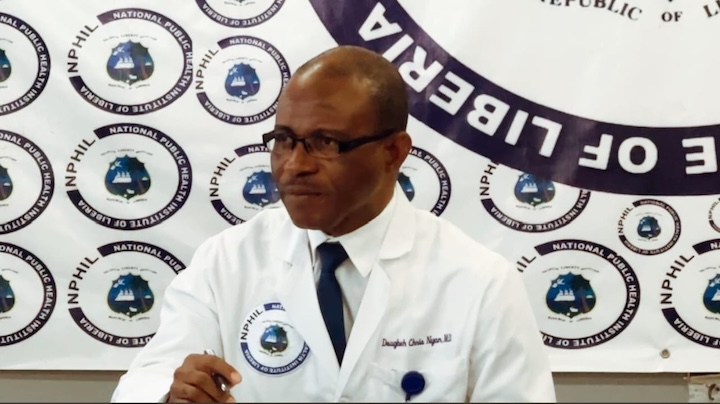
MONROVIA — In a fiery response to his dismissal by President Joseph Nyuma Boakai, the embattled Director General of the National Public Health Institute of Liberia (NPHIL), Dr. Dugbeh Chris Nyan, called the allegations against him “baseless, vague, and politically motivated,” asserting that his removal violates the NPHIL Act of 2016 and compromises Liberia’s progress in public health leadership across Africa.
In a lengthy statement addressed to the President and copied to the Office of the Minister of State Designate, Samuel A. Stevquoah, Dr. Nyan said he was “pained but not surprised” by what he described as “a well-orchestrated conspiracy by elements within the NPHIL Board” to discredit his work and derail the institution’s scientific growth.
“I returned home to serve my country in a technical, scientific, biomedical, and public health role — not to be involved in unhealthy political theatrics,” Dr. Nyan wrote, outlining his thoughts with the question “Why are they fighting me?” as the beginning.
Dismissal Sparks Controversy
Dr. Nyan’s dismissal comes barely a year after his appointment as Director General of NPHIL, a period he says has seen “unprecedented progress,” including the designation of NPHIL as a Regional Center of Excellence by the Africa Center for Disease Control (Africa CDC).
President Boakai’s decision followed a resolution by the NPHIL Board calling for Nyan’s removal on 11 counts, ranging from alleged lack of coordination with the Ministry of Health and other agencies to procedural breaches in travel and administrative decisions.
However, in his detailed 12-page response, Nyan systematically countered each allegation, arguing that the Board failed to provide evidence for its claims and violated the very law governing the institute.
‘Unconstitutional and Unfounded’ Allegations
“The Board’s request for my removal is unconstitutional and does not satisfy Section 4.4 (iii) of the NPHIL Act of 2016,” Nyan asserted. “All 11 counts are unsubstantiated and lack evidence.”
He maintained that his administration has kept the Board “regularly informed” about critical decisions and that major actions, including investigations into staff misconduct, budget submissions, and inter-agency collaborations were properly documented and reported.
“It is puzzling that the Board would accuse me of ‘lack of pre-decisional involvement,’ when I have reported all activities through the appropriate channels,” he wrote, referencing quarterly reports and correspondence submitted to the Board and the Executive Mansion.
Clashing with the Ministry of Health
One of the most contentious issues has been NPHIL’s relationship with the Ministry of Health (MoH). Nyan claimed that rather than fostering collaboration, the Ministry has sought to “create parallel structures” that undermine NPHIL’s statutory authority.
He cited the establishment of a Department of Environmental and Occupational Health within the Ministry of Health, a function he says legally falls under NPHIL’s mandate as an example of “territorial overreach.”
“The Ministry of Health has created parallel structures to conduct NPHIL’s work,” he said, noting that his attempts to engage the Minister of Health were met with limited cooperation.
Travel and Administrative Integrity
On allegations that he traveled without informing the Board, Nyan dismissed the claim as “false and inaccurate,” citing documented emails, text messages, and official memos showing prior communication with the Board’s chairperson.
He emphasized that all his travels were “official, not private,” and were sponsored by regional and international partners such as Africa CDC and ECOWAS-WAHO.
“If the Board insists that I traveled without notice, then let them provide evidence,” he challenged, adding that his deputies always remained in-country during his absence, in compliance with the NPHIL Act.
A Clash Over Power and Reform
The rift between Nyan and the NPHIL Board appears to reflect deeper governance tensions between a technocrat pushing for reform and entrenched administrative forces allegedly resistant to change.
Nyan accused the Board of holding meetings from which he, as Secretary to the Board, was intentionally excluded — yet still billing the institution for “ad hoc sitting fees.”
He further alleged that some Board members sought to “micromanage” NPHIL’s media and communication functions, contrary to the institute’s Human Resource Management Policy approved by the same Board in 2022.
“Such behavior reflects administrative intimidation and conspiracy rather than collaboration,” Nyan wrote, adding that “integrity, not manipulation, should define the relationship between the Director General and the Board.”
‘No Partner Has Raised a Complaint’
Dr. Nyan also dismissed claims that international partners had expressed concerns about his leadership, calling the accusation “completely fabricated.”
He pointed out that development partners are represented in the biweekly Incident Management System (IMS) meetings, where all coordination and concerns are addressed.
“If any partner had an issue, the IMS is the ideal platform to raise it,” he said. “To date, no such issue has ever been brought forward.”
A Plea for Presidential Review
Concluding his statement, Nyan urged President Boakai to “carefully review the attached documentation” before affirming the Board’s resolution.
“I only wish to serve my country with transparency, accountability, sincerity, and integrity,” he said. “Without those qualities, systemic failure may occur and that would reflect poorly on your administration.”
A Divided Public Health Front
The unfolding controversy has stirred sharp reactions across Liberia’s health and governance circles. Supporters of Dr. Nyan describe him as “a reformer under attack,” while critics argue that his leadership style alienated key partners.
As the Boakai administration continues its cleanup of government institutions, the NPHIL standoff exposes a critical test: whether Liberia’s public health leadership will be defined by collaboration or confrontation. For now, Dr. Nyan remains defiant and determined to clear his name.
“All I desire is to do the work of the Liberian people unhindered,” he declared. “Is that too much to ask for?”
The National Public Health Institute of Liberia (NPHIL) was established in 2016 when the NPHI Act was passed by the legislature, and it was officially signed into law in January 2017. This action was a direct response to weaknesses in the public health system exposed during the 2014-2015 Ebola outbreak.
So far since its founding, no Director has completed his or her tenure in office as all have been either dismissed or forced to resign.
For now, following President Boakai’s dismissal of Dr. Nyan, Dr. Sia Watta Camanor, has been appointed to serve as the Officer-in-charge of NPHIL. Camanor is a board member of NPHIL and close associate of President Boakai-especially bearing the same tribal and regional identity. Critics see it as a perpetuation of nepotism and political patronage.
As reported by KMTV, Global Health Practitioner, Courage Sundburg, has termed as a “Huge Mistake”, the appointment of Dr. Sia Camanor as Officer in Charge of the National Public Health Institute of Liberia (NPHIL).
Many mixed reactions, with many condemning the appointment of Camanor continue to flood the social platforms online.




Discussion about this post