


Published: November 10, 2026
MONROVIA — A one-time US$200 million payment from ArcelorMittal Liberia carried the country’s revenue past US$1 billion this year for the first time. Next year, the government is betting taxes can do the same job.
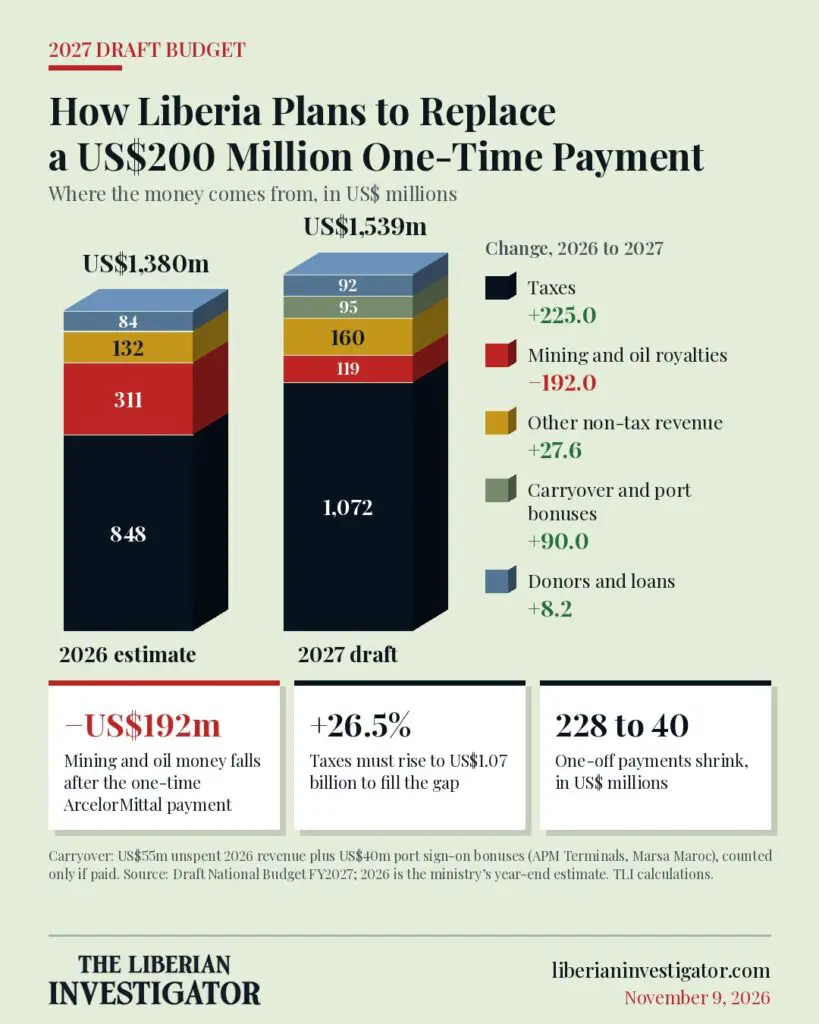
Its US$1.54 billion budget for 2027 projects tax collections rising 26.5 percent, from an estimated US$847.5 million this year to US$1.07 billion.
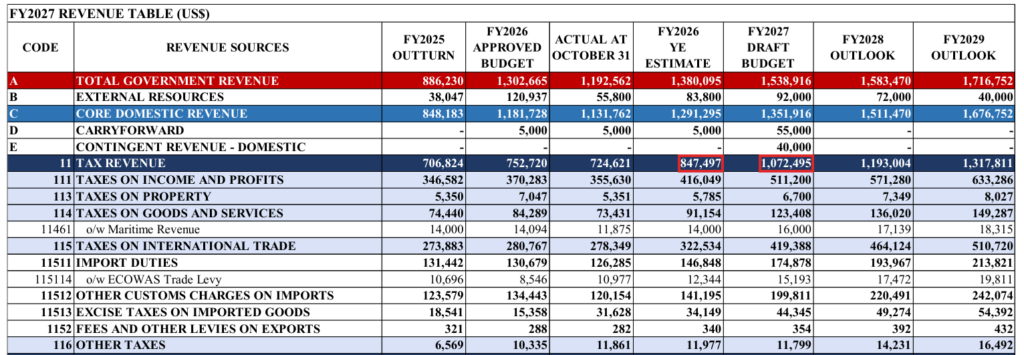
The figures come from the revenue table of the draft National Budget for Fiscal Year 2027, which President Joseph Nyuma Boakai sent to the Legislature last Friday. They are the first full account of how the government intends to fund its largest budget yet.
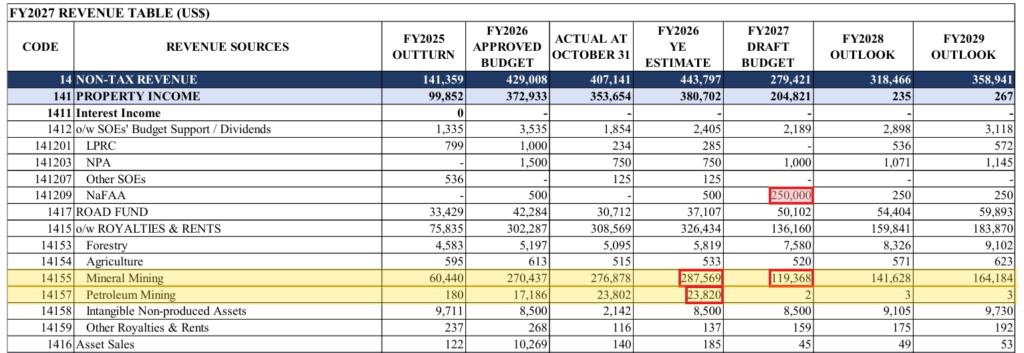
Royalties and rents from mineral mining, the line that carried ArcelorMittal’s payment, fall from an estimated US$287.6 million this year to US$119.4 million in 2027, a drop of US$168.2 million. Petroleum royalties and rents, which brought in US$23.8 million this year from offshore block signing fees, fall to almost nothing. The draft says the government received US$228 million in one-off receipts in 2026 and expects only US$40 million from such payments in 2027.
Taxes on income and profits are projected to rise by US$95.2 million, taxes on international trade by US$96.9 million, and domestic taxes on goods and services by US$32.3 million. On paper, the larger tax base more than replaces the lost mining revenue and leaves Liberia’s revenue resting far more on taxes than it did this year.
The payment that built the record
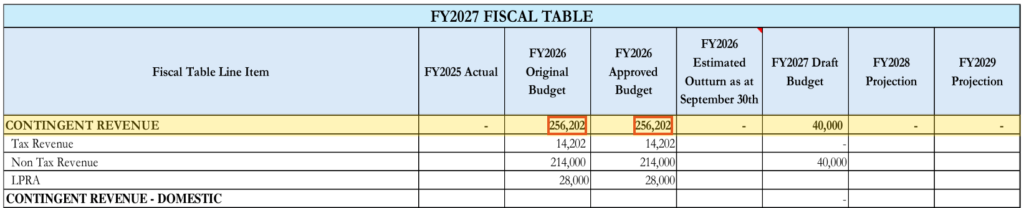
The 2026 budget was built around a payment it could not count on. Lawmakers enacted a US$1.2497 billion budget in December 2025. Of that, US$256.2 million was classified as contingent revenue, money whose arrival was uncertain. BudgIT’s analysis of the approved budget shows that ArcelorMittal’s US$200 million was included in that line. The 2027 draft’s fiscal table breaks down the 2026 contingent revenue into US$14.2 million in tax, US$214 million in non-tax revenue, and US$28 million from the Liberia Petroleum Regulatory Authority.
ArcelorMittal paid the fee under the third amendment to its Mineral Development Agreement, which extends its concession to 2050. In June, the International Monetary Fund described it as a “one-off bonus payment of US$200 million,” equal to 3.5 percent of gross domestic product.
Revenue collections stood at US$997.43 million on Sept. 13 and crossed US$1 billion days later, The Liberian Investigator reported. Without ArcelorMittal’s payment, collections at that point would have been about US$797 million. For comparison, total domestic revenue for all of 2025 was US$847.7 million, according to the draft.
A US$53 million supplementary budget, signed in May and funded mostly by delayed World Bank budget support, raised the 2026 budget to US$1.3027 billion. That is the figure the 2027 draft measures itself against. The ministry estimates 2026 will close with US$1.38 billion in total resources.
Finance Minister Augustine Kpehe Ngafuan acknowledged the gap in September. He said the mining payment would not recur in 2027, described the result as a US$200 million gap and said he was confident economic growth would close or exceed it.
Where the new money is supposed to come from
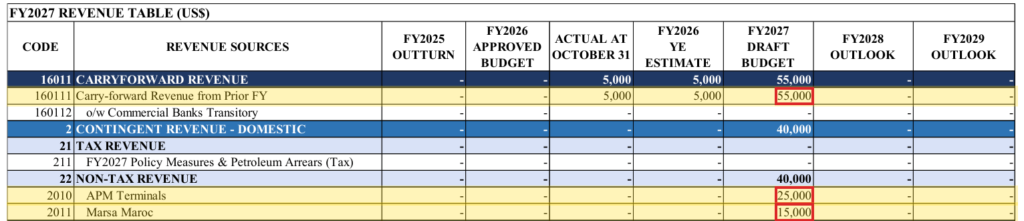
The 2027 envelope of US$1.5389 billion has four parts, according to the draft. Core domestic revenue accounts for US$1.35 billion, or 87.8 percent. External resources provide US$92 million and contingent revenue US$40 million. The remaining US$55 million is revenue carried forward from 2026, eleven times the US$5 million carried into this year.
Within that envelope, the balance shifts from mining to taxes. Tax revenue rises from 61.4 percent of total resources in this year’s estimate to 69.7 percent in 2027. Non-tax revenue, which includes royalties, falls from 32.2 percent to 18.2 percent.
Taxes on income and profits remain the largest single source at US$511.2 million, nearly half of all tax revenue. Taxes on international trade follow at US$419.4 million: import duties of US$174.9 million, other customs charges on imports of US$199.8 million and excise on imported goods of US$44.3 million. Other customs charges show the sharpest rise of any major line, up 41.5 percent from this year’s estimate. Domestic taxes on goods and services, which include maritime revenue, rise to US$123.4 million.
Several smaller lines also rise. The National Road Fund, financed largely by the levy on imported fuel, grows by US$13 million to US$50.1 million. Administrative fees and charges grow by US$10.2 million, led by the Ministry of Labor, whose fees rise from an estimated US$22.7 million this year to US$29.4 million.
The US$40 million in contingent revenue comes from two port operators. APM Terminals, which runs the Freeport of Monrovia, is listed at US$25 million, and Marsa Maroc at US$15 million. The draft calls these sign-on bonuses but does not describe the agreements behind them. The government has tied US$40 million in spending to that money, to be released only if the payments arrive and only after quarterly revenue reviews. Salaries, debt service, pensions and the public investment program are protected from those cuts.
External resources are smaller than the government planned for this year. The draft lists a US$20 million European Union grant and US$72 million classified as borrowing: US$40 million from the World Bank’s International Development Association, US$20 million from the IMF-administered Resilience and Sustainability Facility and US$12 million from the African Development Bank. The 2026 approved budget expected US$120.9 million from outside sources, but only US$55.8 million had arrived by the end of October.
The bet on VAT
The draft’s tax projection rests on three assumptions. The first is that replacing the goods and services tax with a value-added tax will raise more revenue because VAT has “built-in mechanisms to mitigate against under-declarations.” The second is that income and trade taxes will continue to grow with the economy and with improved compliance, supported by better billing and extended banking hours. The third is that the government will depend far less on one-off receipts.
The Liberia Revenue Authority has set VAT at 15 percent from Jan. 1, 2027. The draft says petroleum products will stay outside VAT and continue to pay fixed taxes and levies per volume, and rice is also exempt. The ministry says both exemptions follow impact studies of how VAT would affect prices.
The draft also relies on a Liberia Tax Amendment Bill of 2026. According to the ministry’s summary, the bill would introduce a minimum excise on digital financial services, reform the penalty regime, change how real property is valued, and tighten electronic tax invoicing and customs controls. The draft refers readers to indirect and direct tax “policy update” sections for the bill’s details, but those sections do not appear in the document, and the bill itself has not been made public.
How big a jump
Liberia collected US$706.8 million in taxes in 2025. The 2027 projection of US$1.07 billion is 52 percent higher, an increase of US$365.7 million in two years. Measured against this year’s estimate of US$847.5 million, it is a one-year rise of 26.5 percent.
The ministry projects real growth of 5.1 percent in 2027 and inflation averaging about 5.5 percent from 2027 to 2029. Together, those imply nominal growth of roughly 11 percent. To hit the target, the tax take would have to grow more than twice as fast as the economy.
Even this year’s estimate is not yet secure. The revenue table shows tax collections of US$724.6 million at Oct. 31. Reaching the year-end estimate of US$847.5 million requires another US$122.9 million in November and December.
The government is right that its dependence on one-off payments has fallen sharply. The US$40 million it expects from such payments in 2027 is 17.5 percent of what it received this year. But it has moved the risk rather than removed it. In 2026, the uncertain money sat in a contingent line that could be switched off. In 2027, most of the new money sits in core tax revenue, which pays salaries and debt.

Debt service rises to US$275.5 million in 2027 from US$232 million, according to the draft, and compensation in the core budget rises to US$369.4 million. Public debt stood at US$2.88 billion at the end of September, or 50.54 percent of GDP.




Discussion about this post