

Published: July 13, 2026
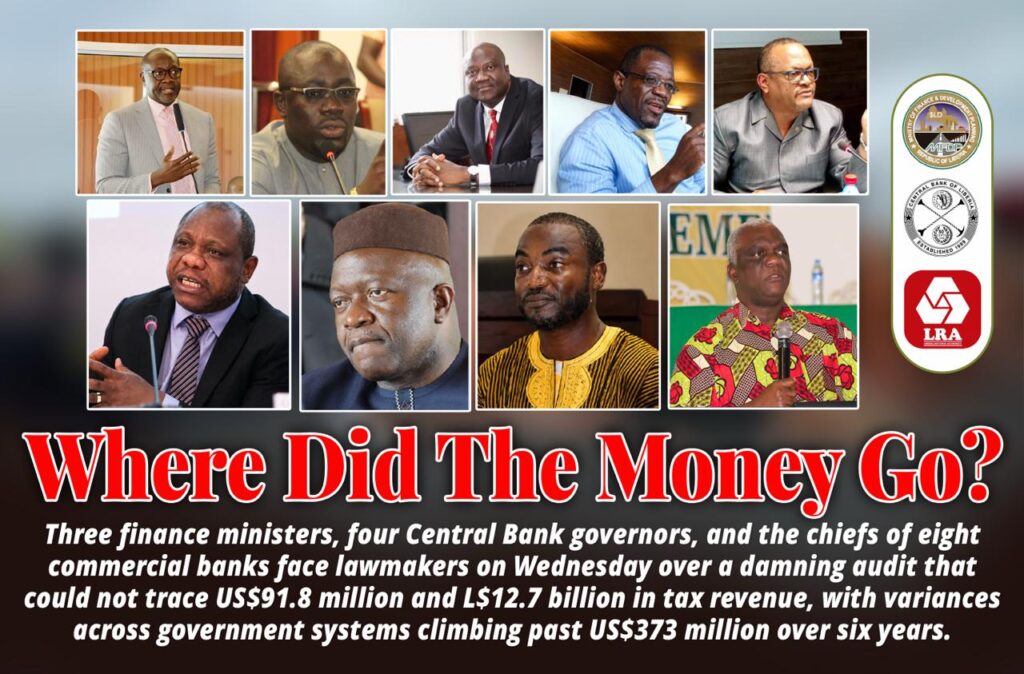
CAPITOL HILL, Monrovia — Three finance ministers, four Central Bank governors, and the heads of eight commercial banks will face lawmakers on Wednesday over a government audit that could not account for hundreds of millions of United States and Liberian dollars in tax revenue collected over six years.
The Joint Public Accounts, Expenditure and Audit Committee of the 55th Legislature opens the public hearing at 11 a.m. in the Chamber of the House of Representatives at the Capitol Building. On the table is the General Auditing Commission’s Special Reconciliation Audit of Government Tax Revenue Collected Through Government Transitory Bank Accounts and the Consolidated Accounts, covering July 1, 2018, through Dec. 31, 2024.
The stakes are considerable. The audit, signed by Auditor General P. Garswa Jackson Sr. and transmitted to the Legislature in April, found that US$257.5 million and L$23.6 billion recorded in government transitory accounts at commercial banks could not be traced to the General Revenue Account at the Central Bank of Liberia. When auditors reconciled the flows in both directions, the net variances stood at US$91.8 million and L$12.7 billion. Cumulative variances between the Liberia Revenue Authority’s Tax Administration System and the General Revenue Account reached US$373.9 million and L$16.7 billion.
According to a joint release issued by the Press and Public Affairs Bureaus of the Liberian Senate and the House of Representatives, the committee has summoned former and current officials of the Ministry of Finance and Development Planning, the Liberia Revenue Authority and the Central Bank of Liberia to explain the findings.
“The hearing forms part of the Joint Committee’s constitutional oversight responsibility to promote transparency, accountability, and sound financial governance in the management of public resources,” the release stated.
Those expected to appear include Finance Minister Augustine Kpehe Ngafuan and his predecessors Samuel D. Tweah Jr. and Boima S. Kamara; LRA Commissioner General James Dorbor Jallah; LRA Commissioner for Internal Audit Rufus Mahn; Controller General Elwood T. Netty; former Controller General Janga A. Kowo; and Deputy Controller and Accountant General Prince Lighe Sr. From the Central Bank, Executive Governor Henry F. Saamoi will testify alongside former Executive Governors Milton Alvin Weeks, Nathaniel R. Patray and Jolue Aloysius Tarlue.
The audit period spans three administrations of the Finance Ministry. Ngafuan took office in September 2024 and received the audit letter addressed directly to him. Kamara served through July 2024, and Tweah through December 2023.
Representatives of eight commercial banks have also been invited: Afriland First Bank Liberia, Ecobank Liberia, Bloom Bank Africa Liberia, International Bank (Liberia) Limited, Guaranty Trust Bank Liberia, Liberia Bank for Development and Investment, United Bank for Africa Liberia and First International Bank Liberia.
The banks sit at the center of the audit’s findings. Under memoranda of understanding with the LRA, commercial banks holding transitory accounts are required to sweep tax collections into the government’s consolidated account at the Central Bank within 24 hours on any business day. The audit found that not a single bank consistently met that deadline over the six-year review period. Average transfer times ranged from three days at Access Bank to 24 days at Ecobank, with Global/Bloom Bank averaging 21 days and United Bank for Africa 10 days.
Auditors also documented unauthorized withdrawals of US$59,786 and L$551,774 from the transitory accounts, including entries described in bank records as “school fee deducted, suspended fees payment, online transfers, etc.” — transactions that should never have touched accounts reserved exclusively for government tax revenue. Reversals totaling US$16.1 million and L$501.3 million posted to the transitory accounts could not be traced to the original transactions they purportedly corrected, while unexplained reversals in the General Revenue Account reached US$37.5 million and L$1.9 billion.
The transitory accounts, which financial regulations require to be closed at the end of each fiscal year, remained open when the audit was completed, carrying unswept balances of US$574,766 and L$59 million as of Dec. 31, 2024. Banks also charged the accounts US$51,410 and L$1.6 million in fees above the US$30 monthly maintenance charge authorized under their agreements with the LRA.
Several banks and mobile money operators, including Bloom Bank, Lonestar Communication Corporation and Orange Liberia, failed to provide statements requested by auditors — a refusal the GAC said prevented it from assessing the completeness and accuracy of revenue collected through those accounts.
The findings extend deep into the customs system. Transactions worth US$958.9 million in ASYCUDA, the automated customs data system, carried duplicated receipt numbers assigned to different transactions; another US$833.8 million had no receipt numbers at all. At rural collectorates, auditors found tax bills raised manually and cash held by collectors for extended periods before being deposited in bulk, making individual reconciliation impossible.
Underlying it all, auditors found no written policy framework governing revenue reconciliation responsibilities among the three institutions at the heart of the system — the Finance Ministry, the LRA and the Central Bank. All three responded to the findings, attributing variances to timing differences, bulk sweep transfers or system architecture. The auditors rejected most of those explanations, noting that management’s assertions were not supported by reconciliation reports and that the variances persisted regardless of the methodology applied.
Jackson has urged both chambers to treat implementation of the report’s recommendations as urgent, citing what he described as the pervasive impact of the findings on the government’s ability to manage public revenue with accuracy and accountability.
The Legislature has encouraged broad public participation in the proceedings. “The general public, civil society organizations, government institutions, development partners, and members of the media are encouraged to attend and observe the proceedings,” the release said.
Wednesday’s hearing, part of the committee’s regular public hearing and decentralization exercise, gives lawmakers their first opportunity to question the officials directly on the audit’s findings, test the strength of existing financial controls and determine what corrective measures are required to restore accountability to Liberia’s revenue collection system.






Discussion about this post