


Published: April 27, 2026
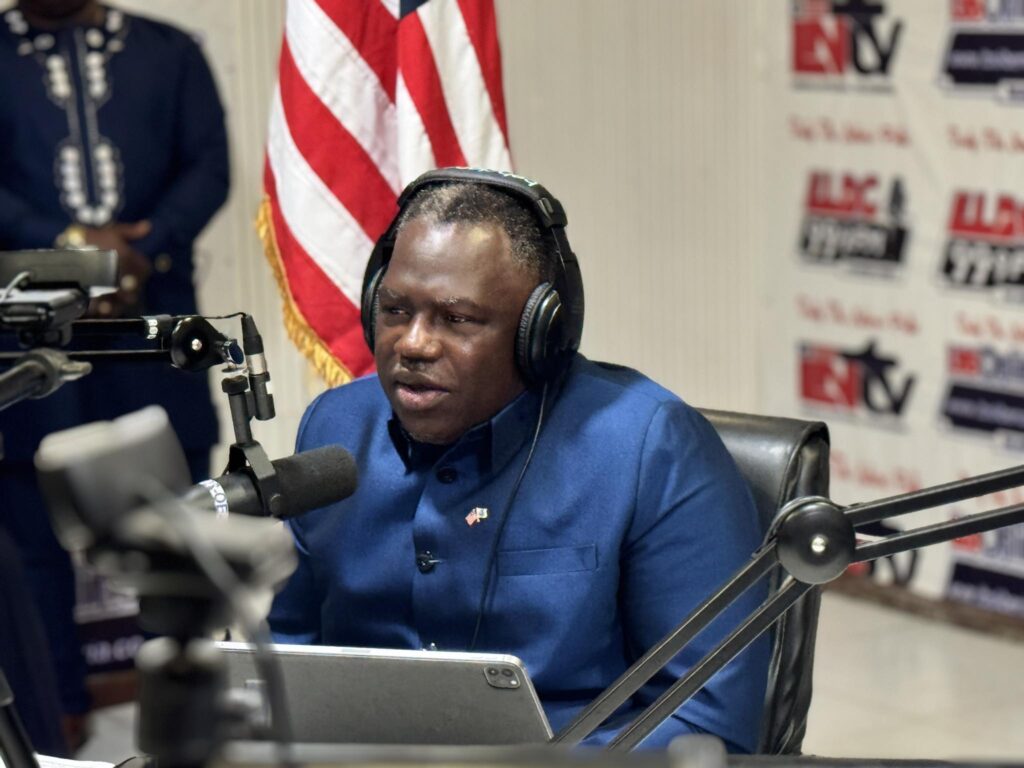
MONROVIA — Vice President Jeremiah Koung said Monday that foreign nationals, including citizens from Ghana, Nigeria, Kenya, Sierra Leone, and Côte d’Ivoire, are illegally dominating businesses that Liberian law explicitly reserves for Liberians, and that the government intends to give violators 10 days to come into compliance before enforcement actions begin.
Speaking for more than two hours on ELBC Radio’s Super Morning Show in one of the most expansive public addresses, Koung laid out a sweeping economic agenda that touched on business enforcement, petroleum cartels, mining law, electricity infrastructure, the Putu iron ore deal and the border situation with Guinea.
“Our market is complex. It’s unfriendly to my communities,” Koung said. “Too many times, we discovered that businesses reserved exclusively for Liberians are dominated by foreign friends. I’m talking about people from Ghana, Nigeria, Kenya, Sierra Leone, Côte d’Ivoire.”
The Law That Is Not Being Enforced
Vice President Koung said the committee’s investigation led them to the Investment Act of 2010, a law that designates between 16 and 20 categories of business exclusively for Liberian nationals. Among those reserved categories, he said, are sand supply and mining, block making, retail trade, travel agencies, and critically, the distribution of locally produced beverages.
That last category, he said, is where the most visible violation is occurring.
“What are the factories in this country? What happened to them? Who are the distributors?” he asked rhetorically. “Unfortunately, you will realize maybe one, two, three drinks are part of the distributors. Most of them are foreign friends.”
He cited G5, identified as the former Coca-Cola bottling facility, as a specific example, alleging that distribution networks for major locally produced beverages are effectively controlled by foreign nationals, including Indian business interests, operating either directly or through Liberian fronts.
“These companies are in Liberian names,” he acknowledged, “but I know most of the businesses are our Indian friends and brothers.”
The fronting practice, he explained, works through informal arrangements in which a Liberian citizen lends their name to a business registration in exchange for monthly payments, sometimes as little as $250, rent assistance, or school fees, while a foreign national runs and profits from the operation.
“People are fronting,” Koung said. “Maybe somebody say, ‘Clarence, I want to do this business. Every month I’ll give you $250. I’ll pay your tuition and school fees. And maybe I’ll rent a place for you for 75 dollars.’ And so there are a lot of people doing this.”
He acknowledged that prosecuting fronting schemes through the courts is almost impossible under current conditions because documents show a Liberian as the owner. The committee’s practical solution, he said, is to require that any Liberian listed as a business owner must be the signatory on the company’s bank account, making it financially unfeasible for foreign nationals to continue transferring money freely through front arrangements.
“If Clarence is the authorizing signature to the account, the foreign person would have to ask Clarence to authorize all their money transfers,” he said. “They can continue, but before they are okay, they can continue, but that will be risky for a lot of people. They will get out.”
Ten Days
Koung said the government’s first proposal to affected businesses is to self-correct within 10 days.
“Our proposal to them is that local intelligence, we are breaking out the intelligence, you should correct yourself. If you cannot correct yourself, there will be actions taken against you,” he said.
Asked whether enforcement could mean shutting businesses down, he was unambiguous.
“They are lost. They are already left on our book. When people are not making them lose, they are penetrating. There are ways to deal with it. They are already lost, you know.”
He said the committee will work through the Liberia Business Association, the Liberia Revenue Authority, immigration authorities, and other agencies to execute the enforcement. He also said he intends to consult with the bar association and the Jurists Association on the legal mechanics.
The Vice President added that President Boakai has given his direct authorization. “The president told me to come myself and let them know: in 30 days we’ll be having serious conversations,” he said, noting that Boakai had instructed him personally to appear on the program rather than sending the Commerce Minister.
“Unless the president calls me back, nobody can stop me,” Koung said.
The Putu Iron Ore Deal: A Liberian Company Failed to Prove It Had the Money
The vice president also provided a detailed account of the government’s handling of the Putu iron ore mining concession in southeastern Liberia, and confirmed that the government has moved away from a Liberian company recommended for the deal after it repeatedly failed to provide proof of funds.
The Putu mine was granted under a Mineral Development Agreement signed in September 2010 to a company called Putu Iron Ore Mining, connected to Russian interests operating under the name Silver Star, for a period of 25 years. When Ebola struck and the investment climate worsened, the Russian group sought to transfer control of the concession, an action that under the MDA requires government approval. The government cannot unilaterally select a new partner; both sides must agree.
A ministerial concession committee shortlisted three companies for the transfer: AMR, a Liberian company; Jindar, a large Indian conglomerate; and Planet One, a Dubai-based entity with Indian partners. The committee recommended AMR.
But months passed without AMR concluding a sales agreement with the Russians or providing credible documentation of financial capacity.
“We ask them for proof of funds. They haven’t given up written communication showing proof of funds so we can verify,” Koung said. “In four, five months we’re talking, they haven’t started anything.”
When the committee asked both sides how long a deal would take, the difference was clear. The Russians said an agreement with AMR would take six months to a year just for the sales deal, plus another six months to a year to handle U.S. sanctions issues, because paying Russian entities requires navigating OFAC compliance through American authorities. For Planet One, they said, the sales deal could be finished in 10 business days and the sanctions process resolved within six months.
Koung said the committee made a decision.
“We took a decision: let’s go with Planet One.”
He was direct about his personal assessment of AMR’s pitch.
“He didn’t convince me,” Koung said of AMR’s representative. “And I believe they didn’t convince the committee either, because every committee member signed and said our guy is delayed, let’s go with Planet One.”
Planet One has since presented documentation to the government, including proof of funds, with multiple banks listed and amounts specified. The Minister of Mines has been authorized to proceed. Koung said the invoice for the transfer fee, $10,000 payable to the Liberia Revenue Authority, had already been sent and was expected to be honored within days.
“Once the invoice goes, we pay that $10,000 to LRA. That is the fee for leaving Silver Star to Planet One. Same deal, nothing changed, same amount of time, same balance of years,” he said.
On the financial obligations attached to the concession, Koung said the Russian group owes the Liberian government approximately $40 million in cumulative social development fund taxes and other payments, of which 75 percent is earmarked for the three affected southeastern counties — Grand Gedeh, River Gee and Sinoe.
“Imagine putting 20, 25, 30 million dollars right after the deal changes into those communities. That is Grand Gedeh, that is River Gee, that is Sinoe,” he said. “Once things start in the southeast, that part of the country will start to get life.”
He projected that if the sanctions process is completed by late this year, Planet One could begin moving iron ore through the Port of Greenville within 15 to 20 months of signing.
Electricity: The Foundation Everything Else Sits On
On electricity, which he described as the single largest barrier to economic development in the country, Koung outlined both the infrastructure failures that have plagued the Mt. Coffee hydroelectric plant and a potential long-term solution involving B. Martin, the Chinese mining company operating in Liberia.
He said a study conducted in the 1970s found that the Via River and the Simbe River, which feed into Mt. Coffee, create a dry-season problem that causes the plant to lose most of its generating capacity when water levels drop. The solution the study proposed, a reservoir upstream that could regulate water flow year-round, was never built.
“Once you build that reservoir, whether dry or rain, you will always have a flow of water, because all you need is a force of water to turn the turbine,” he said. “The preliminary study shows you don’t need one billion. But we got to take a step, if you don’t start, you’ll never stop.”
He said a team from B. Martin is currently in Liberia studying the country’s hydropower options, and that the company, experienced in infrastructure construction, including airports, has expressed interest in building a hydro facility. He noted that a site identified for Simple Four, a power station near the proposed reservoir location, could generate up to 400 megawatts.
“If we can get the full founder, or even a thousand megawatts, after building the reservoir, Liberia is ready,” he said.
On near-term mitigation, he said the Liberia Electricity Corporation is exploring options for a 150-megawatt thermal plant at the Bushrod Island facility, with discussions involving LEC and Samsung among others. He said the installation, which would use heavy fuel oil, could take approximately two years to commission.
He also addressed the transmission system, calling it severely undercapitalized. He said the Joba substation, Liberia’s largest, requires an investment of $20 to $30 million to be upgraded adequately.
“We need to do generation, transmission and distribution. All three sectors must be taken care of. When you do that, tourism will work, agriculture will work, health will work,” he said. “You got to deal with the foundational issue so that when the structure goes up, you don’t have a problem.”
APM Terminal and Shipping Lines: A Reckoning Is Coming
Koung trained pointed criticism at APM Terminal and international shipping lines operating in Liberia, saying their practices are among the most serious structural problems facing the Liberian business community.
He said shipping lines have routed major cargo away from Monrovia’s port to Abidjan and San Pedro in Côte d’Ivoire, forcing Liberian importers to pay a second leg of freight to bring containers into the country, a cost that compounds with the already high delivery order fees charged by terminal operators.
“APM Terminal, Max Line, and shipping lines in this country are some of the major problems. We have to face them, not to fight them, but call them to the table,” he said. “After 25 years, we have to look at it. If we have to go to arbitration, let’s do it. Let’s take some action.”
He said discussions are ongoing and that the president is treating the matter seriously. “I can assure you there are discussions ongoing and there will be some actions taken,” he said.
Guinea Border: Soft Diplomacy Is Working
On the ongoing border confrontation with Guinea, in which Guinean forces deployed to contested territory earlier this year, Koung defended the government’s decision to pursue dialogue rather than military escalation, and said the situation is moving in a positive direction.
“If we had gunfire at our border, it would be happening right in Lofa, or we start drinking wine among ourselves about what happened,” he said. “Soft diplomacy is the way out.”
He said Guinean forces and heavy weapons have been withdrawn from the border area, schools in affected communities have reopened, and displaced residents have returned. He acknowledged that low-level movement across the border continues but framed it as consistent with the deep historical and family ties between Liberian and Guinean border communities.
“These people are family. You’ll be surprised that when one elder dies in Guinea, people cross from Nimba to bury them,” he said. “We are one people. We can’t fight one another.”
He said engagement is continuing through ECOWAS, the African Union and bilateral channels, and described the dynamic on the Guinean side as political positioning rather than genuine military intent.
“The diplomat said, ‘My man, we’re not fighting.’ The president went to Guinea. He’s been in the region, looking at where we can negotiate, to get our country back,” Koung said. “Discussions are going on. The first thing, the men pulled all the people from the border, all the heavy weapons gone back.”
On Loans, Fronting, and the 2029 Question
Vice President Koung also addressed the committee’s recommendation to the president to establish a low-interest or interest-free loan facility for Liberian businesses, potentially capitalized at $10 to $20 million placed in LBDI, with branches accessible across the country. He said discussions are ongoing and a decision could come when the 2027 budget is being formulated.
He called the current banking interest rate environment, which he said effectively reaches 20 percent or higher once fees, insurance assessments, and processing costs are factored in, a structural barrier that makes borrowing commercially unviable for most Liberian entrepreneurs.
On the question of the 2029 presidential election and whether President Boakai intends to seek a second term, and whether Koung himself might succeed him, the Vice President was measured but revealing.
“Every president elected has the right to go for two terms,” he said. “Whatever it is, if he wants to go for 2029, then I can’t. As a state, it is the right and law to do two tours. The president has my full support any day, any time, any decision.”
On his own role, he offered a metaphor that drew laughter from the hosts but carried a clear political message.
“The vice president is a parked car. The laws are clear. The power of the executive is inherent in the president. The law says the vice president will assist the president,” he said. “So I execute. I come back to base. I report. The president moves. Any vice president who thinks they share power with the president is in trouble.”




Discussion about this post