


Published: November 18, 2026
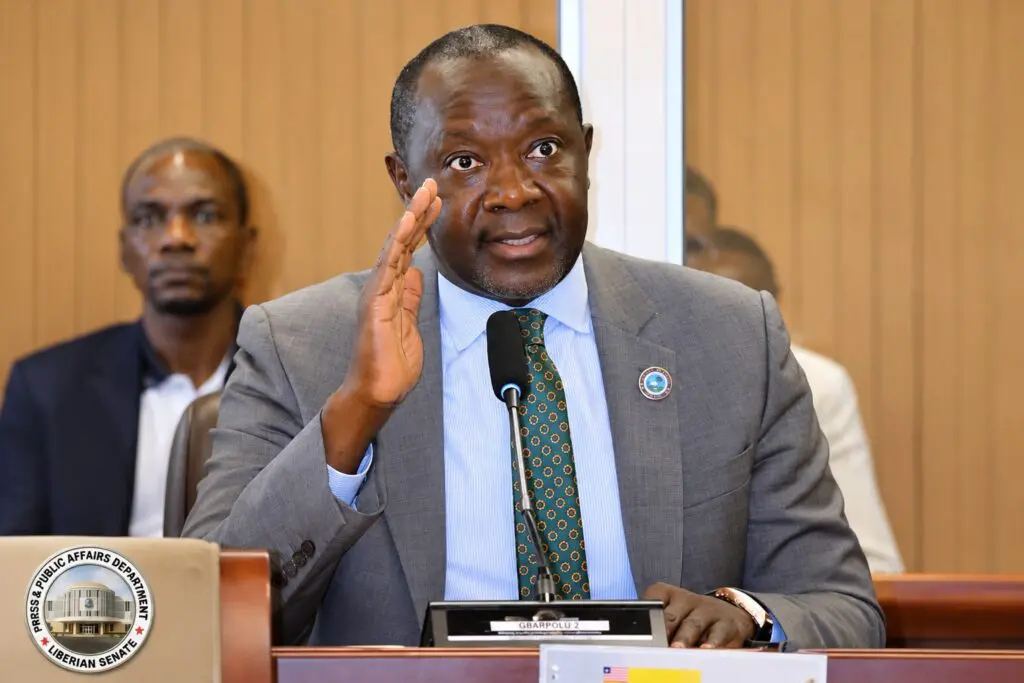
MONROVIA — Gbarpolu County Sen. Amara M. Konneh has warned that the Freeport of Monrovia, which he described as the gateway to Liberia’s economy, is becoming a major obstacle to commercial activities, accusing authorities of failing to address persistent cargo delays that are financially crippling small businesses, particularly women traders, ahead of the Christmas season.
Declaring the situation an “economic emergency,” Konneh said the country’s principal commercial port, rather than facilitating trade and economic growth, is increasingly placing pressure on importers whose merchandise remains stranded at regional ports or delayed in transit.
“The Freeport of Monrovia is the gateway to our economy. Right now, that gateway is rusting the other engine of the economy — the businesses, particularly the small businesses,” Konneh declared.
His criticism came Tuesday, Nov. 17, 2026, during a public hearing of the Liberian Senate involving officials of the National Port Authority (NPA), Liberia Revenue Authority (LRA), APM Terminals, MedTech Scientific and GTMS.
The hearing, the third convened by the Senate to examine the situation, brought into focus the financial difficulties confronting Liberian importers and the government’s efforts to address congestion, shipping delays and inadequate port infrastructure.
Konneh expressed frustration over what he considered the failure of institutions responsible for port operations and trade facilitation to take proactive measures before the crisis intensified.
“We’re here for the third time,” he said. “This, simply, is an economic emergency.”
“Let me be blunt here. Everybody sitting before plenary has not been a solution to the process because they didn’t take a fully active approach to address this emergency months ago as we approach Christmas,” the senator added.
He said the situation was particularly troubling because Liberia was approaching the Christmas season, traditionally one of the busiest periods for commercial activities.
According to Konneh, the greatest victims are not large corporations with substantial financial resources but ordinary Liberian traders, many of them women, who depend on imported goods to sustain their businesses and families.
He recalled a recent appearance before the Legislature by women traders who complained about the consequences of delays affecting merchandise purchased from China, Turkey and other international markets.
Konneh said many of the women depend on commercial bank loans and community savings groups, commonly known as susu clubs, to finance their businesses, sometimes borrowing as much as US$20,000 at high interest rates.
He explained that some traders use personal property as collateral and are required to begin repaying their loans after a 30-day grace period, even when their merchandise has not arrived.
“As we sit here, as the containers are on the boat or in the regional ports waiting to come into our port, they are paying interest. And if they don’t pay, the interest accumulates,” Konneh told the Senate.
The Gbarpolu County lawmaker said the economic consequences extend beyond Monrovia to commercial centers across Liberia, including Duala, Red Light, Kakata, Ganta, Robertsport, Zwedru and communities in the southeastern counties.
“We’re not talking about the big guys who have their own trains and ships to ship things out of here. We’re talking about these women in all these places who depend on this gateway of the economy so that they can fuel this growing economy we have,” he emphasized.
Konneh questioned why the institutions responsible for facilitating trade had not taken sufficient steps to prevent the situation from worsening.
“We want answers today. We want answers so that we can give relief to our people and keep this engine of the economy going, and not bust it,” he declared.
Responding to the concerns, LRA Commissioner-General Dorbor Jallah acknowledged operational difficulties affecting cargo clearance but rejected suggestions that government institutions had remained inactive.
Jallah disclosed that the LRA, NPA and APM Terminals were working toward introducing 24-hour port operations to accelerate cargo processing and reduce congestion.
He identified the closure of commercial banks during regular business hours as one of the major obstacles preventing importers from completing customs payments and clearing their goods.
“The challenge we’ve had, like we’ve already mentioned, is that banks close at 2. So if you were processing a document to clear your cargo and you didn’t finish until the bank closed, you would have had to wait until the following day,” Jallah explained.
He announced that the LRA was collaborating with the Central Bank of Liberia to introduce a payment switch before the end of 2026, while upgrading its customs system to integrate with commercial banks.
According to Jallah, the initiative would enable importers and customs brokers to complete transactions beyond normal banking hours, eliminating one of the constraints affecting cargo clearance.
“We are upgrading now to the latest version, which will allow for integration with the commercial banks and Central Bank,” he said.
Jallah further disclosed that a stakeholders’ meeting held Monday, Nov. 16, resulted in commitments to introduce continuous port operations, with government institutions, shipping lines, customs brokers and importers expected to cooperate.
“We are moving to a 24-hour port operation. We intend to do that, and hopefully this will help with the decongestion,” he told lawmakers.
The LRA commissioner-general also announced that a new destination inspection facility under construction would not become operational during the final quarter of 2026 as previously anticipated.
He attributed the delay to supply chain difficulties affecting equipment delivery and other project components, indicating that the facility was now expected to become operational during the first quarter of 2027.
“Due to those delays, we will not be able to open this site for destination inspection this quarter. We will do it next quarter,” Jallah disclosed.
He clarified that the Freeport currently lacks an operational container scanner, explaining that scanning equipment being manufactured in China would be installed after completion of the new inspection facility.
According to him, the technology would allow customs and security personnel to examine container contents without physically opening them, improving inspection efficiency and reducing processing delays.
Meanwhile, NPA Managing Director Sekou A. M. Dukuly attributed the congestion partly to growing commercial activities that have overwhelmed the Freeport’s existing infrastructure.
Using the analogy of a family outgrowing its four-bedroom house, Dukuly explained that the port requires expansion to accommodate increasing cargo volumes.
“Let me put it simply, our issue is, the growth already has overwhelmed our infrastructure,” Dukuly told senators.
He maintained that the government was pursuing major investments to address the infrastructure deficit, adding that approximately US$280 million in proposed port investments had been attracted and were under discussion through the relevant concession review process.
Dukuly also identified the absence of comprehensive development plans, technical surveys and feasibility studies as obstacles that previously discouraged potential investors.
“Whenever we went around the world and asked for investment, the first question was, ‘Do you have a master plan?’ No. But how do we make the investment decisions if you don’t have a master plan?” he questioned.
The NPA managing director argued that having such documentation would have accelerated investment negotiations and helped the country respond more effectively to rising demand.
He further referenced a management arrangement intended to improve the utilization of existing port facilities while longer-term investment discussions continue.
Dukuly also cited disruptions in global shipping and said the NPA was engaging shipping lines and other stakeholders to identify measures that could relieve importers.







Discussion about this post