


Published: June 12, 2026
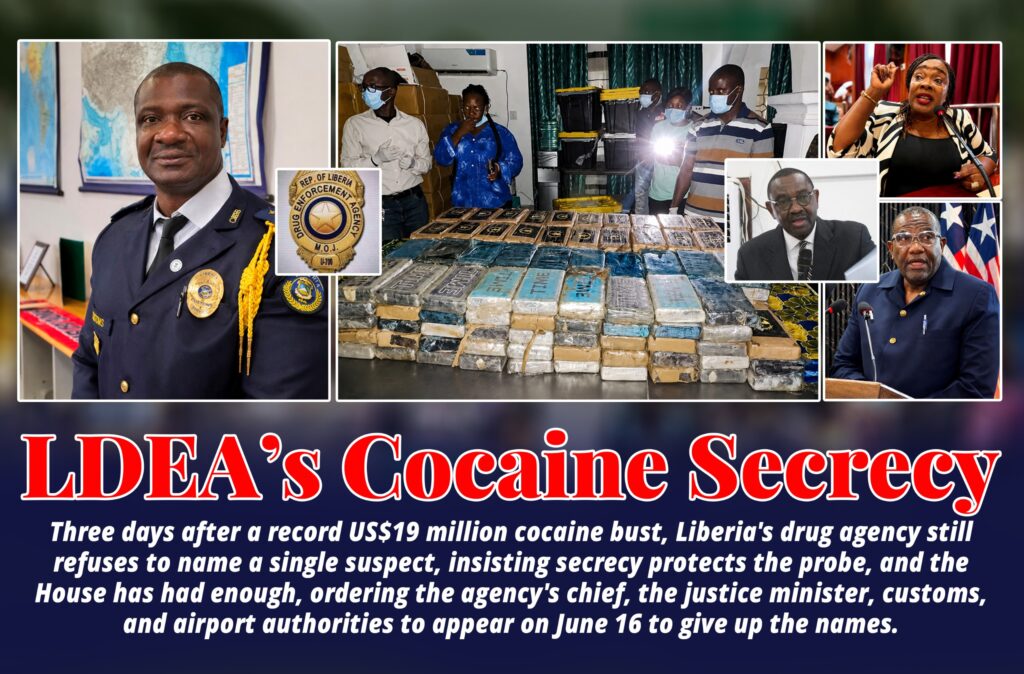
CAPITOL HILL, Monrovia — The House of Representatives has summoned Liberia’s top drug enforcement, justice, customs and aviation officials to explain why the identities of suspects in a US$19 million cocaine seizure at Roberts International Airport remain secret, after a lawmaker demanded those responsible be “named and shamed.”
By Gibson Gee and Blamo N. Toe
The Liberia Drug Enforcement Agency’s officer in charge, Justice Minister Cllr. Natu Oswald Tweh Sr., the Liberia Airport Authority and Customs officials are to appear before plenary on Tuesday, June 16, to answer for their handling of one of the largest narcotics interceptions in the country’s history.
Agents seized 198 compressed cocaine plates weighing 237.6 kilograms, concealed in six cargo boxes, at the RIA cargo terminal on Monday, June 8, as the consignment was being processed for an outbound shipment to Europe aboard Brussels Airlines, the LDEA has said. The agency put the street value at US$19,226,000, roughly 3.65 billion Liberian dollars.
The summons followed a communication from Bong County District 6 Rep. Moima Briggs Mensah, who accused security authorities of concealing critical information from the public and demanded that everyone tied to the bust be exposed.
“The Liberian people deserve to know who these people are,” Mensah told the House floor. “Mothers are crying every day because drugs are destroying our children, and we cannot continue to conceal the identities of those responsible.”
Mensah questioned why authorities have stayed silent on the suspects more than 72 hours after announcing the seizure, contrasting the case with earlier arrests in which names and photographs were released within hours. She recalled that when a woman was caught with drugs months ago, her picture and name circulated immediately.
“Today, we have a US$19 million drug case, and after more than 72 hours, the authorities are still saying they are investigating and cannot name the people involved,” she said. “That is deceptive to the Liberian people.”
The lawmaker, who said she visited the airport on Monday, told colleagues the drugs were already inside Liberia and were being prepared as cargo for shipment through Brussels rather than entering the country. She said the person arrested had provided information on others connected to the operation and on the drugs’ origin, yet investigators continued to cite an open probe.
“The LDEA cannot continue to conceal names from the Liberian people while claiming investigations are ongoing,” Mensah said. “If we have not done anything before, let us do this one. Let them come and tell us who these people are.”
Plenary subsequently voted to compel the agencies to appear.
The LDEA has defended its silence as temporary. Speaking Thursday at the Ministry of Information’s regular press briefing, LDEA Officer in Charge and Deputy Commissioner of Police Fitzgerald T.M. Biago confirmed that six people remain in the agency’s custody and said their identities were being withheld to protect the integrity and confidentiality of the investigation.
Biago cast the case as far more than a routine arrest, describing it as organized crime operating across borders, a network with contacts, surrogates and multiple moving parts that investigators must map before going public. He said the consignment had been destined for England aboard Brussels Airlines when joint security officers intercepted it at the cargo terminal on June 8, calling the interception one of the most significant in recent history and a product of the agency’s intelligence reforms and interagency cooperation.
“All we are asking is for time to put all our pieces of evidence together and make an informed determination,” Biago said, invoking the forensic maxim that every clue can leave a trace.
He pledged that the particulars of those in custody, along with other suspects linked to the bust, would be released to the public within a short period, insisting the LDEA remained committed to seeing everyone connected to the network identified, investigated and prosecuted. “This operation sends an unequivocal message that Liberia is not a transit point, a marketplace, nor a safe haven for drug traffickers,” he said.
The Liberia Airport Authority’s managing director credited the seizure to the coordination of the Airport Security Department, the LDEA and other stakeholders, describing the substance as a high-grade, solid-plated narcotic caught as it was being staged for Europe. “Business as usual will not be tolerated,” he said, calling the country’s gateways “secure, monitored and uncompromised.”
Officials have declined to disclose the detection methods used at the terminal, saying only that established mechanisms were in place and had worked.
The agency’s refusal to identify the suspects has fueled public debate, with many Liberians asking why names in earlier drug cases surfaced almost at once while those in the largest seizure on record stay hidden. The case has also renewed concern over Liberia’s exposure to transnational trafficking and sharpened calls for transparency from the institutions charged with fighting it.
Lawmakers are expected to press the officials for answers when they appear before plenary on June 16.





Discussion about this post