


Published: April 17, 2026
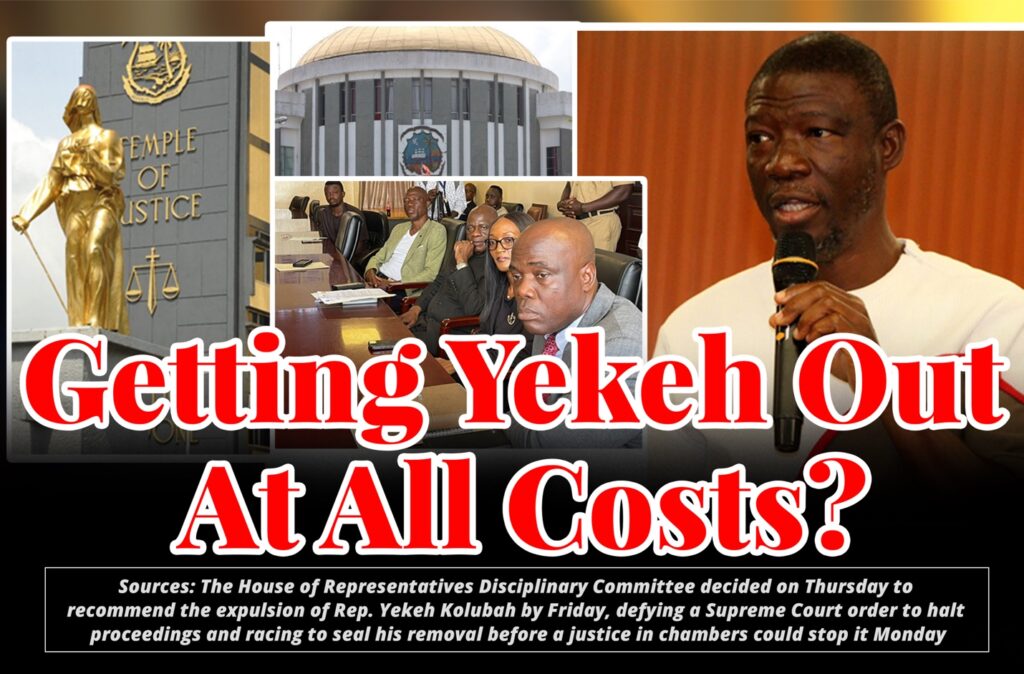
MONROVIA – The House of Representatives completed disciplinary proceedings against Montserrado County District 10 Rep. Yekeh Kolubah on Thursday and has now called plenary into session for Friday to ratify the committee’s findings, a move that would finalize the expulsion of the outspoken lawmaker just three days before House leadership is due to appear before the Supreme Court for a judicial conference that could nullify the entire process.
By Gibson Gee and Melvin Jackson
“Plenary will meet tomorrow,” a senior lawmaker, speaking on condition of anonymity, told this paper. “The committee has done its work. They will present the report and members will vote.”
If the vote proceeds on Friday as sources indicate, the House would have taken a landmark legislative disciplinary action in recent Liberian history in open defiance of a standing Supreme Court stay order.
The Supreme Court’s directive, signed by Clerk Cllr. Sam Mamulu and issued Wednesday in two separate communications bearing the court’s official seal, orders Speaker Richard Nagbe Koon, Deputy Speaker Thomas Fallah, the House Chief Clerk, the Sergeant-at-Arms and all individuals acting under their authority to halt all further proceedings and actions in the matter pending the outcome of a conference scheduled for April 20 at 2:30 p.m. before Associate Justice Yussif D. Kaba. That conference is now two days away if the House votes Friday.
A Process Built to Outrun the Court
Plenary mandated the Committee on Rules, Order and Administration on April 13 to investigate Kolubah and report back within the special session, which President Joseph Nyuma Boakai had called to run through April 23. The committee began its work on Monday. By Thursday, sources say, it had concluded. Plenary is now set to receive that report on Friday, giving the House a completed expulsion on the record before Justice Kaba ever convenes.
The petition before the court takes the form of a writ of prohibition — a court order directing a lower body to cease actions exceeding its legal jurisdiction. The respondents named are the House itself, Speaker Koon, Deputy Speaker Fallah, the Chief Clerk, the Sergeant-at-Arms and all individuals acting under their authority.
The House’s own press director, Robert Haynes, had stated just days earlier that “only the full Plenary can make such decisions” on expulsion, and that House leadership lacks the authority to expel any member acting outside of a constitutionally mandated plenary session.
The Due Process Rupture That Started It All
The chain of events leading to this constitutional precipice began in earnest Wednesday morning, when a hearing before the Rules Committee descended into controversy.
The committee denied Kolubah’s legal team the right to actively participate in the hearing, restricting his attorneys to an advisory role and barring them from speaking unless expressly recognized. Kolubah had appeared with a high-profile legal team that included former Associate Justice Cllr. Kabineh Ja’neh, Cllr. Moriah Yeakula and Cllr. Jonathan Massaquoi. The defense had submitted a formal challenge the day prior, arguing the citation issued to Kolubah was deficient.
“We have reviewed the citation for hearing served on him and find it lacking sufficient information to properly represent him,” the lawyers wrote, demanding access to all statements, audio, video, or written, attributed to Kolubah, the government’s official position referenced in the citation, and proof that his remarks were “celebrated and disseminated” by Guinean authorities.
The committee refused. The legal team walked out. Kolubah followed, telling the panel: “Since you didn’t give my lawyers the chance and I’m being left alone, I will walk out.” After the hearing, he was characteristically dismissive: “Capitol Building is not my bedroom so they can do what they want to do.”
The committee, by its own account, proceeded without him, relying on documentary submissions and the formal complaint. By Thursday, sources say, it had completed its work. By Friday, if the plan holds, plenary will have voted.
The 2021 Precedent — and Why It Was Ignored
The case marks the second time in recent years that Liberia’s highest court has stepped in on a disciplinary matter involving Kolubah. In 2021, a justice in chambers found that the House had denied the lawmaker due process in a suspension proceeding, compelling the Legislature to lift the ban, which it did within minutes of being told that a writ of prohibition would otherwise be issued.
Nimba County District 7 Rep. Musa Hassan Bility, who filed a formal internal complaint about the committee’s conduct, has argued that when a body exercises quasi-judicial authority, the accused must be given a full and fair opportunity to be heard, including through legal representation, and that the committee proceeded without clearly stating which provision of the Constitution, House rules or statutory law Kolubah allegedly violated. “This matter goes beyond one individual,” Bility wrote to Speaker Koon and members of the 55th Legislature. “It concerns the credibility of this House and the democratic values we claim to defend.”
The Political Undercurrent
Since breaking ranks with the ruling bloc, Kolubah has emerged as a fierce critic of the Boakai administration and is now aligned with the opposition Congress for Democratic Change. Critics claim the push to expel him may be politically motivated, aimed at silencing his anti-government stance rather than solely addressing his comments on the Liberia-Guinea border dispute.
Alternative National Congress Political Leader Alexander B. Cummings framed that argument plainly, stating: “Kolubah’s radical style is nothing new. During the CDC-led administration, Yekeh was tolerated as a necessary voice in opposition to its ills. Today, under the Unity Party-led government, his remarks are suddenly grounds for expulsion. That is the height of hypocrisy.”
Human rights lawyer and former Solicitor General Tiawan Saye Gongloe went further, arguing the move reflects a fundamental misunderstanding of Liberia’s legal framework. “The Legislature is not a criminal court and cannot determine guilt or innocence for such an offense,” Gongloe said, warning that using expulsion as a substitute for criminal prosecution would blur the lines between the legislative and judicial branches and undermine the doctrine of separation of powers.
Bong County District 3 Rep. Marvin Cole has openly opposed any attempt to expel Kolubah, warning against what he described as a rush to judgment and arguing that the Legislature should instead invite key government officials, including ministers of Justice, Foreign Affairs, Internal Affairs and National Defense, to provide clarity on the border crisis.
The disciplinary effort has reportedly gained traction within the 73-member House, with at least 36 lawmakers backing the push, this paper gathered. Expulsion, however, requires a two-thirds majority of 49 votes, a threshold designed to prevent arbitrary or politically motivated removals.
What the Court Can Still Do
A completed plenary vote on Friday would not automatically insulate the House from judicial consequences. If Justice Kaba finds Monday that the House violated the stay order, exceeded its constitutional authority or denied Kolubah due process, the court could issue the writ of prohibition and declare any action taken in defiance of the stay order void ab initio — legally as if it never occurred. Such a ruling would potentially require Kolubah’s reinstatement and would expose House leadership to contempt proceedings.
But that remedy, even if forthcoming, would arrive after the fact, after a vote, after a public expulsion, and after the political and reputational damage to Kolubah has already been inflicted. In that sense, the House may be calculating that the political objective will have been achieved regardless of what any court subsequently orders. Kolubah has been expelled before, in the court of legislative opinion, more than once. Each time, he has returned.






Discussion about this post