


Published: July 15, 2026
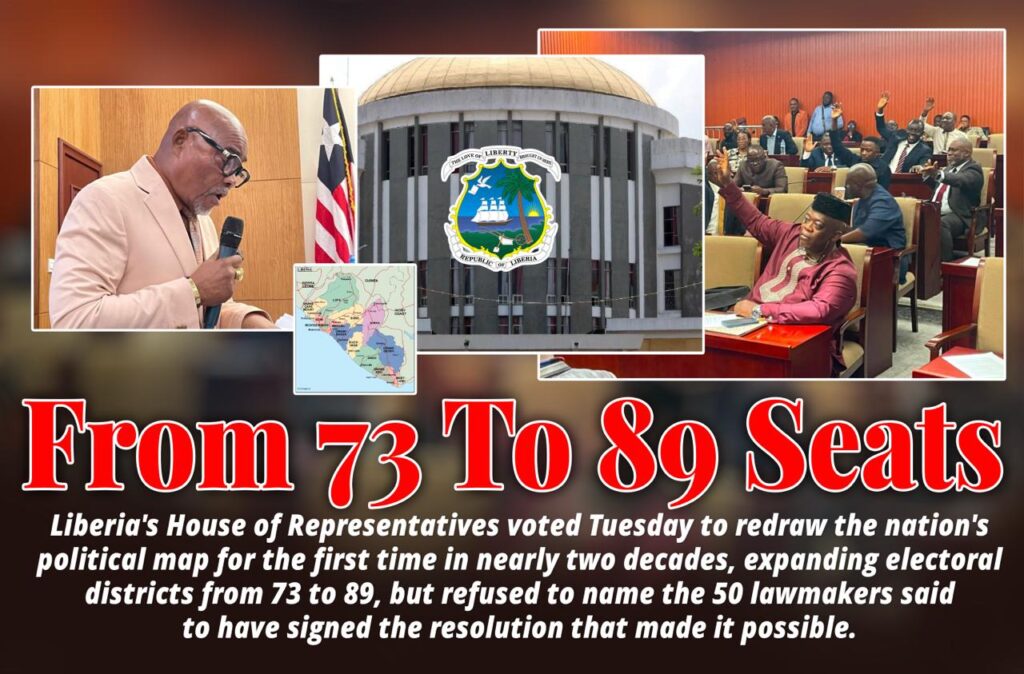
MONROVIA — Liberia’s political map moved a step closer to its biggest redrawing in more than a decade Tuesday when the House of Representatives approved a controversial resolution to expand electoral constituencies from 73 to 89, sending the measure to the Senate over unanswered questions about who actually signed it.
The resolution seeks to establish a new constitutional population standard under Articles 39, 80(d) and 80(e) of the 1986 Constitution, enabling the National Elections Commission to redraw constituency boundaries using the certified results of the 2022 National Population and Housing Census. It would be the first major reapportionment of legislative districts since the 2008 census.
If enacted, the proposal would create 16 additional electoral districts while keeping Liberia below the constitutional limit of 100 constituencies.
But the measure did not pass without controversy. Before the House voted, Grand Gedeh County District No. 3 Rep. Jacob C. Debee II questioned the committee’s assertion that 50 lawmakers had signed the resolution and demanded that their identities be disclosed before the House proceeded.
“Mr. Speaker, we want to know the names of our colleagues who signed the resolution,” Debee told plenary.
Despite his objection, the House proceeded with debate. Margibi County District No. 2 Rep. Ivar K. Jones subsequently moved that the House adopt the report of the Committee on Elections and Inauguration and approve the resolution for transmission to the Senate. The motion was seconded and carried by plenary.
Presenting the report, the committee argued that the proposal is not a political initiative but a constitutional obligation triggered by the certification of the 2022 census.
“This report rests on three constitutional commands and one historical fact. The commands are Articles 39, 80(d), and 80(e). The historical fact is that the public record identifies only one census-based reapportionment of constituencies under the current constitutional order that is comprehensively documented. The present submission addresses that constitutional discontinuity and places before the House the duty now arising from the certified 2022 census,” the committee said.
According to the committee, Article 39 requires the Legislature to conduct a national census every 10 years, while Article 80(d) empowers lawmakers to prescribe a constituency population standard based on population growth revealed by a national census. Article 80(e) requires the NEC to reapportion constituencies immediately following a national census and before the next election.
The committee said Liberia’s population increased from 3,476,608 in 2008 to 5,250,187 in 2022, a rise of about 51 percent, necessitating a revisit to the existing electoral map.
Under the committee’s proposed population-tier formula, Montserrado County would record the largest increase, rising from 17 to 20 electoral districts. Nimba County would increase from 9 to 11 districts, Bong County from 7 to 9, and Lofa County from 5 to 7. Margibi and Grand Bassa counties would each gain one district, increasing from five to six, while Grand Gedeh, Grand Cape Mount, Maryland, Sinoe, and Bomi would each increase from three to four. River Gee, Gbarpolu, Grand Kru and River Cess counties would retain their current representation.
The committee argued that the model addresses longstanding disparities in representation, under which lawmakers from densely populated counties represent significantly more citizens than colleagues from counties with smaller populations.
“Reapportionment is not a political accommodation, not a legislative convenience for officeholders, and not a discretionary enlargement of the House, but the constitutional method by which citizens counted in the national census are given lawful representation in the House of Representatives,” the committee said.
The committee further insisted that once the Legislature establishes the constitutional standard, no political actor should interfere with the technical work of determining county entitlements or drawing electoral boundaries.
“The object of this resolution is to prescribe the tier standard, bind the data inputs, require the Commission to apply the standard without discretion, outlaw gerrymandering, require public inspection, impose mandatory reporting, and prevent any political actor from altering the mathematical or geospatial result once the standard is enacted,” the report states.
The report provides that the NEC, not lawmakers, will determine each county’s constituency entitlement by applying the prescribed population formula to the certified census results before delineating constituency boundaries entirely within county limits.
Although supporters described the proposal as a constitutional necessity, Tuesday’s debate underscored the political sensitivity surrounding any attempt to redraw Liberia’s electoral map. The committee informed plenary that 50 lawmakers had signed the resolution, indicating majority support. Debee’s challenge, however, reflected concerns among some members over transparency in the legislative process before such a far-reaching proposal could be adopted.
If the Senate concurs, Liberia could witness its most significant electoral reapportionment in more than a decade. Supporters argue the proposal is essential to correcting population imbalances by ensuring that representation in the House more closely reflects demographic realities revealed by the 2022 census. They contend that rapidly growing counties have remained underrepresented for years, leaving some lawmakers to represent significantly larger populations than others.
Critics, however, caution that expanding the Legislature could increase government spending through additional salaries, benefits, staff and operational costs at a time when Liberia continues to face significant fiscal challenges. Others have called for greater public scrutiny of the formula used to allocate new constituencies before the proposal becomes law.
The Senate’s decision will now determine whether the proposed constitutional framework advances to implementation, potentially reshaping Liberia’s electoral landscape ahead of future elections.





Discussion about this post