


Published: October 30, 2026
MONROVIA — Cocoa grown on land illegally cleared within Liberia’s Grebo-Krahn National Park is being carried across the Cavally River into Ivory Coast’s official supply chain, where it becomes indistinguishable from legal beans. That leaves Liberia’s cocoa trade exposed months before the European Union begins enforcing a ban on cocoa linked to deforestation, according to a new report by three conservation groups.
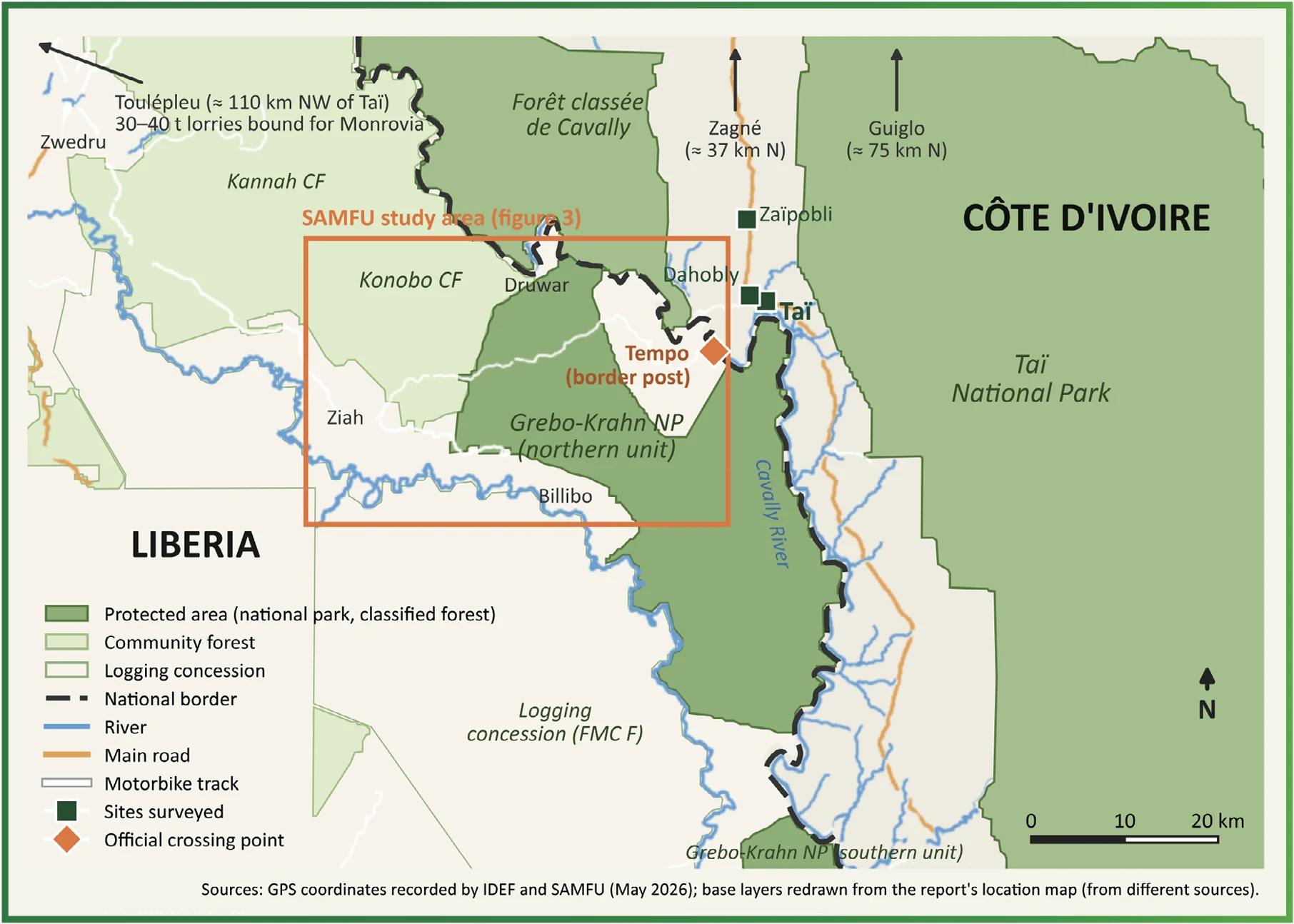
By Lennart Dodoo
Field researchers found 26 cocoa farms near or within the park in Grand Gedeh County, 11 inside its mapped boundary, located between 160 meters and 1.6 kilometers from the edge. The farms were at every stage, from fresh clearing to full production, which the authors said indicates “an active frontier of cocoa farm expansion” rather than old encroachment.
The report, “No, problem… There is plenty of forest!”, was published in October by Liberia’s Save My Future Foundation, the Ivorian group Initiatives pour le Développement communautaire et la conservation de la Forêt, and the European forest campaign group Fern. It says an organized cross-border network recruits young Burkinabè men in Ivory Coast, settles them on Liberian forest land, and sells the resulting cocoa back into Ivory Coast.
“The evidence suggests that labour recruitment, land allocation, farm establishment and cocoa marketing form a single cross-border system,” the report said.
The authors said the encroachment on the Liberian side is still in its early stages “and can be stopped.”
The European Union, which imports most of the world’s cocoa, will begin enforcing its Deforestation Regulation in 2027, banning cocoa linked to post-2020 deforestation or produced in violation of the producing country’s laws. The United Kingdom plans similar legislation. Clearing and farming in a Liberian protected area are illegal under both the 2016 wildlife and protected areas law and the 2006 National Forest Reform Law. The researchers could not trace cocoa to specific exporters, but they warned that once it enters established channels, noncompliant cocoa “will be impossible to distinguish from legally sourced cocoa.”
How the system works
The report describes two waves of migrants. The first consists of experienced farmers whose plantations in Ivory Coast are failing because decades of cocoa-driven deforestation have depleted the soil. “I have a cocoa plantation that no longer produces as it used to because the soil has become depleted. I’ve heard there’s a new forest in Liberia. I’m going to have a look,” one migrant told researchers.
The second, larger group is young men, perhaps 16 to 28 years old, brought from Burkina Faso by what the report calls “agricultural entrepreneurs,” or sponsors. Some have never worked on a cocoa farm.
A canoe owner on the Ivorian bank of the Cavally said crossings follow a schedule. “As for the workers who come from Côte d’Ivoire to work on the cocoa plantations in Liberia, there are specific days for their crossings: Fridays and Sundays,” he said. He said he takes at least 50 people across each crossing day, all young men, and estimated nearly 1,000 so far this year.
Sponsors gain access to forest through Liberian landowning families, who might allocate 10 hectares per adult member, or 100 to 300 hectares for a large family, under verbal agreements, the report said. Interviewees described a split of 60% of the crop to the sponsor and 40% to the landowner, with the sponsor supplying seedlings, inputs and the laborers’ food, lodging, transport and health care. Sponsors report in turn to a rarely seen “big big man” investor, described as typically French or a well-established Ivorian or Burkinabè.
The farms use fast-maturing sun-grown varieties brought by the migrants. The report said the land is cleared by slash-and-burn and heavy concentrations of herbicide to kill trees.
Unclear park boundaries make encroachment easier. “We do not indicate the demarcation line, so the Burkinabè go beyond, into the bush,” a farmer in Deliyee told researchers. Some residents openly resent the Forestry Development Authority’s boundary. “If we had the power, we would go beyond the Forestry Development Authority demarcation line,” a community chairperson said.
Many residents do not see a problem. “No problem, there’s plenty of forest,” an elder in Garleo said, adding that animals could migrate to River Gee and Maryland counties.
The report notes that the Liberia Immigration Service recorded about 55,000 Burkinabè in the country by August 2025, and that government assessments in 2026 estimated the number in Grand Gedeh and River Gee counties at more than 140,000. The second figure is drawn from a June 2026 report by The Liberian Investigator.
Falling prices, more clearing
A sharp fall in cocoa prices has not slowed the expansion. In five of the 10 Liberian towns surveyed, interviewees said they were planting more cocoa to make up for lower earnings per bag.
“Even if the price is low, we will keep farming because there is nothing else we can do,” one interviewee said.
Liberia has no cocoa price control. Farm owners cited prices of L$250 to L$350 a kilogram in May and said Ivorian buyers paid L$500. The authors noted that figure would be 35% higher than the highest farm-gate price Ivory Coast has ever set. They said border sales are driven as much by poor roads, shared language, the CFA franc and the fact that Ivorian buyers come to the farmers.
“Because of the road, we cannot go into the town so we just sell our cocoa to Ivory Coast and even buy other things from there,” the town chief of Tempo said.
Researchers identified six informal crossing points into Ivory Coast, in addition to the official crossing at Tempo. Thirty of the 117 people interviewed said cocoa regularly leaves Liberia via unofficial routes, mostly at night. In Ivory Coast, middlemen buy at the border and resell to cooperative agents or licensed buyers, the report said. That is how Liberian cocoa enters the official supply chain bound for the ports of San-Pédro and Abidjan.
The cocoa that remains in Liberia largely moves to Monrovia through a small number of middlemen. Farmers said one Ziah-based trader is often the only buyer able to purchase large quantities. That trader said he sells to Granex, a Monrovia-based exporter. Granex states on its website that it operates “rigorous traceability and transparency” and has set goals to exclude cocoa from protected areas. The report cites a 2025 Global Witness investigation, which found that Granex said it had mapped “about 75–80%” of its supplier farms.
Wildlife and gold
Of the 117 people interviewed, 50 reported seeing fewer animals than in the past. Twenty-five of 30 hunters said their catches had fallen compared with five years ago.
“Because of the expansion of cocoa in forest areas, we do not see any wildlife like before in the forest, even we hunters are finding it difficult to catch bushmeat,” a hunter in Deliyee said.
Grebo-Krahn, gazetted in 2017, is home to more than 300 animal species, including western chimpanzees, giant pangolins, and pygmy hippopotamuses. Along with Ivory Coast’s Taï National Park, a UNESCO World Heritage Site, it forms one of the largest remaining blocks of the Upper Guinean Forest.
The researchers found no recent cocoa encroachment inside Taï, which is patrolled. They said illegal gold mining may pose a greater threat on both sides of the border. Teams saw mining on the Dugbeh River near the park’s southern boundary and found machinery indicating growing mechanization.
Recommendations
The groups urged Liberia to strengthen joint border monitoring with Ivory Coast, mark and publicize protected-area boundaries more clearly, and accelerate customary land reforms. They called on the Forestry Development Authority to prioritize enforcement in the expansion hotspots around the park and to use satellite monitoring. They also urged Ivory Coast’s Coffee-Cocoa Council to collaborate with the Liberia Agricultural Commodity Regulatory Authority on traceability.
They warned that enforcement alone will fail without roads, livelihoods and land governance. “All the fish ponds are gone because they did not teach us how to maintain them,” a town chief in Tempo said about past aid projects.




Discussion about this post