


Published: June 12, 2026
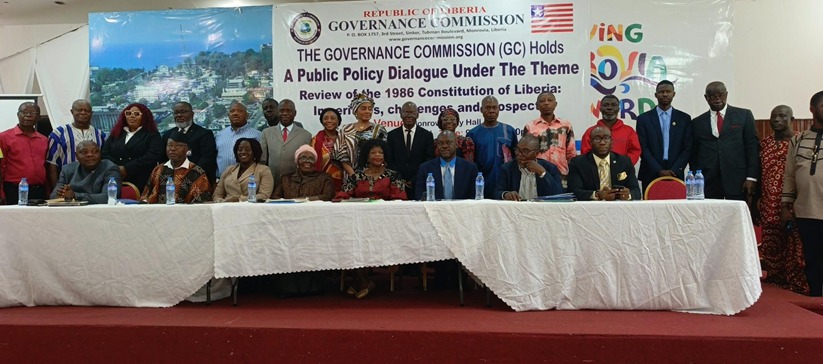
MONROVIA — The Governance Commission and the Law Reform Commission have opened a national dialogue on the future of Liberia’s 1986 Constitution, pressing the country’s legal and political establishment to decide whether to amend the aging charter or rewrite it for a republic reshaped by war, decentralization and the digital age.
Held at Monrovia City Hall under the theme “Review of the 1986 Constitution of Liberia: Imperatives, Challenges and Prospects,” the two-day forum drew policymakers, legal experts, civil society leaders, development partners, traditional authorities, youth representatives and academics, with organizers casting it as a bid to build national consensus on reforms to strengthen democratic governance, accountability, decentralization, inclusion and sustainable development.
Opening the gathering, Governance Commission Acting Chairman Alaric K. Tokpa called the moment a defining one in Liberia’s democratic evolution and urged participants to judge whether the Constitution still reflects the country’s needs. “We gather not merely as representatives of institutions or sectors of society, but as custodians of Liberia’s democratic future,” he said, describing the forum as a chance to examine constitutional ambiguities, governance failures and lessons from earlier review efforts.
While crediting the 1986 Constitution with restoring democratic rule after military government, Tokpa argued that constitutions must evolve with society. He noted that since the charter took effect, Liberia has endured civil conflict, navigated reconstruction, pursued reconciliation and embraced decentralization, and that many of its governance problems are rooted in unresolved constitutional questions over representation, accountability, local governance and the distribution of power.
Tokpa pointed to the review led by former Chief Justice Cllr. Gloria Musu-Scott under former President Ellen Johnson Sirleaf, which gathered views across all 73 electoral districts and among Liberians abroad and produced recommendations on citizenship, tenure of officials, decentralization, land rights, judicial reform, gender equity and institutional accountability. He cautioned against politicizing the current effort. “Constitutional review is not an exercise in political convenience,” he said. “The objective should not be to create winners and losers.”
Law Reform Commission Chairman Cllr. Bornor M. Varmah said review had become necessary because governance systems must adapt to changing realities, and he framed the central choice before stakeholders as one between a targeted revision and a full overhaul. “A restrictive review may be more manageable and less contentious, while a holistic review may provide an opportunity for deeper institutional reflection and long-term constitutional modernization,” he said, listing presidential and legislative tenure, decentralization, dual citizenship, electoral reform, judicial independence, gender equality, youth representation and natural resource governance among the recurring concerns.
Representing House Speaker Richard Nagbe Koon, legal consultant Cllr. James Verdier argued that reform is no longer a question of whether but how. “A constitution that cannot adapt will inevitably fracture under the weight of history,” he said. Verdier set out five priorities, amendment procedures, citizenship and dual nationality, participation and inclusion, decentralization, and constitutional ambiguities, and pressed the case for dual citizenship. “We are a global people,” he said. “Liberians abroad remit, invest, and return. We can protect sovereignty while embracing dual citizenship.” He also backed stronger protections for women, youth and persons with disabilities and the election of county superintendents with greater local control over resources, saying corruption recedes when power moves closer to citizens.
Speaking for the United Nations Development Programme, Resident Representative Aliou Dia called the process timely and warned that a modern constitution must address digital rights, artificial intelligence and cybersecurity, concerns absent when the document was drafted four decades ago. “In 1986, nobody was talking about digital rights, AI, or cybersecurity,” he said, “but these are issues that will define the future.” Citing a line attributed to former U.S. President Thomas Jefferson that laws must keep pace with the progress of the human mind, Dia urged sweeping public consultation and pledged the UNDP’s technical and financial support. “The Constitution is not for the government,” he said. “The Constitution belongs to the people.”






Discussion about this post