


Published: June 5, 2026
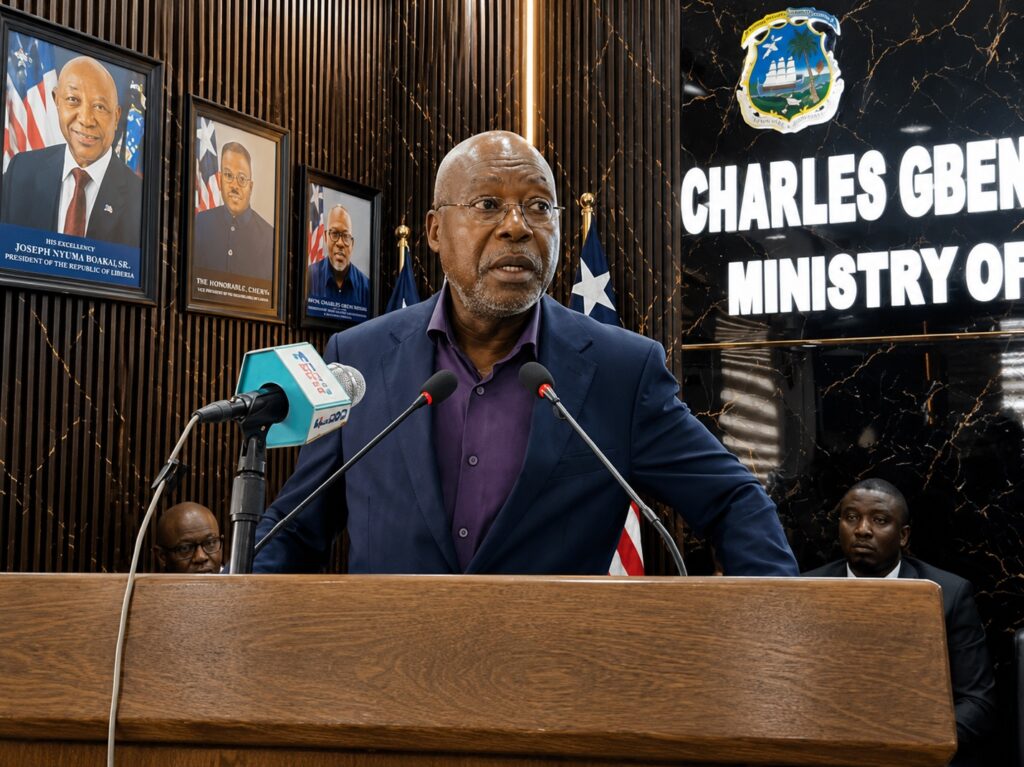
MONROVIA — The Governance Commission, in collaboration with the Law Reform Commission, has announced a two-day national policy dialogue aimed at revitalizing public engagement in the long-delayed review of Liberia’s 1986 Constitution.
The discussions are expected to focus on constitutional reforms, legal ambiguities, governance challenges and the recommendations contained in the 2015 Constitution Review Committee report.
Speaking Thursday at the Ministry of Information’s regular press briefing, Governance Commission Acting Chairman Alaric K. Tokpa stated that the dialogue will be held at Monrovia City Hall from June 10 to 11 under the theme “Review of the 1986 Constitution of Liberia: Imperatives, Challenges, and Prospects.”
Tokpa stated that the forum will bring together policymakers, legal experts, civil society members, and citizens to consider the need for constitutional reform and explore ways to strengthen governance and national development. The event will include presentations, panel discussions, group deliberations, and interactive sessions aimed at promoting critical reflection on constitutional issues.
Citing Section 4.1.10 of the act establishing the Governance Commission, Tokpa said the institution is empowered to propose legislation through the president and to recommend constitutional amendments aimed at promoting good governance.
“This includes revisiting the ideals, mission, and Constitution of Liberia,” he said, stressing that constitutions are not beyond scrutiny.
“No constitution is sacrosanct, holy, or untouchable when it comes to advancing the interests of a country and its people. Constitutions are made by people, and they can be criticized, questioned, or changed,” he said.
Tokpa explained the amendment process under Article 91, pointing out that amendments can be proposed either by a two-thirds majority of both houses of the Legislature or through a petition signed by at least 10,000 citizens, with approval then required from two-thirds of the Legislature. Any approved amendment must subsequently be ratified by a two-thirds majority of voters in a referendum conducted by the National Elections Commission.
He also referenced Article 92, which requires that proposed amendments be accompanied by explanatory statements, published in the Official Gazette and widely communicated to the public. Where multiple amendments are proposed, he said, each must be presented separately for voting in a referendum.
Providing historical context, Tokpa recalled that the Constitution Review Committee, chaired by Cllr. Gloria Musu Scott, was established in 2013 and submitted its final report to then-President Ellen Johnson Sirleaf in August 2015. He said the committee consulted all 73 electoral districts and gathered 56,729 citizen submissions, with strong advocacy throughout for women’s participation and girls’ education.
Tokpa also cited Article 97, which shields actions taken by the People’s Redemption Council following the April 12, 1980, coup from legal challenge in any court or tribunal.
The dialogue is expected to further advance national conversations on constitutional governance and potential reforms to address Liberia’s contemporary challenges.






Discussion about this post