


Published: June 22, 2026
From a press box in Monrovia to a dream of the Sky Sports studio, Liberia’s most visible female sports journalist is rewriting who belongs on the touchline. And she is not asking permission.
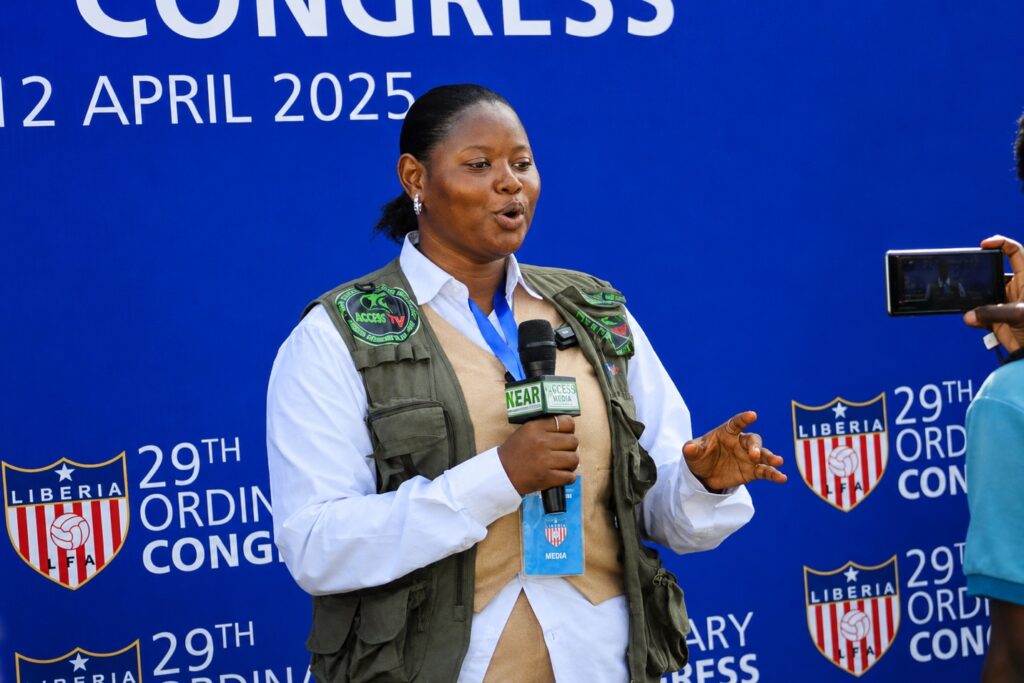
“I possess no magic or no extra talent. It’s just me loving the game and understanding the game and interpreting it into stories for my audience.”
On any given weekend, the press box at a Liberian football ground fills with men. Notebooks, microphones, the easy familiarity of people who have worked the same beats for years. And then there is Fatumata J. Barry, often the only woman in the room, the one some of the others did not expect, the one who long ago learned to expect the stares.
It is a scene that repeats itself far beyond Monrovia. From London to New York, from Nairobi to Lagos, women who cover sport still walk into rooms built for men and find themselves explaining why they belong. Barry knows she is part of that wider story. She also intends to finish it on her own terms.
For many, a football match is a fleeting 90 minutes of excitement, a blur of goals, cheers and final whistles. For Barry, those 90 minutes are the foundation of a hard-won career, a daily contest for respect and a mission to redefine the sidelines for women in Liberia. Today she stands as the most recognizable female sports journalist in a country where women in the field remain a rarity, having turned a lifelong, stubborn love for football into a profession and claimed a seat in a landscape where women are still heavily outnumbered.
A forbidden love
Barry’s love for the game began in 2007, when she was 7 years old. Back then it was a forbidden pleasure. She hid from her mother just to catch a glimpse of a match. Her mother eventually came around, and the secret passion grew into a calling.
The path was not obvious. In senior high she had imagined herself a banker until economics changed her mind. What remained was a clearer sense of her own gifts.
“I’m good with my voice, I’m good with my mind and I’m good with my opinions,” she recalls deciding. Journalism was the answer, and she was specific from the start. She did not simply want to report. She wanted to report on sport.
At the time, she could name only one Liberian woman who had done the job before her, the former sports journalist Martina Brooks. Barry did not read that absence as a closed door. She read it as a space waiting to be occupied.
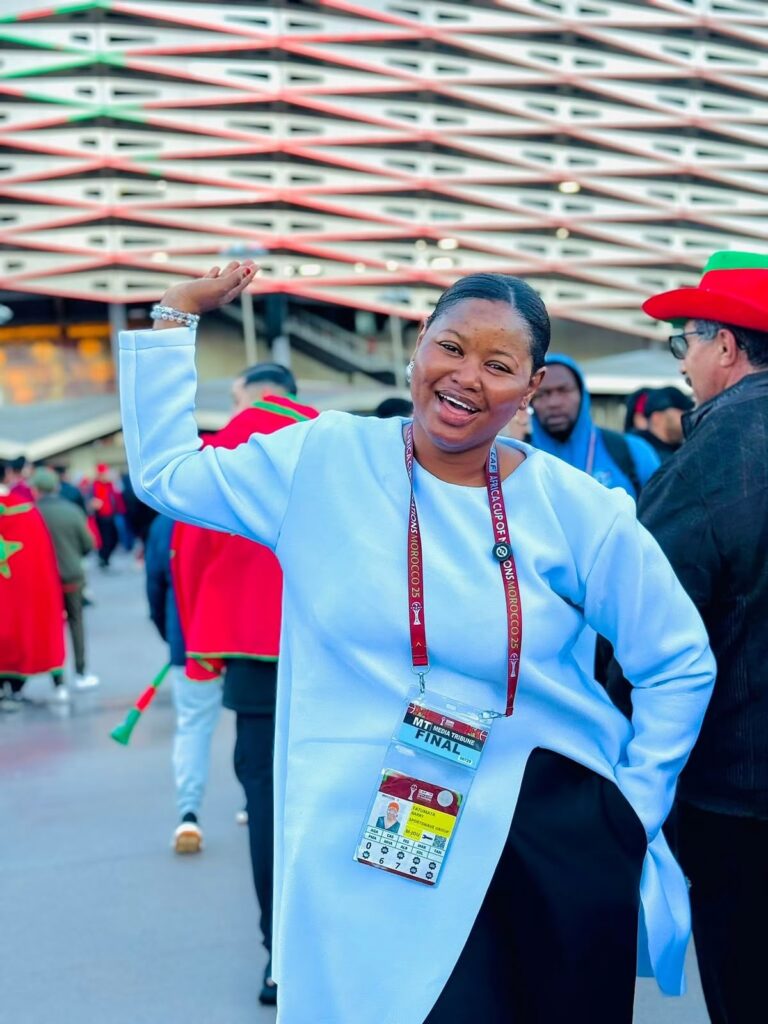
Since 2021 she has worked at Prime FM and Kear FM before moving into full-time freelancing, covering the Liberia First and Second Division Leagues, the Women’s Upper League, qualification tournaments, the FA Cup and international competitions across Africa, including the Africa Cup of Nations.
Learning the craft the hard way
The journey has been anything but smooth. Early on, Barry held a misconception common to outsiders, that sports journalism was mostly about watching games on television or social media and writing headlines. The profession demanded far more.
“One of the biggest challenges I faced was leaving my comfort zone,” she explains. She is, by her own description, a person who guards her space. She assumed the work could be done at a distance and discovered instead that it required her on the field, at grassroots trainings, across every dimension of the sport rather than the 90 minutes alone.
It took a push to break the habit. One of her former bosses, the late Molly Trojan Kiazulu, told her plainly that talent was not enough. “Look, you have a great talent, but you have to explore it,” he told her. “You have to be able to go out there.” So she surrendered her weekends, trading laundry and rest for the touchline, and watched her understanding widen. Beyond the scoreline she found the people who give the sport its meaning, the actors, the coaches, the character development of the players.
Working twice as hard
Some hurdles cannot be outworked, only endured. Barry’s presence in the press box draws a scrutiny her male colleagues never face.
“I have to work twice to earn the same respect as my male counterparts,” she says. In a setting where many assume a woman cannot succeed without surrendering something, her respect, her professionalism or her dignity, she meets constant skepticism. Build a brand, approach sponsors who fit your work, and the accusation follows that you have been bankrolled by powerful men, an accusation, she notes, that men in the field never have to answer.
The cost of that double standard is personal. After four years in the profession, her first award nomination was for emerging sports journalist. The category stung. “It broke me because I felt like I wasn’t emerging,” she says. She felt she had already paid her dues, already done the work her male peers were being recognized for. She was advised to accept it and set pride aside. Instead she set herself a longer clock. She gave herself five years to reach certain goals, met them, and gave herself five more.
The skepticism is not only about gender. It is layered with assumptions about tribe and faith. “I’ve been profiled by tribalism, maybe by religion,” she says. “Some people would tell me, ‘I’ve never imagined a Muslim woman doing this.’ And I’m like, ‘You have not been looking because there are many female Muslim sports journalists around the world. You have just not been looking in the right direction.'”
The questions can be cruder still. “You, what are you doing here?” she has been asked in the stands. “All your friends are in the house cooking. All your friends are taking care of children. Why are you here?”
The armor
When people doubt her or try to intimidate her, Barry does not shrink. She has built what she calls an armor.
“I’m the type that will retaliate. I’m the type that will stand up for myself,” she says. The lesson she passes to the young women coming after her is sharp and unsentimental. “When the men tell you to be humble, they don’t want you to be humble. They want you to be controlled. Do not for any reason allow yourself to be controlled.”
She has watched the same stereotype follow women all the way to the top of the global game. Even celebrated pundits, she notes, are dismissed as faces and voices fed every line through an earpiece, as though the knowledge were never their own. She refuses the premise. Standing your ground, she has found, is the only way to navigate a room that assumes you do not deserve to be in it.
A global gallery of proof
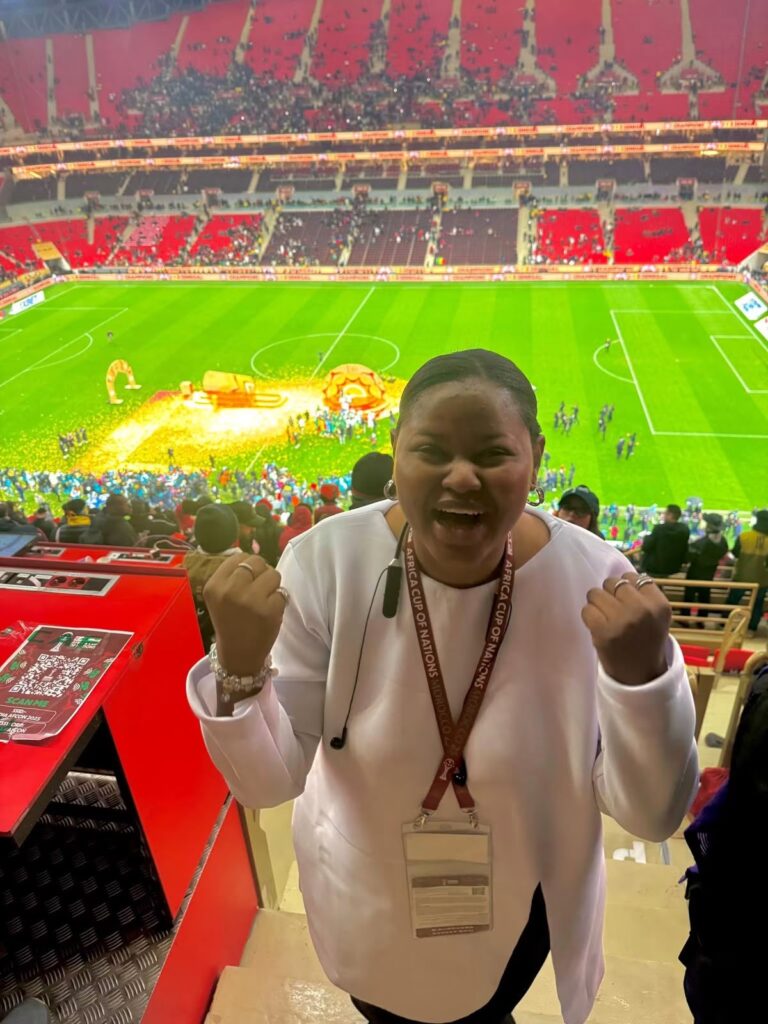
If Liberia offered few role models, the wider world supplied them. Barry grew up studying women who run the biggest desks in sport, and they convinced her the ceiling she was told about did not exist.
Chief among them is the English broadcaster Kate Scott, Barry’s self-described idol, who has anchored CBS Sports’ UEFA Champions League coverage since 2020 alongside Thierry Henry, Jamie Carragher and Micah Richards, and who has hosted football across the United Kingdom, Spain, France, Germany and the United States, often switching between four languages on air. To a young woman in Monrovia, Scott was living proof that the punditry chair at the highest level can belong to a woman, and that it can be earned anywhere.
She drew the same lesson from other women working the international stage, among them the broadcaster she names as Carol Tshabalala. Watching them, Barry says, settled the question for good. There was, indeed, a place for women at the summit of the craft.
That conviction now points at her own ambition. Her dream is to sit on a panel for one of the world’s biggest sports networks, with Sky Sports the name she returns to most often. She knows how distant it can sound. “Is this a dream that is achievable?” she asks herself, then answers by working toward it. “The goal is to be a pundit on one of the biggest sports televisions in the world.”
The people in her corner
Barry credits her endurance first to her family and then to a handful of people in the profession who refused to let her quit. Foremost is her friend and “big brother” Anthony Kwekwe, media manager of the Liberia Football Association and himself a former sports journalist, the first person she runs to for advice and the voice that has steadied her in the moments she doubted she could continue. She names others who shaped her too, the veteran T. Kla Wesley, Yusuf Maffin-Sheriff, and her late boss Molly Trojan Kiazulu, the man who pushed her onto the field and told her to better herself every day. As much as some men in the industry have tried to diminish her, she is quick to say that others have lifted her.
Changing plans, never quitting
There have been pivots but never a retreat. Prime FM was her first job out of journalism school, an internship that became a permanent post. When she wanted a sterner test, she chose freelancing, betting that the harder road would build the brand she imagined.
“I’ve actually never considered giving up,” she says. “I’ve changed plans, but I’ve never considered quitting. I’ve come quite too far to give up.”
Ask her for her proudest achievement and she does not point to a tournament. Covering the Africa Cup of Nations matters, but elsewhere in the world, she notes, women do that routinely. The achievement she values is the one she made herself. “My proudest achievement would be me being able to build a brand for myself,” she says, a platform she calls solid and still unfinished, and one she is determined to grow.
Leaving the door open
Barry’s “why” is simple. She wants to be the representation she never had. The job, she insists, requires no secret gift, only love. “You have to yearn for the job,” she says. “You have to love the job. You have to have passion for the game before you can be able to explain the game.”
To every girl watching, she offers the line she repeats like a creed. “I want them to see me and think, if she can do it, I can also do it. I possess no magic or no extra talent. It’s just me loving the game and understanding the game and interpreting it into stories for my audience. As long as I can do it, they can do it.”
For Barry, success is not simply breaking into a male-dominated field. It is leaving the door open behind her. “The legacy I want to leave,” she says, “is that of a woman who dared to challenge the system, a woman who left a footprint for others to follow.”
With every story she tells, every match she covers and every barrier she breaks, that legacy is already taking shape, in a press box in Monrovia, and aimed squarely at the world.





Discussion about this post