

Published: June 3, 2026
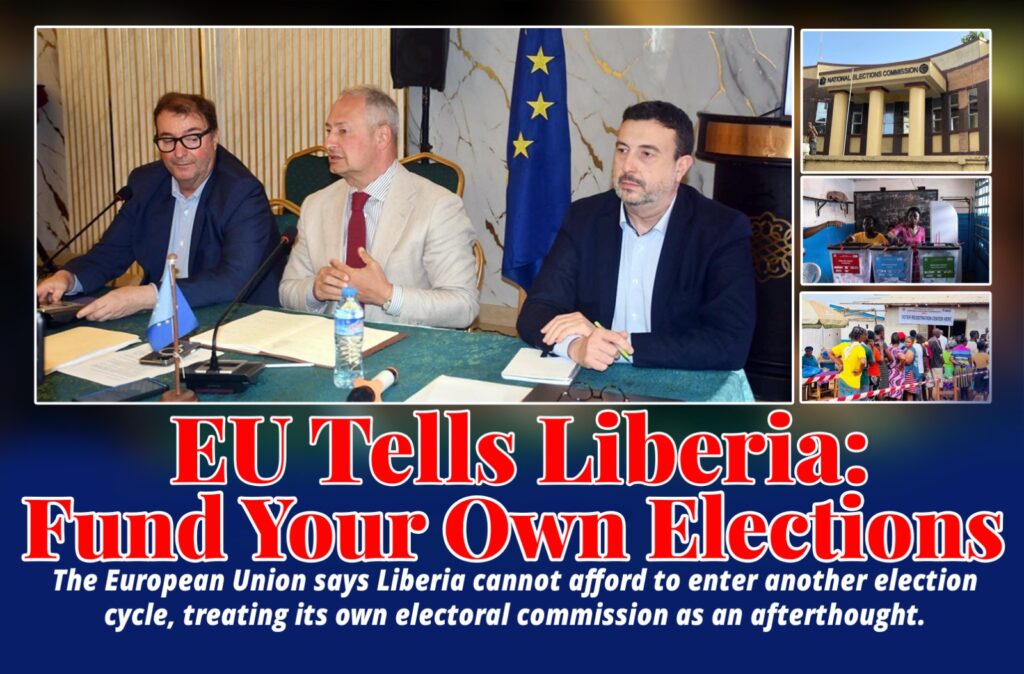
MONROVIA — The European Union has warned Liberia that its repeated failure to fund the National Elections Commission on time is one of the most serious threats to democratic credibility in the country, demanding that election financing become a fixed budgetary line rather than what it called a “political surprise.”
The rebuke came last Friday from Andreas Schieder, head of the EU Election Follow-Up Mission and a member of the European Parliament, who outlined a sweeping set of reform demands at a news conference in Monrovia. Schieder, who also served as chief observer of the EU Election Observation Mission during the 2023 elections, said Liberia must move decisively on multiple fronts before the next electoral cycle in 2029.
“A major issue identified during the 2023 elections was the untimely financing of the National Elections Commission,” Schieder said. “Election funding should be a consistent budgetary item rather than a ‘political surprise.'”
The mission, deployed May 10, was tasked with assessing Liberia’s progress on 22 recommendations the EU issued following the 2023 presidential and legislative elections. Schieder described the mission as independent, nonpartisan and respectful of Liberian sovereignty.
Beyond financing, Schieder identified a cluster of structural deficiencies that hampered the 2023 polls: inadequate voter education, low political participation by women, insufficient voter registration centers and weaknesses in electoral administration.
He called for an increase in the number of voter registration centers nationwide, stronger NEC capacity to enforce campaign finance rules, timely publication of election-related information and enhanced training for polling staff. The mission also recommended harmonizing the existing population register to improve the quality of the voter roll and improving accessibility to polling stations.
Electoral constituency boundaries, the mission said, must be reviewed in accordance with national legislation. Gaps in the electoral legal framework need to be closed, and measures aimed at greater gender equality in political participation must be adopted.
Schieder urged the government, the Legislature and the NEC to move beyond discussions and translate ongoing reform efforts into concrete action before 2029.
“I note a strong commitment from the authorities and most notably from President Boakai to use the EU recommendations as one of the bases to improve the election process,” he said.
The mission met with a broad range of stakeholders during its visit, including President Joseph Nyuma Boakai, the Minister of Justice, the Speaker of the House of Representatives, the President Pro-Tempore of the Senate, the Chief Justice, NEC commissioners, political parties, civil society organizations and members of the international community.
On civic and voter education, Schieder was categorical: it is the single most important factor in improving Liberia’s electoral process. He called for long-term voter education programs to be embedded in the national curriculum rather than compressed into the weeks before election day.
“Education should not just happen in the weeks before an election,” he said. “It should be a permanent fixture of the national curriculum to prepare the younger generation for civic duties.”
He added that constitutional referendums present a heightened challenge. “Referendums on constitutional issues are harder for the public to navigate than general elections, making specialized voter education even more critical.”
Despite Liberia’s turbulent past, Schieder said the country’s democratic trajectory is upward, pointing to the 2023 elections as evidence of strengthening institutions and growing citizen engagement. He acknowledged that election irregularities occur in democracies around the world because elections are administered by human beings, but said the objective is to minimize them through effective oversight and statistical safeguards.
The mission also noted persistent technical and geographic challenges, including polling locations more easily reached from neighboring countries than from within Liberia.
Schieder said the EU’s recommendations, alongside those from domestic and international observer groups, continue to serve as a roadmap for reform. He also stressed the importance of advancing media and social media regulation, campaign finance oversight and mechanisms for resolving electoral disputes.
The EU Election Follow-Up Mission will release its final report in the coming weeks, providing a comprehensive assessment of how far Liberia has progressed on the 22 post-2023 recommendations and offering further guidance ahead of future elections.





Discussion about this post