


Published: October 31, 2025

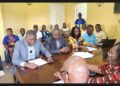
EPA Executive Director Dr. Emmanuel Urey Yarkpawolo and Project Lead Vermon Sangah Lloyd during the signing of the Solid Waste Management MOU in Monrovia
MONROVIA — In an effort to improve the city’s waste management system, key stakeholders signed a Memorandum of Understanding (MOU) on Tuesday, launching the Solid Waste Management Transformative Pilot Project (SWMPP), a collaborative initiative designed to enhance coordination, efficiency, and sustainability in how Monrovia handles its solid waste.
The signing and official distribution of the MOU brought together representatives from the Environmental Protection Agency (EPA), Monrovia City Corporation (MCC), Liberia Marketing Association (LMA), Liberia Water and Sewer Corporation (LWSC), and Community-Based Enterprises (CBEs). The initiative is supported by Novasphere and the Government of Canada through the MRV Climate Action Project.
The SWMPP aims to address long-standing challenges in Monrovia’s waste sector—ranging from limited collection capacity to weak institutional coordination by promoting collaboration between public institutions, private partners, and communities.
Transforming Challenges into Opportunities
Giving the overview of the MOU, Vermon Sangah Lloyd, Project Lead for the SWMPP, described the project as a turning point for Monrovia’s urban sanitation.
“The signing and distribution of this MOU symbolize our collective commitment to strengthening institutional cooperation, defining clear roles and responsibilities, and promoting accountability in delivering solid waste management services,” Lloyd said.
According to her, the project’s objectives include improving waste collection and disposal efficiency, enhancing coordination among government institutions, and empowering community-based enterprises to play a greater role in local waste management.
“This pilot will not only strengthen institutional synergy but also promote inclusive participation by creating jobs and enabling community ownership,” she added.
Waste as a Resource
EPA Executive Director Dr. Emmanuel Urey Yarkpawolo commended the collaborative spirit of all partners and emphasized the project’s alignment with Liberia’s environmental and climate goals.
“Waste management is captured in our Nationally Determined Contributions (NDCs) – it’s one of the priority areas we’re addressing under the national climate agenda,” Yarkpawolo said.
He noted that the project’s focus on composting organic waste is critical to building a “circular economy,” where waste is converted into valuable products such as organic fertilizer.
“Waste becomes a resource. By collecting food waste and turning it into compost, we produce natural fertilizer that avoids harmful emissions. This initiative contributes to a cleaner environment and supports sustainable agriculture,” Yarkpawolo explained.
He expressed gratitude to the project’s financial and technical supporters, especially the Government of Canada and Novasphere, noting that similar pilots would be implemented in other areas beyond Monrovia.
MCC, LMA Laud the Initiative
Monrovia City Manager Jones Williams praised the commitment of all partners, particularly the Liberia Marketing Association, for helping sustain the initiative during its early stages.
“The LMA has been very vital. They stood their ground to ensure the project did not fail,” Williams said. “To Ms. Lloyd, who has been determined from day one, we say thank you. This project shows what dedication and partnership can achieve.”
Williams called on young Liberians, especially women, to draw inspiration from Lloyd’s leadership, saying, “If we want to change this country, we must be focused and determined.”
Representing the Liberia Marketing Association, Vice President Cecelia Weah reaffirmed the LMA’s support. “We embraced this project from the start. As marketers, we generate a lot of waste, but now we see that waste can be turned into something useful. We are grateful to the Canadian partners and everyone making this possible,” she said.
Community Impact and Expansion
Saah Joe Kendamah, speaking on behalf of the Community-Based Enterprises, described the project as “a historic movement” for local waste collectors who have long been excluded from innovative waste transformation efforts.
“For 17 years, our institutions have not had this kind of opportunity to transform waste into compost, a natural fertilizer,” Kendamah said. “This will not only reduce the volume of waste going to the landfill but also extend its lifespan.”
The pilot currently involves four community-based enterprises, with plans to expand as the model proves successful.
A Replicable Model
According to Lloyd, the long-term goal is to develop a scalable waste management framework that could be replicated across other Liberian cities.
“Through this project, we expect stronger institutional coordination, increased public awareness, and a replicable model for sustainable waste management nationwide,” she noted.
In closing, Lloyd thanked all partners for their collaboration and reaffirmed the team’s commitment to achieving tangible results.
“Together, we are not only improving waste management, we are reshaping how Monrovia views and manages its environment,” she said.





Discussion about this post