



Published: May 23, 2026
GBARNGA, Bong County — Inside the crowded conference hall of the Center for Justice and Peace Studies along the Gbarnga-Monrovia highway, applause, testimonies and renewed hope filled the air as adolescent girls proudly sat beside fathers learning to play more active roles in their daughters’ education and wellbeing.
Some girls spoke publicly for the first time, while fathers reflected on how lessons from the Father School initiative had transformed their homes, reduced violence and strengthened communication within families.
The colorful graduation ceremony, organized by the Center for Justice and Peace Studies (CJPS), marked the completion of a community empowerment initiative aimed at promoting girls’ education, responsible fatherhood and nonviolence across communities in Bong County.
The project, supported by the German-based development organization Bread for the World, focuses on empowering adolescent girls while encouraging fathers to become more involved in the educational and personal development of their daughters.
Program Targets Girls’ Education Challenges
Providing an overview of the initiative, CJPS Program Officer Robertson B. Davids said the project was established to address long-standing barriers affecting girls’ education and wellbeing in Liberia.
“This project is funded by a German-based organization called Bread for the World that is interested in Liberia’s development,” Davids said. “We believe when the mind is developed, the surrounding environment will also be affected by that development.”
According to Davids, many girls continue to face serious educational challenges due to limited parental involvement, menstrual-related stigma, poor sanitary conditions in schools and inadequate emotional support from fathers.
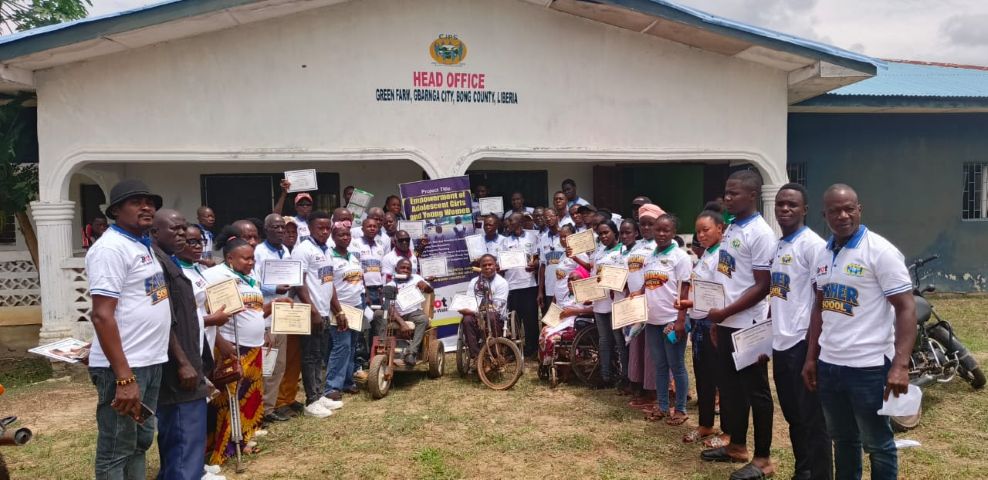
A group photo of participants and organizers taken after the occasion
“Over the years, fathers have mainly focused on paying school fees, but they have not been deeply involved in the development process of their girl children,” he noted. “This project is helping fathers understand that they must go beyond fees and become active participants in the lives of their daughters.”
Davids disclosed that one key component of the initiative is the establishment of Adolescent Girls Clubs in schools across Bong, Margibi and Nimba Counties.
He explained that seven schools in each county are participating in the program, with 15 girls serving as members in each club.
The clubs provide safe spaces where girls meet regularly to discuss issues affecting their education and personal wellbeing while engaging school authorities and communities on possible solutions.
Menstrual Health, Hygiene Concerns Addressed
Davids said baseline assessments conducted at the start of the project revealed that many girls frequently left school during class hours because of menstrual-related challenges, illness, stigma and poor bathroom facilities.
“We discovered that many girls were leaving school during class hours because of menstrual-related challenges and poor bathroom facilities,” he said. “So the mentors and advisors work with them to help them understand how to manage these situations without losing confidence or missing lessons.”
He recounted how female mentors encouraged girls to carry extra sanitary materials to school to avoid embarrassment during unexpected menstrual periods.
The initiative also promotes awareness about hygiene, safe school environments and respectful engagement with school administrations to advocate for improved sanitation facilities for girls.
Mentorship Building Girls’ Confidence
Speaking on behalf of the mentors, Joseph Nuah said the mentorship program has significantly transformed the lives of many young women in participating communities.
“This mentorship program has helped many young women to believe in themselves,” Nuah stated. “Some of them were shy before, but now they are able to speak in public, make informed decisions and stand for their rights.”
According to him, mentorship sessions focused on leadership, self-respect, decision-making, personal development and the importance of education.
Nuah said several girls who participated in the program are now serving as peer educators and student leaders within their schools and communities.
“One of the major achievements of the program is that young women are now becoming role models,” he said. “They are encouraging others to focus on education, avoid risky behavior and think positively about their future.”
He added that the initiative also strengthened teamwork, friendship and unity among girls from different backgrounds, including girls living with disabilities.
“The impact can be seen in families and communities,” Nuah said. “When young women are empowered, they contribute positively to society.”
Nuah called on CJPS and its partners to sustain and expand the initiative so that more girls across Liberia can benefit from mentorship and empowerment opportunities.
Fathers Reflect on Transformation at Home
Also speaking during the ceremony, Philip, a resident of the Kokoyah road community in Gbarnga and one of the graduating fathers, described the Father School initiative as life-changing.
According to him, domestic violence and family conflicts were once common within the community, but training sessions on positive parenting, peaceful conflict resolution and shared family responsibilities have helped reduce tensions in many homes.
“Before this training, complaints about domestic violence were common in our community,” he said. “But since the Father School started, many men have changed the way they treat their wives and children.”
Philip said the program taught fathers the importance of respecting their partners, discussing family issues peacefully and sharing responsibilities at home.
“The Father School taught us that there should be no darkness between husband and wife,” he added. “When couples discuss issues together, the burden becomes lighter.”
He praised CJPS for the intervention and appealed for the expansion of the program to reach more men in surrounding communities.
“If this program continues, it will help transform many homes and communities,” he said.
Girls Call for Continued Support
Speaking on behalf of the graduating girls, Ruth Boimah thanked CJPS and its partners for helping adolescent girls understand their value and potential in society.
“We used to feel like girls in our community were left behind,” Boimah said. “But this program helped us to understand that we are important and that we can become leaders in our communities.”
She said the mentorship sessions taught participants leadership skills, goal setting, self-confidence and decision-making.
According to her, many girls who previously lacked confidence are now actively participating in school activities and community discussions.
“We learned that even if you are not highly educated, you can still contribute positively to your community,” she noted. “The program also taught us how to plan for our future and set goals for ourselves.”
Boimah appealed to CJPS and donors to continue supporting girls through educational opportunities and vocational training programs.
“We want this support to continue so that more girls can benefit,” she said. “We also want opportunities to learn trades and improve our lives.”
‘Real Fathers Build Peaceful Homes’
Delivering the keynote motivational address, Madam Marthaline Jarwoe emphasized the responsibilities of “real fathers” in building stronger families and peaceful communities.
Jarwoe, a former CJPS staff member who previously served as a social worker and county supervisor, praised the organization for empowering communities through social transformation and awareness initiatives.
“A real father is not just someone who brings children into the world,” she said. “A real father takes responsibility for the family, supports the children’s education, communicates with his wife and helps build a peaceful community.”
She criticized the culture of blaming mothers alone whenever children become involved in harmful behavior, stressing that fathers must also accept responsibility for child upbringing.
“In Liberia, when children go wrong, society often blames the mothers,” she said. “But fathers must also accept responsibility because raising children is the duty of both parents.”
Jarwoe encouraged fathers to communicate openly with their wives about finances, education and household responsibilities in order to strengthen family unity and reduce conflict.
“A real father does not run away from problems,” she stressed. “A real father discusses issues, looks for solutions and teaches children respect, discipline and responsibility.”
Addressing the adolescent girls, Jarwoe urged them to remain focused on their education despite challenges and setbacks.
“Life is not easy, but challenges should not stop you,” she encouraged. “Your struggles are part of your journey to success.”
Participants Pledge Peace, Equality
The ceremony concluded with participants taking a public pledge to promote peace, equality and nonviolence in their homes, schools and communities.
Graduates pledged to become role models for respect and partnership between women and men, reject violence, protect children and help create safe and equal learning environments for girls and boys.
Organizers described the graduation as a major step toward strengthening community support for girls’ education and promoting responsible fatherhood in rural Liberia.






Discussion about this post