


Published: November 6, 2026
MONROVIA — China has expressed readiness to expand imports of agricultural products from Liberia, including coffee, cocoa and dried chili peppers, while outlining procedures Liberian exporters must complete to gain access to the Chinese market.
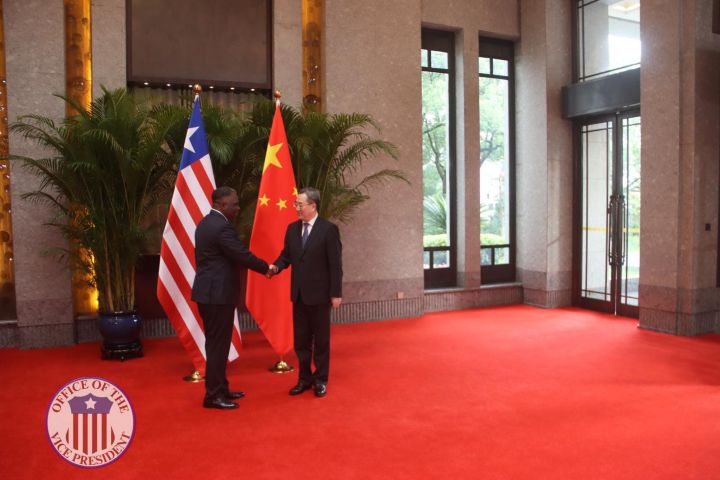
Chinese Vice Premier Ding Xuexiang made the commitment during bilateral discussions with Liberia’s Vice President Jeremiah Kpan Koung Sr. in Shanghai on Thursday, Nov. 5, as both countries explored opportunities to strengthen trade, attract investment and expand development cooperation.
According to a statement released Friday by the Office of the Vice President, Ding disclosed that agricultural products from African countries, including Liberia, have been granted access to the Chinese market, subject to applicable export approval requirements.
He explained that Liberia must submit a list of eligible exporting companies for review and approval before those businesses can begin supplying products to China.
The announcement represents a potential opportunity for Liberian farmers, agricultural businesses and exporters seeking access to one of the world’s largest consumer markets.
Ding also encouraged Liberia to take advantage of the China International Import Expo and other international trade platforms to establish commercial relationships with Chinese buyers.
The discussions followed Koung’s participation in the opening of the ninth China International Import Expo, where he emphasized the need to translate China’s zero-tariff policy into increased Liberian exports, domestic processing and job creation.
During the bilateral meeting at the Xijiao State Guest Hotel, Koung welcomed China’s willingness to expand agricultural imports but stressed that Liberia must move beyond exporting raw materials toward developing industries capable of processing agricultural products locally.
“Our objective is to create jobs, develop Liberian skills, and retain more value within our economy,” Koung said.
The vice president identified rubber, cocoa, coffee and other agricultural commodities as priority areas for expanded trade cooperation.
He also invited Chinese investors to explore opportunities in Liberia’s special economic zones, particularly in rubber processing, agro-processing and light manufacturing.
According to the release, Koung emphasized that Liberia’s economic partnership with China should contribute to industrial development, technology transfer, employment opportunities and increased domestic production.
Ding, responding to the proposals, expressed China’s willingness to encourage additional Chinese enterprises to invest in Liberia.
He also identified iron ore mining as another important area of bilateral economic cooperation, calling for stronger policy coordination to ensure investments generate mutual benefits.
Beyond agricultural trade and investment, China reaffirmed its commitment to supporting several development initiatives in Liberia.
The Chinese vice premier outlined continued cooperation involving the Congo Town overpass bridges, diagnostic laboratory facilities, agricultural machinery, government vehicles and road-related assistance.
He further disclosed that Chinese technical teams would visit Liberia to assess proposed projects involving broadcasting facilities and renovation of the Capitol Building.
The release also indicated that China would continue providing scholarships and professional training opportunities aimed at strengthening Liberia’s technical and human resource capacity.
Koung welcomed the commitments, emphasizing that infrastructure investments must be accompanied by adequate training, maintenance arrangements and technical assistance to guarantee long-term sustainability.
The vice president particularly highlighted Liberia’s electricity challenges, identifying reliable and affordable power as a major requirement for economic transformation and industrial growth.
He encouraged Chinese investment in solar energy, battery storage, hydropower and rural electrification, while also identifying clean water, health services, digital connectivity and vocational training as areas requiring additional cooperation.
To accelerate implementation, Koung proposed the designation of focal persons from both countries and the preparation of a prioritized list of projects for further technical discussions.
He assured the Chinese government that Liberia’s Embassy in Beijing and relevant national institutions would coordinate closely with their counterparts to advance the proposed initiatives.
The bilateral discussions also addressed Liberia’s upcoming presidency of the United Nations Security Council in December 2026.
Ding congratulated Liberia on the forthcoming leadership responsibility and expressed China’s readiness to maintain close diplomatic communication.
Koung thanked China and other international partners for supporting Liberia’s election to the Security Council for the 2026-2027 term.
He outlined Liberia’s priorities, including women’s and youth participation in peace and security, climate-related conflicts, natural resource management, regional stability, peacekeeping and Security Council reform.
The vice president also requested China’s continued diplomatic support during Liberia’s presidency of the Council.
According to the release, both leaders reaffirmed their commitment to strengthening the Liberia-China strategic partnership through practical economic cooperation and development initiatives.
The meeting brought together senior officials from both countries, including Shanghai Mayor Zhu Zhongming, Chinese Vice Minister of Foreign Affairs Miao Deyu, Liberia’s Ambassador to China Dudley McKinley Thomas, Liberia Special Economic Zones Authority Executive Chairman Prince A. Wreh and Rural Renewable Energy Agency Executive Director Samuel Nagbe.
Also attending were Deputy Chief of Staff for Administration Macdonald Metzger, Press Secretary Richmond Neufville and J. Wesley Washington, minister counselor at Liberia’s Embassy in China.



Discussion about this post