


Published: December 20, 2024
Last updated: December 19, 2024
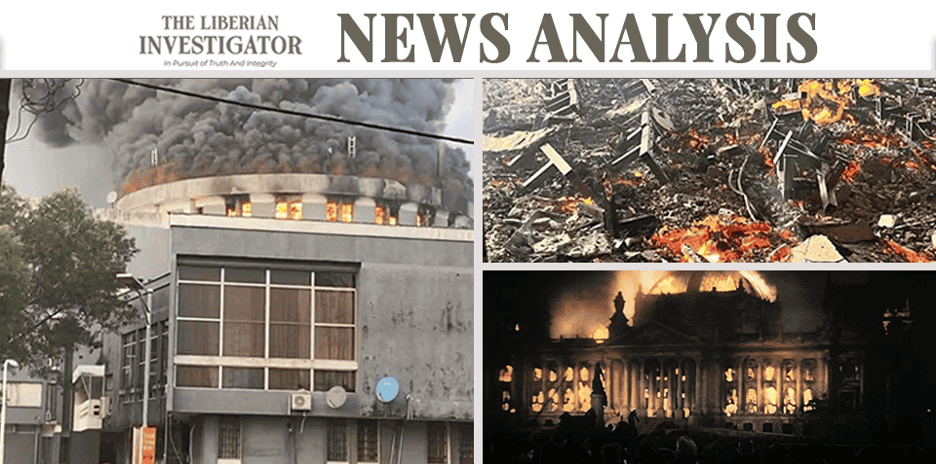
Monrovia — The fire that gutted Liberia’s Capitol Building is more than just a blaze; it’s a political powder keg threatening to ignite deeper divisions in an already fractured democracy. As investigations begin, the stakes couldn’t be higher for a nation grappling with political uncertainty.
The Fire and Its Context
The Capitol Building fire comes amid long-running unrest within the House of Representatives. Just a day prior, Monrovia witnessed protests against the removal of embattled Speaker J. Fonati Koffa, with tensions running high between the protestors and the Liberia National Police. While the Liberia National Fire Service (LNFS) has yet to determine the cause of the blaze, the police have already named key figures for questioning, including Speaker Koffa and Representative Frank Saah Foko, citing controversial remarks and social media posts. Representative Foko’s earlier incendiary statement suggesting that the Capitol Building “should be burned” if legislators fail their constituents has particularly fueled public suspicion among a faction of supporters.
Meanwhile, the political divisions within the legislature—highlighted by the emergence of rival blocs and contested leadership—provide fertile ground for speculation. The accusations of arson or negligence have the potential to exacerbate an already volatile political crisis, further eroding public trust in Liberia’s democratic institutions.
The Historical Parallel: Germany’s Reichstag Fire
The Capitol Building fire draws unavoidable comparisons to the infamous Reichstag fire in 1933. That fire—which gutted Germany’s parliamentary building—became a turning point in the country’s descent into authoritarianism. Exploited by Adolf Hitler and his Nazi party, the Reichstag fire was framed as an act of Communist sabotage, justifying the passage of the Reichstag Fire Decree. This legislation suspended civil liberties, curtailed freedom of speech and the press, and granted the regime sweeping powers to suppress dissent. Though the true culprits behind the Reichstag fire remain a subject of debate, its political utility to the Nazi regime is undeniable.
Liberia’s current context, while different, bears some striking similarities. The Capitol Building fire has already sparked a flurry of allegations and counter-allegations, with political factions leveraging the incident to advance their narratives. Just as the Nazi regime weaponized fear of Communism, some factions in Liberia appear eager to use the Capitol fire as a means of delegitimizing political opponents or consolidating power. This raises the specter of dangerous precedents: the potential erosion of civil liberties, the suppression of dissent, and the manipulation of public institutions for partisan gain.
The Role of Public Discourse and Propaganda
In the aftermath of the Reichstag fire, propaganda played a pivotal role in shaping public perception. The Nazi press painted the Communists as existential threats, reinforcing fears that justified draconian measures. Similarly, in Liberia, the rapid proliferation of unverified claims about the Capitol fire—amplified by social media and partisan rhetoric—risks distorting public understanding of the event.
For instance, police statements highlighting Representative Foko’s incendiary remarks and Speaker Koffa’s cryptic social media post referencing “The Alamo” have already been seized upon to frame these individuals as instigators. Yet, absent concrete evidence, such narratives remain speculative and could prove deeply divisive. The media’s role in responsibly reporting on the incident is therefore critical. Sensationalist coverage risks fanning the flames of public anger and mistrust, while measured reporting can help ensure accountability without jeopardizing due process.
The Investigation: A Crucible for Liberia’s Democracy
Central to the fallout from the Capitol fire is the investigation itself. How it is conducted—and perceived—will have far-reaching implications for Liberia’s democratic health. The involvement of international forensic experts, as announced by the Liberia National Police (LNP), is a promising step toward ensuring transparency and impartiality. However, the process must go beyond technical rigor; it must also address the public’s need for clarity and trust.
This is particularly important given Liberia’s recent history of politically charged investigations. Allegations of bias or cover-ups have plagued previous inquiries, fueling cynicism about the justice system. To avoid a similar fate, authorities must ensure that the investigation into the Capitol fire is both exhaustive and visibly independent. Moreover, it should prioritize substance over optics: rather than focusing on high-profile arrests or dramatic announcements, the investigation should seek to establish a clear and credible account of what transpired.
Cautionary Lessons for Political Actors
For Liberia’s political actors, the Capitol fire presents a cautionary tale. The temptation to exploit the incident for short-term political gain must be resisted, as such actions risk deepening divisions and undermining democratic norms. Both factions within the House of Representatives have a responsibility to approach the investigation’s findings with restraint and respect for due process.
This is particularly true given the high stakes of the current political impasse. With rival blocs vying for legitimacy, any perception of bias in the handling of the Capitol fire could escalate tensions, potentially leading to further unrest. Both faction must therefore prioritize national unity over factional interests, setting a tone of constructive engagement rather than confrontation.
The Role of Citizens and Civil Society
Ultimately, the responsibility for safeguarding Liberia’s democracy does not rest solely with its leaders. Citizens and civil society have a crucial role to play in ensuring accountability and transparency. Public vigilance—exercised through peaceful advocacy, informed debate, and demand for justice—can serve as a counterweight to potential abuses of power.
At the same time, citizens must exercise caution in how they interpret and respond to the Capitol fire. Just as the Reichstag fire fueled a climate of fear that enabled authoritarianism, unchecked suspicion and polarization in Liberia could erode the very democratic principles that the Capitol Building symbolizes. By demanding a fair and thorough investigation—and by resisting the lure of partisan narratives—Liberians can help ensure that this incident strengthens rather than weakens the nation’s democratic fabric.
Conclusion: A Turning Point or a Precipice?
The Capitol Building fire is a defining moment for Liberia. How the investigation unfolds and how leaders and citizens respond will determine whether this tragedy deepens divisions or strengthens democracy. Transparency, accountability, and unity are imperative to ensure the flames of destruction do not consume Liberia’s democratic ideals.






Discussion about this post