


Published: June 15, 2026
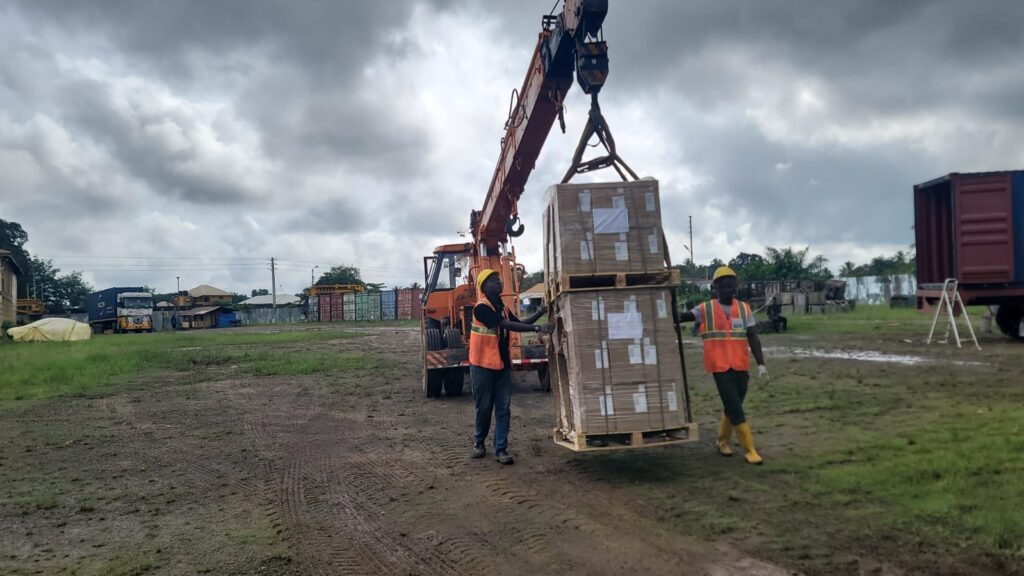
BUCHANAN, Grand Bassa County — A European Union-funded drive to bring reliable electricity to three coastal and southeastern Liberian cities moved closer to its first live connections this week, as a shipment of household and commercial meters arrived in Buchanan for customer hook-ups under a €42 million regional investment.
The single-phase and three-phase split meters were offloaded at the Buchanan Warehouse under the supervision of MBH Power Nigeria Limited, the firm handling warehousing and logistics for the city’s component of the program. The meters will be used to connect households, businesses and public institutions and to extend distribution services across Buchanan and surrounding communities.
The consignment is part of a €42 million EU package to expand electricity access in Buchanan, Greenville and Barclayville, carried out in partnership with the Liberian government. Officials said the safe arrival and storage of the meters marked continued progress toward the project’s electrification targets.
“The European Union remains committed to supporting the government and people of Liberia in advancing the country’s energy sector,” an EU representative said. “Increased access to electricity will foster economic growth, improve public services, and create opportunities for sustainable development.”
The meter delivery is a small but telling marker of a much larger shift in how the EU is spending in Liberia. Brussels has moved away from financing isolated, charity-style projects and toward integrated packages that bundle energy, transport, governance and service delivery into single development pushes. Rural electrification in the southeast now sits alongside roads, digital infrastructure, public financial management reform and civil-society support as a current EU cooperation priority in the country.
The European Commission’s 2024 midterm review set a 2025 to 2027 country allocation of €117 million for Liberia, with €40 million earmarked for enhancing and preserving natural resources for sustainable growth, the same strategic line under which the EU places its southeast electrification work. The financing flows through Global Europe, formally the Neighbourhood, Development and International Cooperation Instrument, which now governs the bloc’s external cooperation and carries an overall allocation of €79.5 billion worldwide.
For a region long treated as the country’s most isolated, the timing matters. Power has rarely reached Liberia’s southern cities in any reliable form, and the absence of electricity has shaped everything from health care to commerce. Greenville, in Sinoe County, and Barclayville, in Grand Kru County, lie deep in a corridor that official assessments describe as cut off from much of the country during the six-month rainy season because of degraded roads. The World Bank has reported that nearly 60 percent of rural Liberians lack access to an all-weather road, a constraint that drives up prices, isolates clinics and complicates the delivery of basic services.
Electricity is widely seen as one of the levers that could begin to loosen that grip. Reliable power supports cold-chain storage for vaccines and medicines, lengthens the working and study day, and underpins the kind of small enterprise that struggles to take root where generators are the only option. The EU has framed the southeast electrification effort not as energy for its own sake but as part of a broader package meant to extend the reach of the state and knit isolated counties more firmly into the national economy.
The logistics on display in Buchanan reflect the difficulty of that ambition. Moving and storing equipment in Liberia’s southern belt is itself a core challenge, not a routine errand, given seasonal road closures, limited warehousing and the long distances between population centers. The use of a managed warehouse and a dedicated logistics contractor points to a delivery model built around pre-positioning supplies before the rains rather than racing against them. Buchanan, with its port and its position on Liberia’s coast, serves as a natural staging point for equipment bound farther south.
The four southeastern counties the wider EU strategy targets, Grand Gedeh, River Gee, Maryland and Sinoe, together hold roughly 665,000 people, according to the 2022 census, and rank among the poorest in the country. Multidimensional poverty in 2022 reached 62.2 percent in Sinoe and 57.2 percent in Grand Gedeh. Literacy among people age 10 and older sat near 51 percent in Sinoe. Those figures help explain why the EU has tied its infrastructure spending to social outcomes, treating energy, water, health and education as interlocking rather than separate problems.
Whether the meters now in Buchanan translate into connected homes will depend on the next phase of work, which officials say is in preparation. Customer enrollment, the installation of distribution lines and the wiring of public buildings typically follow the arrival of metering equipment, and the pace of that rollout will determine how quickly residents see power.





Discussion about this post