


Published: May 8, 2026
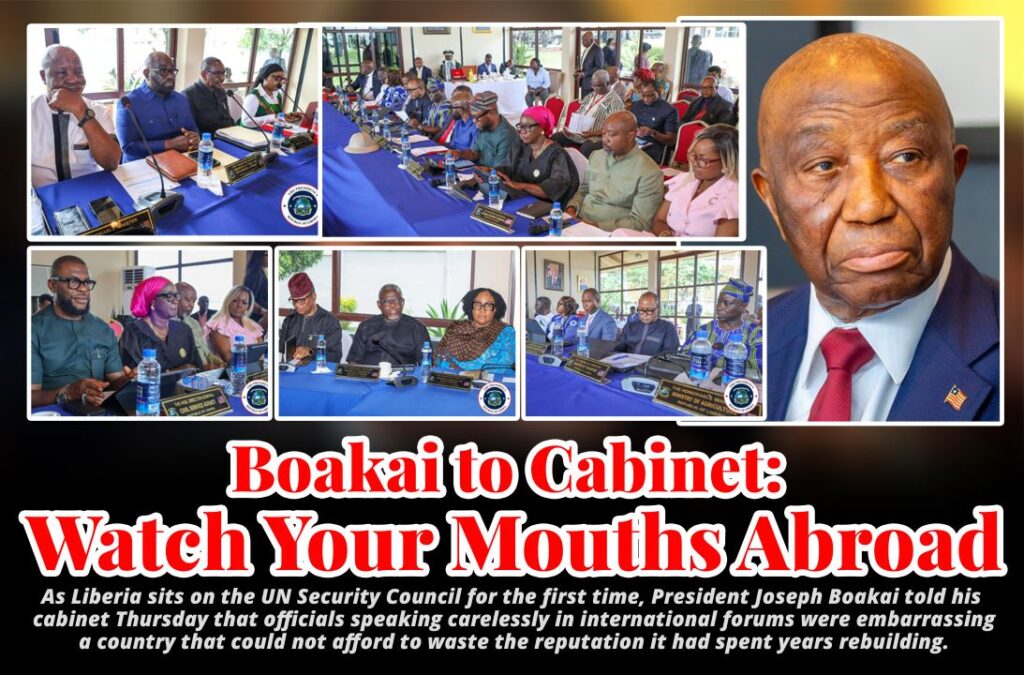
MONROVIA — President Joseph Boakai dressed down members of his own cabinet Thursday, warning them in unsparing terms that speaking carelessly in international forums had become a liability his administration could no longer absorb, and ordering them to consult before making statements abroad that they did not fully understand, or risk doing damage to a country that had worked hard to restore its international image under his administration.
“You are no longer going to do representation in the way you used to,” Boakai told his assembled ministers. “Because this time we have to demand to be treated with responsibility, but we ourselves have to behave as such. Whatever we do, we have to represent what we aspire to be.”
He told the cabinet that his government had received reports of officials traveling to international meetings and making statements without grasping what those statements meant technically, diplomatically or politically. The problem, as he described it, was not malice but a more corrosive kind of negligence, officials speaking as individuals in rooms where they were representing a nation.
“We listen to statements where people do not understand the implications, and we want to talk to those people,” he said. “In the diplomatic arena, if you don’t understand something, I think you should consult. And even for some statements that are going to be made, some of them may be technical, some political in nature, you should consult.”
Liberia currently holds a non-permanent seat on the United Nations Security Council, placing Liberian officials in rooms where careless words travel fast and land hard.
“Don’t think you are isolated from that, because it’s Liberia, and that’s why you represent them,” he said. “You’re not speaking for yourself. Whatever you say, you represent Liberia, and people take it seriously.”
A Reputation Worth Protecting
The session came days after a senior United Nations Peacebuilding Commission official, following meetings with Boakai, former President George Weah and former President Ellen Johnson Sirleaf, described Liberia as emerging as a model on the African continent in the area of peacebuilding, a designation that reflected years of painstaking institutional work and three successive peaceful democratic transitions in a sub-region increasingly defined by coups, political violence and democratic backsliding.
That international standing, the president said, was real, measurable and newly hard-won. It was also, he made clear, fragile.
“Liberia’s image abroad has improved immensely,” he said. “Liberia was not respected before. Now people are very positive about the country.”
A Public Order to the Vice President
Having delivered his diplomatic warning, Boakai pivoted to the domestic economy with equal force, publicly tasking Vice President Jeremiah Koung with investigating the systematic takeover of businesses legally reserved for Liberian citizens by foreign nationals, a problem so deeply embedded in the country’s commercial culture that it had survived years of official acknowledgment without producing any meaningful enforcement response.
“We have the VP working with another group to also look at businesses that over the years have been reserved for Liberians,” Boakai said.
The practice at the center of the investigation is known as fronting — an arrangement in which foreign nationals use Liberian citizens as nominal owners to circumvent laws that restrict certain commercial categories to citizens, while retaining actual operational control and capturing the profits. It is an open secret in Liberia’s business community, particularly in petty trade and retail, and it has persisted for years in part because enforcement has been intermittent, under-resourced and politically complicated.
“You take people who are mining sand, selling sand to us,” he said. “People who sell water out of your own home and sell it back to you. There’s nothing wrong with that, but at least if there’s something that Liberians can do, we should be able to have them do it, because that creates opportunities for employment as well as livelihoods.”
He was careful, however, to frame the policy not as economic nationalism but as the enforcement of rights Liberian citizens already legally possess. “It’s just about giving priority to Liberian citizens,” he said. “Because the economy should be determined by Liberian citizens. Liberians should be in charge of the economy.”
He offered what he called the essential economic argument for why Liberian ownership matters at a level beyond politics or sentiment. “When the Liberian business person makes whatever amount of income, it will be used in the country,” he said. “But for Liberians living here, the money will be used well within Liberia to empower Liberian citizens.”
The Director-General of the President’s Cabinet had earlier flagged the issue as a formal agenda item, framing the Vice President’s upcoming briefing on Liberian economic participation as one of the session’s most significant discussions. “For decades we’ve been talking about how Liberians can take over the economy,” the Director-General said. “And you know this has been one of the priorities of His Excellency. So the conversation around that will be quite informative and revealing.”
The President’s Most Uncomfortable Admission
President Boakai acknowledged before his full cabinet, on the record, on camera, that his administration had a structural problem with following through on its own decisions, and that this failure was costing the government its credibility with the public it served.
“The problem here is the follow-up,” he said, with a plainness that left no room for diplomatic softening. “And I hope this time there will be a way that we can follow up on all these discussions, be able to measure what we achieve out of what we plan and do. Because that’s the only way the public is able to know what we do and how well we do it.”
Fuel Smuggling and Commodity Prices
Boakai also addressed the management of petroleum products, telling his cabinet that business operators were moving subsidized fuel out of the country to sell at profit in neighboring markets, a practice that directly drove up the cost of each successive consignment for Liberian consumers and destabilized a market the government was already struggling to manage.
“We have to commit resources to be able to control the price to the consumer,” he said. “Not only do we have to protect the distribution, but also the way in which it is managed. Everybody wants to make money, but every time you take the product out, the new one you get will be more expensive because of the situation.”
He extended the concern beyond fuel. “It’s not just for petroleum products,” he said. “Even some of the things I would mention, the prices of flour, it will help us to make sure that we protect the people who have been going through too much hardship.”
He did not announce specific enforcement mechanisms or name agencies responsible for implementation. That omission, given the president’s own acknowledgment of the administration’s follow-up problem, was not incidental.
Access Is Not Enough
Boakai argued that reclaiming economic space for Liberians would accomplish little if the citizens who entered that space lacked the basic business management skills to hold and build what they were given.
“Everybody said they want to do business,” he said. “But what is business? Taking money and committing that to get profit is not an easy thing to do.”
He focused on market women as his primary illustration, not to diminish them, but to describe with precision a financial trap he said he had observed at close range. Traders generated income, he said, but immediately recycled all earnings back into inventory without ever separating profit from working capital, without savings accounts, without any mechanism for accumulating the reserves that allow a business to survive a bad week, let alone grow.
“I know some of the people make money, especially the market women, they like to compete. They make all the money, they go and buy goods with all the money. They don’t have any account where they save profit. They don’t even know that making business is different from employment.”
The distinction he drew, between running a business and earning a wage, is fundamental in economics and almost entirely absent from the financial education available to Liberia’s informal traders. Boakai said he hoped the government could establish a business incubation program to fill that gap, though he offered no timeline or funding commitment.
“I’ve been thinking about how to have our people in the economy do small businesses that are able to facilitate the distribution of goods and services,” he said.
He cited waste collection as an example of a sector where Liberian entrepreneurs were already attempting to participate but were being held back not by foreign competition but by their own lack of transport and capital. “I went to the city and I saw a lot of plastic. People are collecting and they are selling. But to move the plastic itself from one point to another takes a lot. People need transportation to do that.”






Discussion about this post