


Published: June 19, 2026
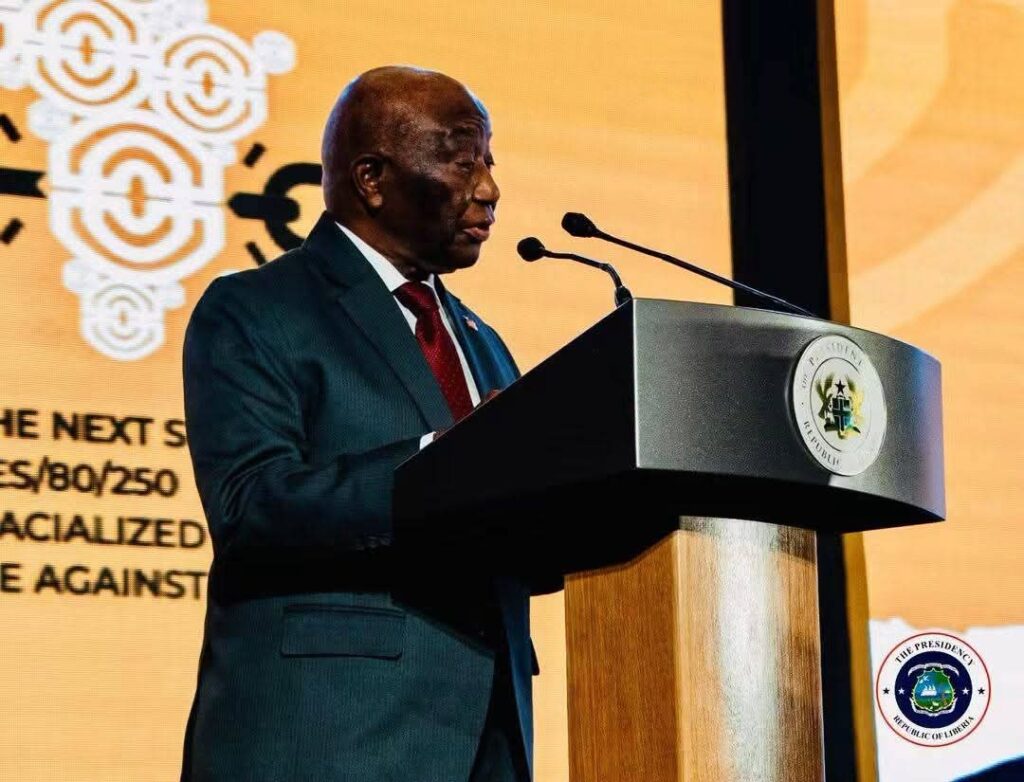
ACCRA, Ghana – President Joseph Nyuma Boakai has urged African nations, CARICOM and the global African diaspora to move quickly from recognition to action on a landmark United Nations resolution on the transatlantic slave trade, proposing a five-point plan anchored by a joint African Union and United Nations commission to design a global reparatory justice mechanism.
Boakai delivered the keynote June 18, 2026, at a two-day High-Level Consultative Conference on next steps for UN Resolution A/RES/80/250, convened by Ghana’s President John Dramani Mahama. Speaking at the Ghanaian capital’s historic shores, a site he said remains marked by the memory of those torn from their homes, Boakai told delegates that “future generations will judge us not by the eloquence of our declarations, but by the courage of our actions.”
The gathering brought together heads of state, African Union and CARICOM representatives, UN agencies, civil society and diaspora organizations to translate the March 26, 2026, resolution into a concrete implementation roadmap.
The resolution recognizes the transatlantic trafficking of enslaved Africans and racialized chattel enslavement as among the gravest crimes against humanity. Boakai said its adoption marked a “significant and necessary moral moment” more than 500 years after the first victims were taken and 200 years after the trade was formally abolished.
For Liberia, he argued, the legacy is not abstract history but national identity. “For Liberia, the legacy of the transatlantic slave trade is woven into the fabric of our national story and continues to shape our understanding of identity, belonging, and nationhood,” he said. The consequences, he added, cannot be measured solely in lost labor, stolen wealth or economic deprivation, but include “intergenerational social, cultural, psychological, and political impacts.”
Framing reparatory justice beyond cash payments, Boakai said the work must embrace historical truth-telling, reconciliation, identity restoration, cultural healing, education, institution-building and stronger social cohesion. He stressed that “justice, healing, and reconciliation are inseparable from sustainable development and lasting peace.”
The Liberian leader then outlined his implementation priorities. He called for a common African position and implementation framework developed with CARICOM and diaspora groups, backed by a coordinated roadmap with clear timelines and responsibilities. “We gather to ensure that this resolution becomes not only a statement of historical recognition but also a framework for truth, justice, healing, and institutional repair,” he said.
Boakai urged the AU and UN to establish an African Union and United Nations Expert Commission to design a Global Reparatory Justice Mechanism, while pushing for education and research to counter erasure. “We must confront misinformation and erasure through truth, education, and research by strengthening the teaching of African history, preserving archives, and supporting universities,” he asserted.
He further demanded the restitution of cultural artifacts and heritage objects, alongside development partnerships to address inequalities rooted in slavery and its aftermath. Boakai pointed to the economic scale of the trade, saying “the transatlantic slave trade, forced labor, and resource extraction generated enormous wealth that shaped the economic foundations of many societies across the world.” The trade and its aftermath, he said, contributed profoundly to inequality and underdevelopment in Africa and across the Global South.
Seeking to defuse political tension around the term reparations, Boakai called for global development initiatives grounded in shared responsibility and mutual respect. “The call for reparatory justice is not an effort to assign personal guilt to the present generation for the sins of the past,” he said.
He closed by inviting the world to join Africa in repair. “We invite our partners across the world to share in our anguish, to recognize the enduring consequences of this historic injustice, and to join us in a common commitment to healing and repair,” he said.
The two-day conference aims to produce a concrete implementation roadmap with clear timelines and responsibilities.





Discussion about this post