



Published: September 26, 2025
WASHINGTON — President Joseph Nyuma Boakai on Friday urged Liberians abroad to “move from sentiment to action,” encouraging the diaspora to contribute capital, share skills, and collaborate with his government on a reform agenda aimed at rebuilding institutions, decentralizing power, and expanding opportunities after years of stagnation.
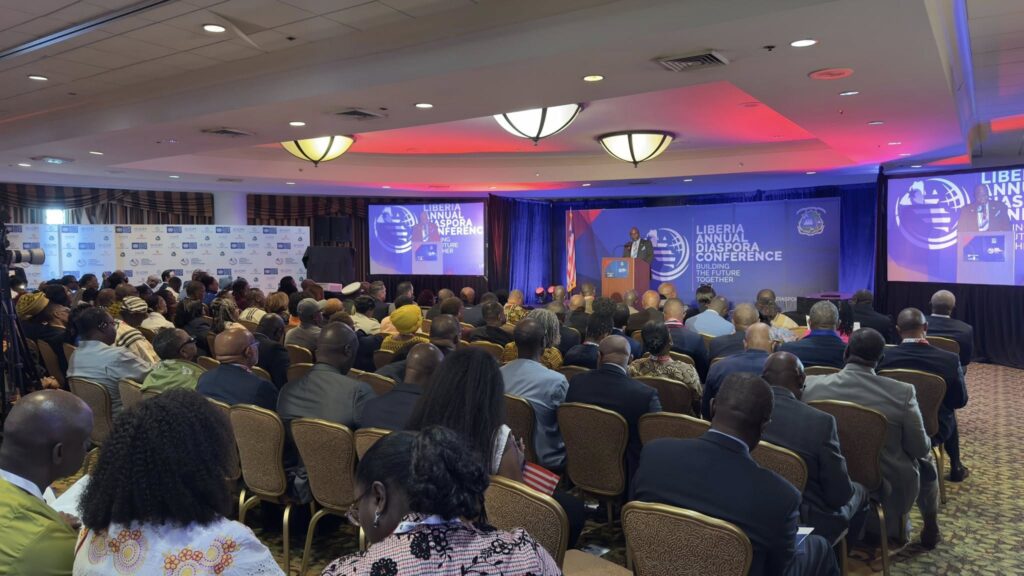
“You will not be treated as observers but as full stakeholders,” Boakai told the opening session of the Liberia Diaspora Annual Conference 2025, a two-day-long gathering of Liberians from the United States, Europe, Australia and Canada. “Reading, branding Liberia and transforming our society cannot be done by government alone. It requires your active, sustained and intentional involvement. Put your money where your mouth is.”
Boakai said his administration “inherited a country facing far more problems than we could resolve overnight”, from a faltering economy to weakened rule of law, but insisted early steps are taking hold. He pointed to a new performance management and compliance system for ministries and agencies, anti-corruption efforts, and a push to align budgets and service delivery with his ARREST agenda, which prioritizes agriculture, roads, rule of law, education, sanitation and tourism.
“Good governance requires accountability, transparency and respect for the will of the people,” he said, adding that coming constitutional reforms will pursue decentralization and stronger local government. “Our economy must be inclusive and work for everyone.”

The conference’s theme, “Build the Future Together: Reconciliation, National Healing, Growth and Prosperity,” put reconciliation and diaspora partnership at its core. Organizers said remittances topped $800 million last year, stabilizing households and the currency, but argued that those flows can be targeted to create enterprises and jobs.
Foreign Minister Sara Beysolow Nyanti told participants the government is building the infrastructure to make that shift possible, including a new, ministry-wide database to map the skills and locations of Liberians abroad so agencies can recruit expertise for health, education, commerce and investment.
“We cannot manage what we cannot measure,” she said. “Every Liberian who leaves Liberia is our responsibility at the Ministry of Foreign Affairs, but we don’t have the reach without systems and data. We now need embassies empowered with tools to know where our people are, what skills they have acquired, and how to link them to national priorities.”
Nyanti said Liberia “cannot rise without the diaspora,” underscoring that the initiative is global, not just U.S.-focused. She also highlighted Liberia’s election to a non-permanent seat on the U.N. Security Council, “the first time in our history for a full two-year term”, as evidence that credibility at home is yielding stature abroad. “We earned it because the administration has shown that the integrity of a leader and the team he’s gathered will be brought to bear,” she said.
Dr. Al-Hassan Conteh, Liberia’s ambassador to the United States, formally welcomed delegates and framed the meeting as a working forum to match diaspora capacity with Boakai’s program.
“This conference is a testament to the president’s commitment to inclusive development,” Conteh said. He thanked international partners, including the United Nations Development Programme and the International Organization for Migration, for financing and technical support, and urged attendees to “sustain the energy” seen during July’s Independence Day observances. “Let us work together to create a prosperous and peaceful Liberia for all,” he said.
A keynote by Ambassador Professor Charles Murigande, Rwanda’s former foreign minister and ex-ambassador to Japan, offered a blunt roadmap from post-conflict recovery to national renewal, drawing on Rwanda’s experience after the 1994 genocide.
“When a nation builds its politics on division, discrimination and exclusion, the result is not just inequality. It can escalate into catastrophic violence,” Murigande said. Rwanda’s recovery, he argued, flowed from three deliberate choices: “We chose to stay together” under a government of national unity that punished revenge killings; “we chose accountable and transparent governance” that decentralized power and fought corruption; and “we chose to think big,” investing in health, education, technology and infrastructure under long-term national visions.
“Liberia needs you now,” he told the diaspora, sharing how he left a comfortable research post abroad to return home on a fraction of the pay. “If Rwanda could rise from genocide to global respect, surely Liberia—with its proud history, rich resources, resilient people and vibrant diaspora—can build a future of unity, justice and prosperity.”
Throughout the program, diaspora leaders pressed for practical fixes that would make engagement easier: the opening of consulates to serve growing Liberian communities in Australia and across Nordic Europe, faster access to passports and civil documents in Canada and Europe, and streamlined investment channels. Nyanti said those concerns underscore why the ministry is standardizing data and equipping embassies, while Boakai pledged “an enabling environment that is transparent, accountable and inclusive,” including collaboration on a diaspora investment fund.
Boakai also leaned into reconciliation, calling it a precondition for durable development.
“We may build infrastructure and superstructures, but without true reconciliation and healing, all those will come crashing down,” he said. He asked Liberians abroad to “lend your voice to reconciliation and national healing,” noting that “many of our fellow Liberians have carried their pain in silence with little space for dialogue or closure.”
The president tied governance reform to economic inclusion, arguing that Liberia’s long reliance on extractive concessions “supported growth without development” because profits were not reinvested in health, education, roads and jobs.
“We must replace growth with development—growth that delivers development,” he said, promising to “reconsider the concession regime,” promote local ownership and expand agriculture, where “the majority of our people, especially women and youth, can be engaged.”
Several presentations showcased the government’s new Performance Management and Compliance System, launched last October, which ties quarterly targets to the national plan and publicly recognizes top-performing agencies. Officials said the next phase will digitize reporting and link performance to budgeting.
While praising traditional partners, including the United States, Boakai said Liberia must do more to earn investment. “We cannot ask others to invest in us if we are mismanaging our resources,” he said. “We must demonstrate that we are worthy of partnership by upholding the rule of law, fighting corruption and delivering services to our people.”
Boakai closed with a simple invitation and a promise of protection for returnees who face common hurdles such as land disputes. “This conference is a new beginning,” he said. “Whether you are retired or ‘not tired,’ come home. Bring your ideas, your networks, your capital. My team will protect your rights. Together we can build a functional and fair society—and make Liberia, again, the land of liberty in deed.”
The day’s tone swung between celebration, a rousing national anthem and spirituals, and sober calls for discipline. As the room waved small Liberian flags, the head of the government’s diaspora office, Erasmus Williams, summed up the rallying cry: “Once a Liberian, always a Liberian.”





Discussion about this post