

Published: October 22, 2026
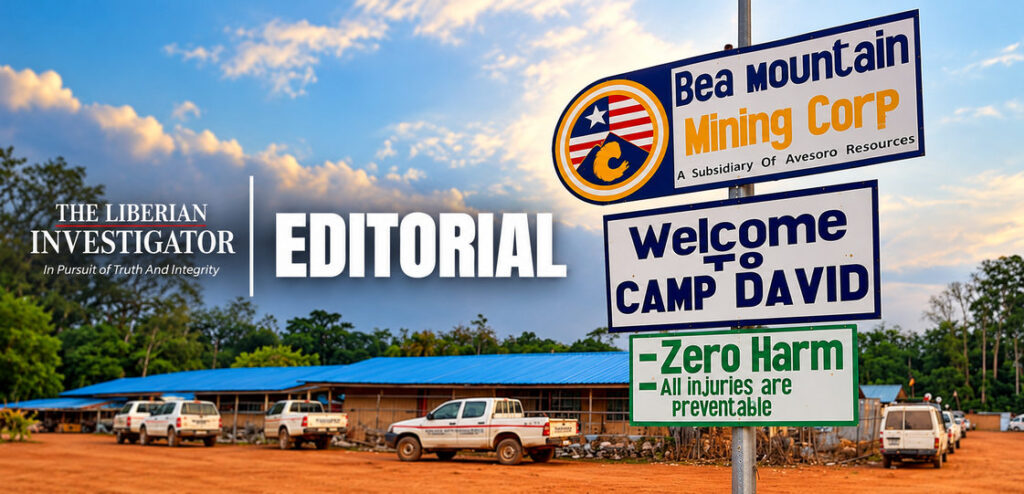
The reported US$1.8 million petroleum levy shortfall involving Bea Mountain raises a fundamental question: Why should a country struggling to finance roads, schools and basic services allow its natural resources to generate wealth without ensuring that the public receives what the law requires?
There is something profoundly troubling about a country blessed with extraordinary mineral wealth yet perpetually struggling to provide its citizens with the most basic necessities of life. Liberia exports gold and iron ore worth hundreds of millions of dollars, but communities surrounding these operations continue to plead for roads, clinics, schools and clean drinking water.
Now comes another disturbing revelation.
According to preliminary findings presented to the Liberian Senate by Gbarpolu County Sen. Amara M. Konneh, Bea Mountain Mining Corporation lifted 16.4 million gallons of diesel over nine months without paying a cent in petroleum levies intended to support county equipment and community development.
The reported shortfall is US$1.8 million, representing approximately 55% of the US$3.24 million in unpaid levies identified by the Senate committee.
Bea Mountain reportedly claims a duty-free exemption. That claim has not yet been publicly resolved, and the Senate has requested the legal basis for it.
Let us be clear: An exemption lawfully granted must be respected. But an exemption merely claimed cannot be treated as established law. Nor should an exemption from customs duties automatically be presumed to cover every petroleum levy imposed for a specific public purpose.
The question before Liberia is not simply whether Bea Mountain paid. It is whether the company was legally obligated to pay, who authorized any exemption, and whether that exemption extends to levies established to benefit the counties.
Those questions deserve documentary answers, not administrative assurances.
Because when a mining company can lift millions of gallons of petroleum without contributing to a fund intended for communities, the public deserves to know precisely which law permits it.
And if no such law exists, the money must be recovered.
A Rich Country Cannot Keep Financing Its Own Poverty
Consider what US$1.8 million means in Liberia.
It is money that could help equip county administrations, improve feeder roads, strengthen public health facilities or support desperately needed community development projects.
In communities where pregnant women travel long distances to reach clinics, where children attend schools without adequate facilities, and where farmers struggle to transport produce over deteriorating roads, US$1.8 million is not an insignificant accounting entry.
It represents opportunities that public institutions could have used to improve lives.
Yet Liberia has developed a troubling relationship with its natural wealth. Large investments are announced with impressive figures. Production increases. Exports grow. Government officials celebrate economic expansion.
But ordinary Liberians continue to ask a question that should embarrass every administration: Where is the benefit?
The issue is not that mining companies should be denied lawful incentives. Mining requires enormous capital, and Liberia must remain competitive in attracting responsible investment.
But investment incentives must have limits, legal foundations and measurable public benefits.
A concession agreement cannot become an unquestionable passport to exemption from every fiscal obligation. Nor should the government negotiate away revenues intended for communities without transparently explaining the costs and expected benefits.
Liberia cannot build prosperity by measuring how much investors extract while remaining indifferent to how much the country retains.
That is the contradiction at the heart of our extractive economy.
Who Authorized the Exemption?
The Senate committee’s findings demand more than another hearing followed by a report gathering dust.
The Ministry of Finance and Development Planning must produce the legal instrument on which Bea Mountain’s reported exemption rests.
The Liberia Revenue Authority must explain how it treated the company’s petroleum transactions and whether the relevant levies were assessed, waived or considered inapplicable.
The Liberia Petroleum Refining Company must account for the diesel released and the payment controls applied before lifting.
And Bea Mountain must be given a full opportunity to present its legal position, including the provisions of any concession agreement or other instrument it believes authorizes the exemption.
The public should be able to examine those documents.
If the exemption is lawful, government must explain why petroleum levy legislation permits it and disclose the revenue implications.
If the exemption does not apply, the responsible authorities must establish the amount legally due and pursue recovery through appropriate procedures.
This should not be complicated by political relationships, corporate influence or institutional rivalries.
The law must decide the question.
What should alarm Liberians even beyond the Bea Mountain finding is the committee’s broader disclosure that 21 of 25 petroleum importers underpaid during the period reviewed.
That finding suggests a problem extending beyond one company.
Was the shortfall caused by unlawful nonpayment, disputed exemptions, inconsistent assessments, delayed remittances or weaknesses in reconciliation between government agencies?
Each possibility demands a different remedy. All demand accountability.
No Pay, No Lift — But No More Secret Exemptions
Sen. Konneh’s proposed “No Pay, No Lift” system deserves serious consideration.
A digital arrangement linking petroleum releases to real-time confirmation of payments could reduce opportunities for revenue leakage and improve accountability.
But technology alone will not solve a problem rooted in discretionary decision-making and opaque exemptions.
A digital system is only as credible as the rules programmed into it.
If powerful companies can secure exemptions without public scrutiny, a computerized payment system may simply process those exemptions more efficiently.
Liberia therefore needs a transparent register of petroleum levy exemptions, identifying their legal basis, beneficiaries, duration and estimated fiscal cost, subject to legitimate confidentiality protections.
The Senate should also establish whether the laws governing these levies permit exemptions under existing concession agreements and, if so, whether those provisions undermine the funds’ intended purpose.
The objective should not be to punish investment.
It should be to ensure that every investor operates under clear, predictable and fairly enforced rules.
The Real Scandal Is What Communities Never Receive
There is a larger moral issue here.
Liberia’s mineral wealth is finite. Gold extracted today cannot be returned to the ground for future generations. Every concession therefore carries an obligation to ensure that the country receives lasting value from resources it cannot replace.
That value cannot be measured solely in export receipts or corporate production figures.
It must also be measured in functioning schools, accessible health facilities, reliable roads, employment opportunities and stronger local economies.
When revenues legally intended for community development are not collected, the consequences are borne by people who may never see the inside of a government ministry or corporate boardroom.
They are borne by farmers, market women, students, motorcyclists and families who depend on public infrastructure.
This is why the Senate’s investigation matters.
It tests whether the government’s promises of inclusive growth are supported by its revenue collection practices.
It also tests whether Liberia has learned from decades of concession arrangements in which the public has too often struggled to determine what was promised, what was paid and what communities actually received.
The answer cannot be another round of accusations without documentary proof.
Nor can it be silence from the institutions responsible for protecting public revenue.
Accountability Must Begin With the Documents
The Senate should complete its investigation, publish its reconciliation methodology and disclose the legal findings supporting any assessment of unpaid levies.
Where lawful exemptions exist, they should be acknowledged. Where payments are outstanding, the government should establish enforceable liabilities and pursue recovery. Where the law contains loopholes, lawmakers should address them prospectively while respecting existing legal rights.
And where public officials failed to enforce applicable laws, their conduct deserves scrutiny.
The same transparency must extend to the use of revenues already collected. Counties should not merely be told that levies exist for their benefit. They should be able to see how much was collected, transferred and spent.
That is how public trust is built.
The Bea Mountain controversy is therefore about more than 16.4 million gallons of diesel or a reported US$1.8 million shortfall.
It is about whether Liberia’s institutions can enforce the terms under which national wealth is exploited and ensure that public benefits promised in law reach the people.
For too long, Liberians have watched impressive figures emerge from the mining sector while their communities remain trapped in deprivation.
The Senate now has an opportunity to replace suspicion with evidence and uncertainty with accountability.
It must not squander that opportunity.
Liberia cannot continue to be a country where its natural resources generate wealth on an industrial scale while its people wait endlessly for the public benefits that wealth is supposed to deliver.
If Bea Mountain owes the levies, it must pay. If it is legally exempt, the government must show the law and explain the public interest served by that exemption.
Anything less leaves Liberians with the same painful question: If our resources are making others wealthy, why must our communities remain poor?



Discussion about this post