


Published: October 7, 2026
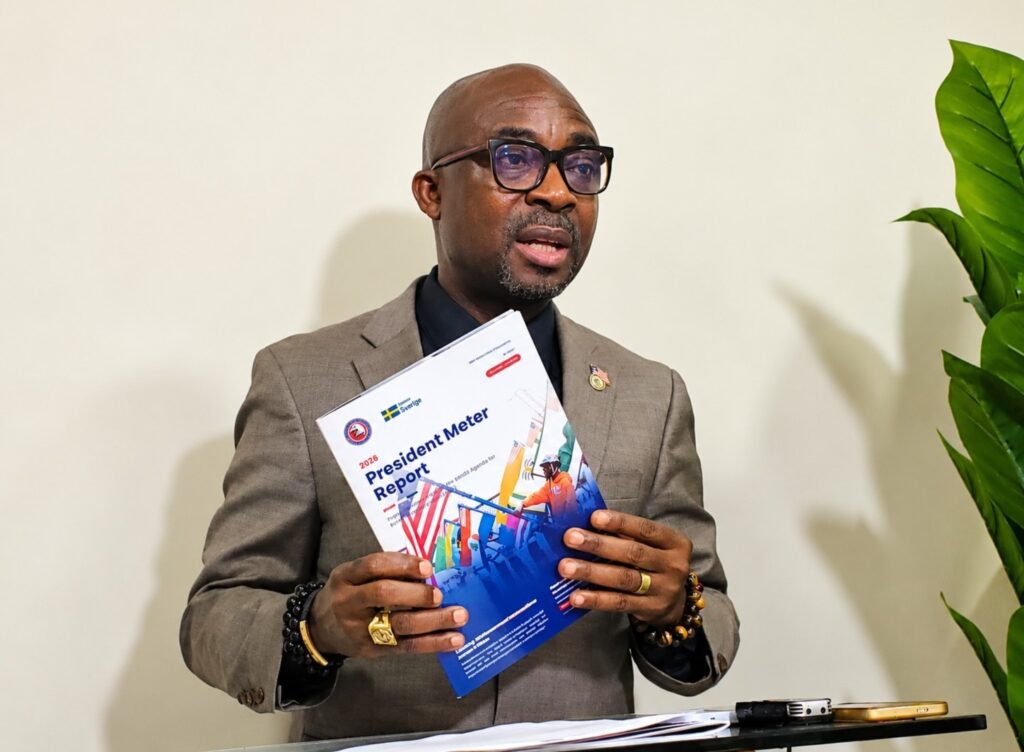
MONROVIA – Twenty-one months into President Joseph Boakai’s five-year development plan, only 12 of its 385 promised interventions have been completed. The government has not made enough evidence public for an independent monitor to judge more than a quarter of the rest, according to a report released Tuesday.
Naymote Partners for Democratic Development’s 2026 President Meter Report tracked the ARREST Agenda for Inclusive Development from January 2025 through September 2026. It found 213 interventions, or 55.3%, ongoing, and 57, or 14.8%, not started. Another 103, or 26.8%, could not be rated because the available evidence was too thin to determine their status.
Completed and ongoing interventions together give what Naymote calls a 58.4% activation rate. The group cautioned that the figure measures activity, not completion or impact.
“The emerging story is not one of inactivity, but of a national development agenda with a large portfolio of work in progress,” Naymote Executive Director Eddie D. Jarwolo said at the report’s launch in Paynesville. “The accountability question is whether these interventions will be completed on time, within budget, at acceptable quality, equitably across all counties, and with measurable benefits for citizens.”
The ARREST Agenda runs from 2025 to 2029 across six pillars. The report shows movement since Naymote’s 2025 assessment, when only three of 378 interventions were complete and 165 were ongoing. Interventions not yet started fell from 76 to 57, and those Naymote could not rate fell from 134 to 103. Naymote cautioned that the two years are not strictly comparable, because the government added seven interventions to its framework.
Human Capital Development, the largest pillar with 130 interventions, has completed none under Naymote’s evidence standard. Sixty-nine are ongoing, 23 have not started and 38 could not be rated. The Environmental Sustainability pillar also has no completed interventions among its 30, with 19 ongoing.
Infrastructure Development had the highest activation rate at 67.3%, but only one of its 49 interventions has been completed. Thirteen have not started. Economic Transformation completed five of 83, with 36 unrated. Rule of Law completed four of 35, and Governance and Anti-Corruption completed two of 58.
Naymote counts an intervention as complete only when its specific commitment, output and target have been fully met with verifiable evidence. A procurement notice, a contract signing or a project launch does not count.
“The report therefore distinguishes among activities, outputs, complete commitments, and measurable outcomes,” Jarwolo said.
The completed interventions include:
- restoring Mount Coffee Hydropower Plant to 88 megawatts
- increasing domestic revenue mobilization
- establishing the Liberia National Tourism Authority
- creating the Ministry of Local Government
- drafting the National Security Strategy 2026-2036
- operationalizing the Armed Forces of Liberia Welfare and Pension Policy
- implementing the national drug and substance abuse action plan
- implementing African Continental Free Trade Area legal instruments
The report also recorded visible outputs short of completion. According to government-reported figures cited by Naymote, 92.11 kilometers of primary roads were paved or rehabilitated and 231.69 kilometers of secondary roads were rehabilitated or maintained. The government procured 285 pieces of yellow machinery and 304 agricultural machines. Electricity access rose from 33% in 2024 to 37% in 2025, and a 20-megawatt solar plant was commissioned. Domestic revenue passed US$1 billion by September 2026, and inflation fell from 12.8% in the first quarter of 2025 to 4% by December 2025.
In education, the government reported renewing or issuing 2,445 school operating permits and training 1,463 parent-teacher association leaders and 692 teachers. Naymote noted that the three World Bank-supported model senior secondary schools commissioned in Gbarnga, Ganta and Kakata were approved in 2019, before the current administration.
Naymote said the 103 unrated interventions do not necessarily mean nothing happened, only that the evidence was not available. It blamed inconsistent information-sharing by ministries, agencies and commissions, the limited publication of progress reports, and poor access to implementation records. It also said many interventions are written as broad objectives without baselines, annual targets, timelines or an assigned institution, which makes them hard to measure.
The group called on the government to:
- rewrite the interventions as specific, measurable, time-bound commitments
- publish a single public tracking matrix and quarterly progress updates
- link each intervention to its budget and spending
- build a searchable public evidence portal
- provide evidence for the 103 unrated interventions and recovery plans for the 57 not yet started
“The President Meter Report is a longitudinal accountability product, not a government performance scorecard,” Jarwolo said.






Discussion about this post