



Published: July 14, 2025
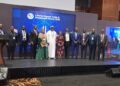
MONROVIA — In a major milestone for corporate leadership development in Liberia, four top professionals from ArcelorMittal Liberia (AML) have completed the prestigious LEAD CONNECT High Impact Leadership Program at Columbia Business School Executive Education in New York City.
The four honorees—Rebecca Kwabo-Buegar, Head of Human Resources and Development; Jallah Selmah, General Manager of Mines; Garmondyu Crusoe, General Manager of Port; and Mulbah Gbozee, Rail Maintenance Manager—join an elite global network of executives who have undergone the transformative leadership training offered by one of the world’s most esteemed business schools.
AML, Liberia’s largest foreign investor, announced the achievement on its official Facebook page on July 13, 2025, describing the moment as a “new milestone” in its commitment to building Liberian corporate leadership. The company declared, “At ArcelorMittal Liberia, we believe our people are our greatest asset, and we are proud to invest in their growth.”
The achievement underscores AML’s long-standing strategy of cultivating a robust Liberian talent pipeline to manage its growing operations, particularly as it ramps up Phase II expansion efforts in ore processing, rail, and port infrastructure.
Global Training, Local Impact
The LEAD CONNECT program at Columbia Business School is designed for senior executives navigating high-stakes and fast-changing industries. It focuses on strategic decision-making, emotional intelligence, adaptive leadership, and change management, equipping participants with world-class skills that transcend borders and sectors.
The program includes interactive simulations, coaching sessions, group projects, and case-based learning led by Columbia’s globally renowned faculty. Participants are challenged to rethink leadership in complex environments, a framework directly applicable to Liberia’s evolving mining and logistics sectors.
For Kwabo-Buegar, Selmah, Crusoe, and Gbozee, the experience was not just academic; it was transformational. It provided international exposure and cutting-edge insights that they are now expected to deploy in strengthening AML’s operations in Liberia—from human resource management to infrastructure maintenance and community relations.
Investing in Liberia’s Future
This latest development adds to AML’s expanding record of human capacity investments. Over the past decade, the company has poured millions of dollars into education and skills training for Liberians, aiming to reduce dependence on expatriate talent.
Central to these efforts is the ArcelorMittal Liberia Training Academy (AMLTA) in Yekepa, Nimba County, where hundreds of young Liberians have been trained in electrical, mechanical, and mining-related trades. Many have secured full-time jobs within AML and other companies, reinforcing local expertise in technical fields that once relied on foreign labor.
Additionally, more than 99 Liberians have received international scholarships from AML to study engineering, metallurgy, and business administration in countries like China, South Africa, and the United Kingdom. These scholarships are part of AML’s long-term localization strategy—ensuring Liberians are prepared to lead in sectors critical to the country’s development.
AML also operates a full-service elementary and high school in Yekepa, offering quality education to the children of its employees and the surrounding community. The institution features science laboratories, libraries, and qualified instructors—entirely funded by AML.
A Model for Corporate Liberia
The participation of the four executives in Columbia’s program has drawn praise from education advocates and industry watchers who view it as a model for what is possible when the private sector takes leadership development seriously.
“These are the kinds of investments that change the narrative,” said an education consultant in Monrovia who asked not to be named. “It’s one thing to talk about corporate social responsibility. It’s another to actually equip Liberians with the global skills to lead multi-million-dollar operations. AML is setting the pace.”
The development also comes at a pivotal moment for the company. With Phase II of AML’s expansion now underway—featuring enhanced rail connectivity, upgraded port facilities, and modern ore processing technology—having competent Liberian professionals in leadership roles will be key to ensuring efficient, inclusive, and sustainable growth.
According to AML, the success of its four leaders is not merely a corporate achievement, but a national signal of what can be achieved when strategic investments are made in Liberian talent.
“In empowering these professionals, we are empowering Liberia,” AML concluded in its statement.





Discussion about this post