


Published: November 27, 2026
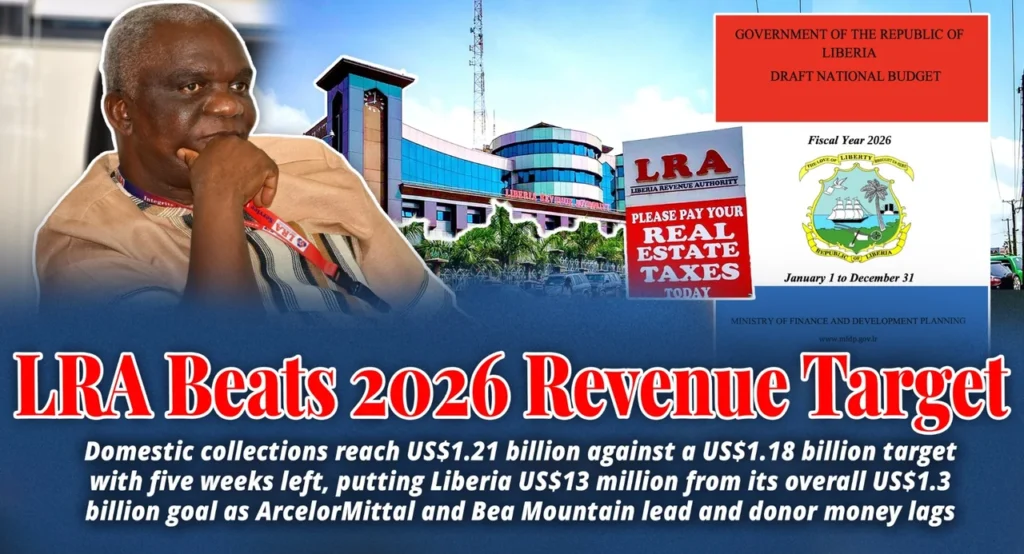
MONROVIA — Liberia has beaten its domestic revenue target for 2026 with five weeks to spare. On Thursday, the Liberia Revenue Authority’s live dashboard showed US$13.18 million left to collect against the government’s overall target of US$1.30 billion.
The domestic numbers are the strongest the country has recorded. Domestic tax collections reached US$902.3 million on Thursday afternoon, US$6.5 million above their US$895.8 million target. Customs brought in US$307.7 million against a target of US$280.9 million, beating it by 9.5 percent. Together, domestic revenue stands at US$1.21 billion, US$33.2 million above its target.
That is a leap from last year. The LRA collected about US$818 million in domestic revenue in 2025, the highest outturn in the country’s history. This year’s collections are already US$392 million higher, up 48 percent.
The growth is concentrated in a few payers.
Two miners, one windfall
ArcelorMittal Liberia leads the LRA’s list of top contributors with US$289.4 million so far this year. Bea Mountain Mining Corp. is second with US$134.1 million. Together, the two companies account for 35 cents of every dollar of domestic revenue collected in 2026, and for 70 percent of what the top 10 contributors paid.
ArcelorMittal’s total includes a one-time payment. The 2026 budget allocated the entire US$200 million ArcelorMittal signature bonus to projects. The payment arrived in a US$209 million transfer on March 9, which is why domestic tax collections hit US$383.1 million in the first quarter alone, more than in the second and third quarters combined.
Without the bonus, ArcelorMittal’s 2026 contribution falls to about US$89.4 million. Bea Mountain would then be Liberia’s largest taxpayer this year by about US$44.6 million.
The gold miner’s payments have accelerated with the gold price. Bea Mountain paid US$16.7 million in October, more than any other contributor that month. It has paid US$9.3 million so far in November, behind only ArcelorMittal’s US$13.5 million and a European Union grant.
The payroll comes third
The third-largest contributor is not a company. The Civil Service Agency, which remits income tax withheld from government workers’ pay, has paid US$46.7 million this year, more than Orange Liberia, APM Terminals or any other private firm except the two miners. Below the top three, the next seven contributors each paid between US$13 million and US$38 million: Orange, Aminata & Sons, Conex Petroleum, APM Terminals, Monrovia Breweries, the Liberia Petroleum Regulatory Authority and West Oil.
The government’s own salary bill is one of its biggest sources of tax. That says as much about how narrow the base is as it does about collection.
Where the budget falls short
The shortfall is in donor money, not taxes. The dashboard budgets US$120 million in external resources for 2026, made up of five commitments: US$40 million from the World Bank’s International Development Association carried over from fiscal 2025, another US$40 million in IDA support for 2026, US$20 million from the European Union, US$12 million from the African Development Bank, and US$8 million in additional World Bank support added in the May supplementary budget.
By Thursday, only the European Union had paid, with a US$17.8 million grant recorded in November. That is less than 15 percent of the budgeted donor money, with five weeks left in the year. About US$102 million is still outstanding, including all US$80 million in IDA funds and the full AfDB and supplementary World Bank amounts.
That gap, not tax collection, is why the overall target remains open even though the LRA has beaten its own.
The 2027 question
President Joseph Nyuma Boakai has submitted a US$1.538 billion draft budget for 2027, about US$327 million more than the US$1.211 billion draft for 2026. The 2027 budget will not include a US$200 million ArcelorMittal bonus.
That leaves Bea Mountain as the most important growth driver. On Wednesday, the government signed a separate agreement with the company.
Under the US$5.7 billion Master Infrastructure Development Agreement that Boakai signed at the Executive Mansion, Bea Mountain will finance dams, power lines and roads. It recovers those costs, plus interest, by setting them against the income tax, royalties, dividends and other payments it owes the government. At the signing ceremony, Boakai said the government would ring-fence new revenue streams from the company, beginning in 2027, to pay for the projects. The agreement does not limit offsets to new revenue.
If the Legislature ratifies the deal, Liberia’s fastest-growing taxpayer would pay a large and growing share of its bill for power plants and roads, rather than in cash to the Consolidated Fund. That may be good value for the country. It also means the budget cannot count on the same cash from Bea Mountain that the dashboard shows this year.
There is a strong case that Bea Mountain will be Liberia’s largest taxpayer for the rest of the decade. Its gold sales are rising, and ArcelorMittal’s one-time money is spent. The question for the 2027 budget is how much of that tax will reach the treasury as cash.
What the numbers say
Liberia’s revenue authority has hit its domestic target for a third straight year, and by a margin that would have seemed unrealistic two years ago. Customs is beating its target, collections are averaging US$2.9 million a day, and the year will likely close above US$1.2 billion in domestic revenue.
But the record rests on a one-time bonus, a gold boom and a civil service payroll, while donor support has largely failed to arrive. The real test comes in 2027: whether the revenue base can carry a US$1.5 billion budget without the bonus and with its biggest gold payer’s taxes committed to construction.
Related coverage
- Liberia’s Next US$1 Billion Must Come From a Thin Tax Base
- Civil Servants Rank as Liberia’s Third-Biggest Taxpayer
- Fuel, Phone Credit and Beer: How Ordinary Liberians Help Pay for a Record Revenue Year
- LRA: US$442M in Customs Exemptions Dwarfs US$278M Collected From Trade
- EXPLAINER: What Liberia Would Build Under the US$5.7 Billion Bea Mountain Deal




Discussion about this post