


Published: November 10, 2026
GUANGZHOU, China — Vice President Jeremiah Kpan Koung has intensified efforts to attract Chinese investment into Liberia, urging businesses in China to explore opportunities in agriculture, renewable energy, manufacturing and infrastructure development as the government seeks to expand industrial production, create jobs and strengthen economic growth.
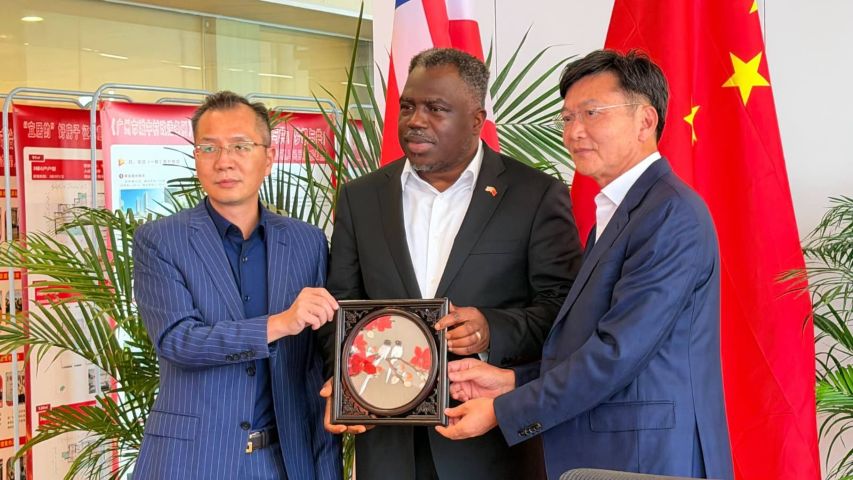
Speaking at a business exchange organized by the China-Africa Business Council on Monday, November 9, Koung encouraged Chinese companies to establish partnerships with Liberian businesses, assuring potential investors of the government’s commitment to facilitating investment and providing a conducive business environment.
The meeting, held at YuLong Fashion Plaza in Guangzhou, brought together members of the Liberian delegation and representatives of Chinese companies specializing in agricultural production and processing, renewable energy, industrial development, construction, consumer goods and financial services.
“Liberia is open for business, and I want to invite all of you sitting here,” Koung declared, extending an invitation to Chinese investors to visit Liberia and assess opportunities across the country’s priority economic sectors.
The vice president emphasized that his office would collaborate with the Liberian Embassy in China to maintain communication with interested investors, review investment proposals and connect prospective businesses with relevant government institutions.
He assured participants that the government would support investors in navigating business registration procedures while promoting a fair, transparent and secure investment environment.
Koung also presented Liberia as a potential commercial gateway to neighboring West African markets, citing its geographical proximity to Guinea, Sierra Leone and Côte d’Ivoire.
“We are here to establish a bridge so we work together for both China and Liberia and Africa as a whole,” the vice president added.
He emphasized the importance of building mutually beneficial economic partnerships that would support Liberia’s development priorities while creating opportunities for Chinese enterprises seeking to expand their presence in West Africa.
Agriculture emerged as one of the major areas of discussion, with representatives of Famsun, a Chinese agricultural technology and industrial equipment company, presenting opportunities for cooperation in grain storage, rice and flour milling, animal feed production, livestock farming, irrigation and food processing.
The company’s presentation highlighted technologies and investment opportunities that could help improve agricultural productivity, strengthen food security and increase local processing of agricultural commodities.
The discussions also focused on opportunities to promote value addition, reduce dependence on imported agricultural products and support the development of Liberia’s domestic agribusiness sector.
Welcoming the Liberian delegation, Gong Wu, standing chairman of the China-Africa Business Council and chairman of CHINESTAR Construction R&D (GuangDong) Group, expressed the council’s willingness to facilitate partnerships between its member enterprises and Liberian institutions.
Wu emphasized the importance of investment cooperation that generates employment, promotes technology transfer and strengthens domestic production.
He identified infrastructure development, agricultural processing, energy and vocational training as promising areas for potential collaboration between Liberia and Chinese businesses.
According to Wu, closer engagement between the two countries’ private sectors could help transform investment discussions into practical projects that support economic development.
Meanwhile, Wu Weihua, co-director of the council’s Guangzhou office and chairman of YuLong Fashion Plaza, called for stronger commercial connections between Liberia and Guangzhou’s extensive trading networks.
Weihua encouraged Liberian businesses to explore opportunities through the Belt and Road Foreign Trade Integrated Service Platform of Guangzhou Specialized Markets, which facilitates commercial exchanges and access to international trading networks.
He also proposed that Liberia consider establishing an official commercial liaison point in Guangzhou to strengthen business communication, facilitate information sharing and improve coordination between Liberian enterprises and potential Chinese partners.
The proposal, if pursued, could provide a mechanism for sustained engagement between Liberia’s business community and Chinese investors beyond official government visits.
Liberia’s Ambassador to China, Dudley McKinley Thomas, welcomed the growing relationship between Liberia and the China-Africa Business Council, expressing optimism about opportunities for increased trade and investment cooperation.
Thomas assured participating companies of the Liberian Embassy’s commitment to facilitating engagements with relevant government institutions and supporting efforts to establish productive business partnerships.
The Liberian delegation included Dr. Macdonald Metzger, deputy chief of staff in the Office of the Vice President; Melvin S. Sendolo Garpeh, special envoy for government and investment; Moses Mooney, director of protocol; and Washington J. Wesley, minister counselor at the Liberian Embassy in China, among other officials.
The Guangzhou business engagement followed Koung’s participation in the ninth China International Import Expo in Shanghai, where international businesses and government representatives gathered to explore trade and investment opportunities.


Discussion about this post