

Published: November 9, 2026
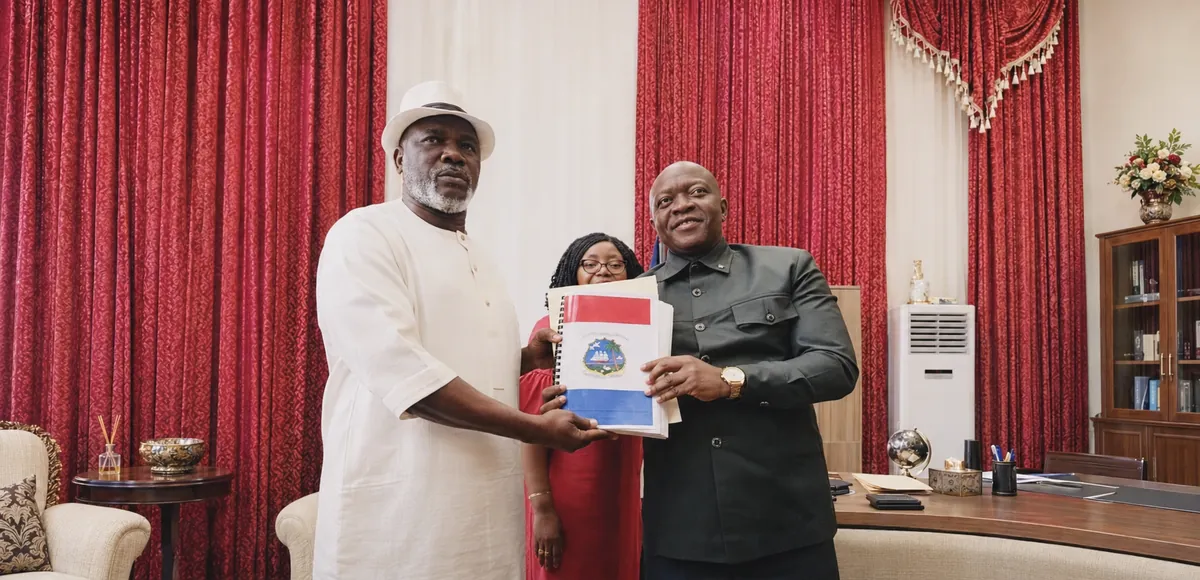
MONROVIA — President Joseph Nyuma Boakai sent the Legislature a US$1.538 billion budget on Friday, the largest Liberia has ever proposed. It builds on a revenue year that crossed US$1 billion for the first time, but the one-time payment that accounted for about a fifth of that record will not recur. Much of the new spending the government wants to add is recurring.
Finance Minister Augustine Kpehe Ngafuan submitted the draft to House Speaker Richard Nagbe Koon. It is about 23 percent, or roughly US$288 million, above the approximately US$1.25 billion budget lawmakers approved for 2026.
The government’s case is in the theme it chose: “A Growing Budget for Bigger Impact.” The Ministry of Finance and Development Planning said the budget reflects the government’s commitment to turning stronger revenue into visible improvements in ordinary Liberians’ lives. What the ministry’s summary leaves out is where the extra money will come from.
The one-off in the record
Revenue collections stood at US$997.43 million on Sept. 13 and crossed US$1 billion days later, The Liberian Investigator reported. In March, ArcelorMittal Liberia paid a one-time US$200 million fee under the third amendment to its Mineral Development Agreement, which extends its concession to 2050. That payment alone was roughly a fifth of the total. Without it, collections at that point would have been about US$797 million.
Ngafuan has acknowledged the hole. In September, he said the mining payment would not recur in 2027 and described the result as a US$200 million gap, which he said he was confident economic growth would close or exceed. He also said the money coming in is already going out.
“It is raised, and it is spent. It is raised, and it is spent. It is raised, and it is spent,” Ngafuan said.
The Liberia Revenue Authority’s original domestic revenue target for 2026 was US$1.176 billion. It has since referred to a US$1.3 billion target.
The ministry’s summary of the 2027 draft gives no revenue projection, no borrowing figure and no breakdown of how much is expected from domestic taxes, donors or loans. Until the budget book is examined, it is not possible to say how the government plans to fund the US$1.538 billion without the payment that lifted this year’s total. The draft budget has not yet been made public as of the time of this publication.
Spending that recurs
The largest commitments in the draft are to the payroll, and payroll does not shrink when a one-time payment ends.
More than 17,000 people would benefit from compensation measures: nearly 13,000 government workers receiving raises and about 4,350 new hires, including volunteers. Teachers’ pay would be standardized across Ministry of Education and Monrovia Consolidated School System schools, with a US$650 monthly floor for teachers with master’s degrees and US$400 for those with bachelor’s degrees. Minimum salaries for directors, deputy directors and assistant directors rise from January. The Armed Forces of Liberia would recruit 800 people and the Liberia National Police 600.
Ngafuan signaled in September that pay would be generous. Speaking about a committee then reviewing civil service salaries, he said: “We are not going to budget frustration. We’re going to budget joy.”
President Boakai framed the raises as part of a multi-year effort to fix pay inequities “inherited by this government, which cannot be addressed in one fiscal year,” the ministry said. The 2026 budget already added more than 2,000 health and education volunteers and more than 800 chiefs and local officials to the payroll, the ministry said.
Each of those measures becomes a permanent claim on revenue. The summary does not give the total wage bill for 2027 or its share of the budget.
An admission on pensions
President Boakai acknowledged that the government owes nearly US$60 million to the National Social Security and Welfare Corporation in employer contributions it owed but did not pay over several years.
From 2027, the government says it will fully fund the 6 percent employer contribution on public servants’ wages and pay down the arrears on an amortization schedule. That is a second recurring cost layered on top of the raises: the higher the wage bill, the larger the 6 percent. The ministry did not say how much it has set aside next year for either the current contributions or the arrears.
The pension debt joins others already on the books. The 2026 budget included US$235 million for debt service, of which US$90 million went to clearing arrears with commercial banks, Ngafuan said in September.
Where the money goes
Health spending would rise about 22 percent, to US$135.8 million from US$110.9 million. Even so, health would account for less than 9 percent of the total budget. African Union governments committed in the 2001 Abuja Declaration to spend 15 percent of their budgets on health.
Education would rise 13.9 percent, to US$163.5 million, including US$7 million to continue renovating the University of Liberia. The gender ministry’s allocation would rise 77 percent, though the ministry gave no dollar figure.
Some of the new lines are small and specific: US$800,000 to start a national hepatitis B response, US$1.4 million toward a children’s referral hospital, US$3 million to continue school feeding. Others are politically visible. The draft includes US$3 million for the Lone Star national football team, which Boakai said fulfills a commitment he made about two months ago, US$650,000 for veteran Lone Star players and US$2 million for commercial motorcyclists, including rest stops.
The World Bank found that Liberia spent on average 33 percent of its capital budget from 2018 to 2025, The Liberian Investigator reported in September. A larger allocation for hospitals and schools is a plan, not a guarantee of construction.
Who pays
Ordinary consumers pay a disproportionate share of this revenue. Five companies whose tax bills are collected largely from customers through the price of fuel, phone credit and beer paid 27 percent of what the 10 largest taxpayers paid in the first 10 months of this year, excluding ArcelorMittal’s one-time fee, The Liberian Investigator reported last week. The goods and services tax is due to be replaced by a value-added tax on Jan. 1, 2027.
At the same time, the government gives up large sums in tax breaks. The World Bank’s Liberia Public Finance Review 2026 puts revenue lost to exemptions and other incentives at US$240.3 million in 2024, more than 40 percent of all tax revenue collected that year. That is more than the ArcelorMittal payment the 2027 budget must now do without.
Boakai said the budget is “not only bigger in size but also evidently bigger in potential impact” and asked for quick passage, according to the ministry. Lawmakers passed this year’s budget in December 2025, weeks before the fiscal year began.


Discussion about this post