


Published: November 9, 2026
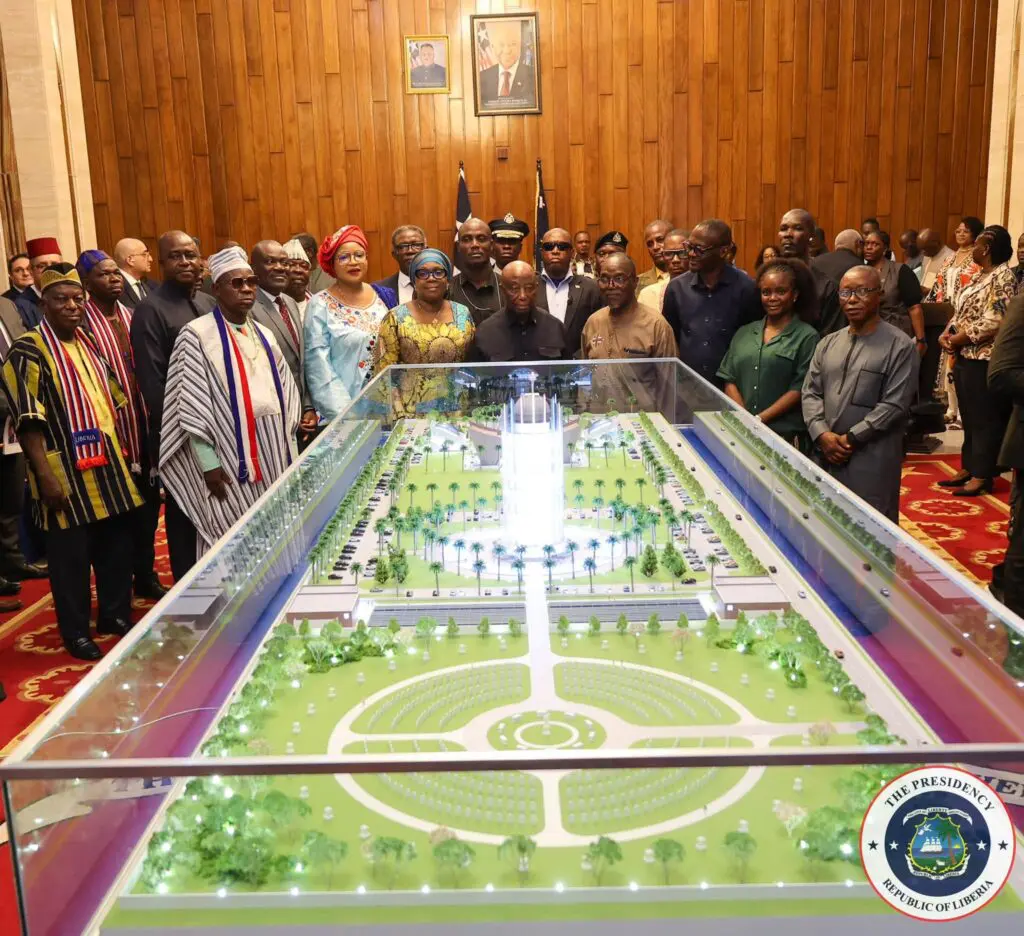
MONROVIA — Liberia will begin building its first national memorial to the people killed in its civil wars in mid-2027, President Joseph Nyuma Boakai said Friday as he unveiled a prototype of the memorial wall at the Executive Mansion. The memorial is the first major government action on a war-era recommendation that successive administrations left untouched for nearly two decades.
The Executive Mansion said the memorial will be built on Bali Island in Monrovia. It will honor the Liberians killed during the conflicts, which ran from 1989 to 2003. Estimates of the dead range from tens of thousands to as many as 250,000, Human Rights Watch has said.
Boakai told guests in the Parlors of the Executive Mansion that the memorial would stand for every Liberian life lost, including people “whose names may never be known,” according to an Executive Mansion release. He said the memorial was a chance for the country to acknowledge its painful history “with dignity and compassion,” and assured victims’ families that their relatives would not be forgotten.
He also said a memorial alone cannot heal a nation, and that remembrance must be accompanied by justice.
That second commitment is the one still waiting. Liberia’s Truth and Reconciliation Commission called in its 2009 final report for memorials at massacre sites in every county capital and for a national memorial day. It also called for a special court to try those most responsible for war crimes. Neither former President Ellen Johnson Sirleaf nor former President George Manneh Weah took substantial steps on the commission’s 207 recommendations, New Narratives reported.
Boakai created the Office for the Establishment of the War and Economic Crimes Court by executive order in May 2024. The government’s bill to establish the court went to the Legislature on May 20 this year, Human Rights Watch reported. In June, the Senate endorsed a roadmap aiming for final committee action on the bill by mid-December, The Liberian Investigator reported.
The office’s executive director, Cllr. Jallah A. Barbu, said last month that lawmakers would not take up the bill until January 2027. The executive order that last renewed his office’s mandate, Executive Order 164 of May 3, directs it to begin winding down by March 1, 2027, according to Human Rights Watch.
Boakai first pledged a national war memorial in July 2025, in his Independence Day address, three weeks after publicly apologizing to war victims. At the time, he said it would also honor West African peacekeepers who died in Liberia.
“This sacred monument will not only commemorate the fallen but will also serve as a call to conscience,” Boakai said then.
Some advocates welcomed the pledge but warned it should not take the place of accountability. “The most urgent right now is the funding to the War and Economic Crimes Court,” Hassan Bility of the Global Justice and Research Project said at the time.
Friday’s ceremony was held under the theme “Honoring the Past, Celebrating Peace, and Inspiring the Next Generation.” Retired Maj. Gen. Daniel Dee Ziankahn Jr., chairman of the ECOMOG Memorial Committee, said the project would allow Liberia to collect and preserve accounts of its passage through conflict, peace, reconciliation and healing.
Boakai said the memorial is tied to the work of the Liberia Peace, Reconciliation and Memorial Museum, whose steering committee is scheduled to meet Nov. 16 to 18. The initiative is meant to preserve the country’s history and teach future generations about the wars, he said.
Foreign Minister Sara Beysolow Nyanti linked the memorial to Liberia’s term on the United Nations Security Council. She said it signals Liberia’s commitment to global peace and security and supports efforts to keep young people out of extremism and armed groups. Liberia takes up the council’s rotating presidency in December, the Liberian Observer reported. Nyanti has listed youth, peace and security among the priorities for that month.
Representatives of the Inter-Religious Council of Liberia, the Federation of Liberian Youth and the Traditional Chiefs and Elders of Liberia also spoke in support of the memorial.
Boakai urged Liberians to treat the memorial as a promise to future generations that the country will never return to war.
The Executive Mansion did not say how much the memorial will cost, how it will be funded or whether victims’ names will be inscribed on the wall.

Discussion about this post