


Published: November 6, 2026
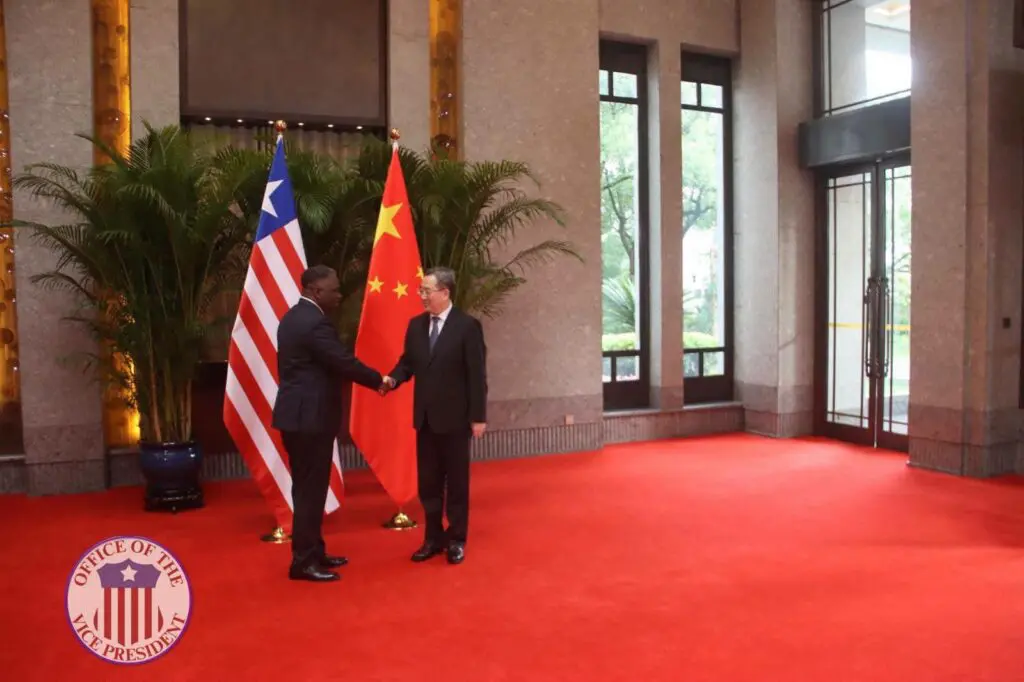
SHANGHAI, China — Liberia and China have renewed efforts to deepen their economic partnership, with Vice President Jeremiah Kpan Koung seeking increased Chinese investment in energy, agriculture, manufacturing and infrastructure to boost domestic production, create jobs and strengthen Liberia’s economy.
The renewed push followed bilateral talks Thursday, Nov. 5, 2026, between Vice President Koung and Chinese Vice Premier Ding Xuexiang at the Xijiao State Guest Hotel in Shanghai, where both officials discussed expanding trade opportunities, improving essential services and advancing development projects.
During the meeting, Koung reaffirmed Liberia’s commitment to strengthening bilateral relations under President Joseph Nyuma Boakai and Chinese President Xi Jinping, emphasizing the importance of existing cooperation frameworks, including the Forum on China-Africa Cooperation (FOCAC) and the Belt and Road Initiative.
The vice president welcomed China’s zero-tariff policy for Liberian exports, describing it as an opportunity to expand Liberia’s access to the Chinese market and increase earnings from agricultural commodities.
He called for technical assistance to help Liberian producers meet international export standards and increase shipments of rubber, cocoa, coffee and other agricultural products.
Koung also encouraged Chinese businesses to invest in Liberia’s special economic zones, particularly in rubber processing, agro-processing and light manufacturing, arguing that increased domestic processing would create employment opportunities and allow Liberia to retain more value from its natural resources.
Responding, Vice Premier Ding expressed China’s willingness to expand commercial cooperation with Liberia, including through the China International Import Expo (CIIE).
He encouraged relevant Liberian institutions to provide information on companies eligible to export products to China, a move intended to facilitate greater access to the Chinese market.
Energy development also featured prominently in the discussions, with Koung identifying affordable and reliable electricity as a critical priority for Liberia’s economic transformation.
He called for increased Chinese cooperation in solar energy, battery storage, hydropower and rural electrification, emphasizing the need to expand electricity access to underserved communities and support industrial development.
The vice president further highlighted opportunities for cooperation in clean water, healthcare, digital connectivity and vocational training, describing these sectors as essential to improving living conditions and strengthening Liberia’s workforce.
Koung acknowledged China’s contributions to several development initiatives in Liberia, including the construction of two overpass bridges in Congo Town, the provision of agricultural machinery and government vehicles, support for the Liberia Broadcasting System and diagnostic laboratory assistance near the 14 Military Hospital.
For his part, Ding reaffirmed China’s commitment to supporting Liberia’s development priorities, including ongoing infrastructure and laboratory projects.
He disclosed that Chinese technical teams would assess broadcasting facilities and the proposed renovation of Liberia’s Capitol Building as part of further cooperation between the two countries.
The Chinese vice premier also pledged continued scholarships and professional training opportunities for Liberians, emphasizing education and capacity development as important components of the bilateral relationship.
On investment, Ding identified Liberia’s mining sector as another area with significant potential for cooperation, expressing China’s willingness to encourage more Chinese enterprises to explore investment opportunities in the country.
Both officials underscored the importance of maintaining strong diplomatic relations while expanding practical cooperation in sectors capable of generating economic growth and employment.
Koung reaffirmed Liberia’s adherence to the One-China policy and its respect for national sovereignty and territorial integrity.



Discussion about this post