


Published: October 2, 2026
Liberia’s first billion-dollar revenue year was built on a one-time mining payment and a small group of large payers, not on a broader economy. Without the US$200 million signature bonus, first-half collections would reach only 78% of target. Sales, property, excise, and vehicle taxes, which would broaden the base, made up 4.3% of revenue, and under 6% even without the bonus.
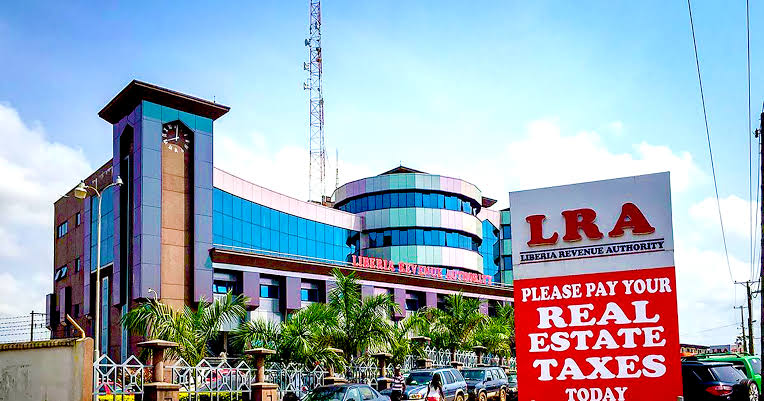
MONROVIA – Liberia’s next US$1 billion will have to come from the parts of the economy that barely register on the tax ledger: everyday commerce, urban property, vehicles, agriculture, tourism, manufacturing and the many businesses outside the small circle of top corporate taxpayers.
Lennart Dodoo | News Analysis
During the first half of 2026, general sales, property, excise and motor vehicle taxes together produced US$32.63 million, about 4 cents of every dollar the government collected. The general sales tax, which reaches formal shops, hotels, restaurants and service businesses, raised US$23.39 million. Real property taxes produced US$3.94 million, excise taxes US$3 million and motor vehicle taxes US$2.3 million.
The figures come from the Ministry of Finance and Development Planning’s Consolidated Mid-Fiscal Year Review for January through June. They expose the thin base beneath Liberia’s new revenue ambition.
Liberia crossed US$1 billion in annual domestic revenue for the first time in September. At 12:03 a.m. Oct. 1, the Liberia Revenue Authority’s public dashboard showed US$1,046,742,155.69 collected for fiscal 2026. That is 80.4% of the US$1.302 billion national budget, with three months remaining.
The question now is how Liberia raises its next annual US$1 billion after this year’s exceptional receipts are gone.
The Liberian Investigator’s analysis of the dashboard shows the country’s 10 largest taxpayers account for close to half of the national budget, a share expected to hold through year’s end. These taxpayers include ArcelorMittal, Liberia, Bea Mountain Company, Civil Service Agency, Orange Liberia, Aminata & Sons, Conex Petroleum Liberia Ltd., APM Terminals Liberia, West Oil Investment Liberia and LISCR Trust Company.
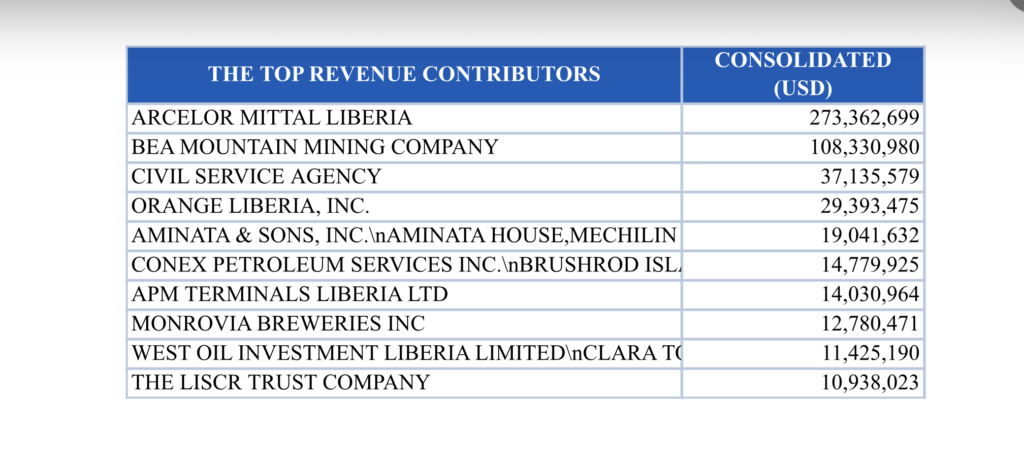
If the estimate holds, the rest of Liberia’s registered taxpayers, along with the large share of economic activity that remains informal or weakly captured, must provide the broader foundation for future budgets.
The base narrows quickly
Personal income and withholding taxes raised US$142.66 million during the first half of the year, or 18.7% of the US$761.15 million collected. Taxes on international trade, principally import duties collected at the ports, produced US$147.35 million, or 19.4%. Corporate income tax generated US$68.92 million, or 9.1%.
Those three categories carried much of the recurring collection. After them, the figures fall sharply.
The general sales tax and administrative fees each produced US$23.39 million, about 3.1% apiece. Maritime revenue contributed US$9.2 million, and fines and penalties brought in US$5.41 million. Real property taxes yielded US$3.94 million, just 0.5% of total revenue and 80.3% of an already modest midyear target. Excise and motor vehicle taxes together produced US$5.3 million.
Property, excise and vehicle taxes combined raised US$9.24 million. That is less than one-twentieth of the US$200 million ArcelorMittal reported paying the government under its extended mining agreement.
The figures show how heavily Liberia depends on wage withholding, imports and a narrow circle of major corporate taxpayers. They also show how little the government collects from urban property, domestic consumption, vehicles and other activity that should widen as the economy grows.
Raising rates on the people and businesses already paying will not broaden the base. Broadening it means registering more economic activity, making compliance easier, improving property valuation, reviewing tax exemptions and applying enforcement equally to every taxpayer, however well connected.
The US$200 million benchmark
ArcelorMittal said in its second-quarter earnings release that it paid the Liberian government US$200 million “for certain rights it acquires per the agreement.” The agreement extended the company’s Mineral Development Agreement to 2050, an extension ArcelorMittal dated to the first quarter of 2026.
The government’s midyear review records US$210 million under “Signature Bonus (Mineral Mining)” and classifies it as nonrecurring revenue. The two published figures differ by US$10 million, and the review does not say whether its total includes another payment.
Using the government’s figure, the signature bonus accounted for 27.6% of all revenue collected during the first half. Add US$46.55 million in mineral royalties and US$10.79 million in mining social development contributions, and directly identifiable mining receipts reached US$267.34 million, about 35% of half-year revenue.
That calculation leaves out the corporate income taxes, import duties and other payments mining companies make, because the review does not break those revenue lines out by sector.
Without the signature bonus, the review said, first-half revenue would have been about US$551.2 million against a US$707.7 million target. Performance would have stood at about 77.9%, not the reported 107.5%. That is the gap Liberia’s recurring revenue base must eventually close.
The LRA dashboard reflects the same first-quarter surge. Its “Domestic Tax” category recorded US$383.06 million in the first quarter, falling to US$213.10 million in the second and US$193.35 million in the third.
Despite its label, the category appears to include nontax receipts such as the signature bonus and mineral royalties. The dashboard and ministry figures for the first half reconcile only when the bonus is included.
That classification makes it hard for the public to separate ordinary tax performance from exceptional concession receipts. A clearer dashboard would report taxes, royalties, concession payments and other nontax revenue separately.
ARREST’s spending ambitions exceed its revenue engines
President Joseph Boakai’s ARREST Agenda is built around agriculture, roads and other infrastructure, governance and the rule of law, education, sanitation and tourism.
Most of those priorities require far more public spending than the revenue the government can trace to them. Even the productive sectors expected to expand the economy barely appear in the midyear revenue data.
Agriculture received a revised appropriation of US$15.7 million. Its allocation fell 8.5% in nominal terms, even though the review describes the sector as a strategic priority.
The review contains no separate revenue line for agriculture. Agricultural businesses still pay taxes, which may appear under corporate income, customs or other categories. The government’s reporting simply makes the sector’s direct fiscal contribution hard to measure.
The Liberia Extractive Industries Transparency Initiative’s 16th report, covering 2023, ranked agriculture second only to mining among extractive-sector contributors to government revenue. Firestone Liberia was among the companies the LRA honored as top taxpayers in November 2024.
Energy and environment received a revised appropriation of US$79 million, up 228.8%. The government had disbursed US$53.8 million of it by midyear.
Fuel-related collections provide one identifiable revenue stream. A presidential directive issued in September 2025 added 11 cents per gallon in petroleum levies, projected to raise about US$17 million a year on estimated imports of 154.7 million gallons. The Road Fund, which the review classifies as property income, collected US$19.31 million during the first half, 61.9% of its target.
Roads fall under infrastructure and basic services, which received a revised allocation of US$144.2 million. Only 26.4% of that had been disbursed by June.
The closest revenue line related to the rule of law, fines, penalties and forfeitures, produced US$5.41 million. Tourism had no dedicated revenue line, so its contribution cannot be isolated.
Education and health received revised allocations of US$145.2 million and US$111.4 million. By midyear, the government had disbursed 38.4% of the education allocation and 34.6% of the health allocation.
Before much of that development spending could happen, wages, interest and debt service consumed US$270.5 million during the first half. That was 58.3% of all recurrent and capital disbursements.
That is why expanding the tax base is more than an accounting exercise. The government’s development commitments compete with fixed obligations, leaving revenue concentrated and vulnerable.
September’s pace is not a forecast
In September, collections came in a few large waves rather than a steady flow. The LRA collected US$95.6 million against a target of US$71.17 million. Domestic tax beat its target by US$16.65 million, and customs beat its target by US$7.77 million.
Five days, Sept. 7, 9, 10, 22 and 23, produced US$40.24 million, or 42% of the month’s collections. Revenue fell below US$25,000 on each of the month’s four Sundays.
The pattern may reflect statutory payment deadlines and the timing of major transactions. It also shows why daily averages are an unreliable measure of the underlying tax base.
The dashboard’s US$254.99 million “target gap” also overstates what the LRA itself must raise. That calculation includes US$120 million in budgeted external resources, which the dashboard records at zero and which the revenue authority does not collect.
The dashboard’s year-to-date total also counts a US$5 million carry-forward from the previous year as revenue. Leave out that carry-forward and the external money, and actual collections of US$1.042 billion stand at about 88.5% of the US$1.177 billion domestic target. That leaves about US$135 million for the final quarter.
At September’s pace, the LRA could cover that amount in less than two months.
The dashboard’s US$1.40 billion year-end forecast is less certain. It projects the year-to-date daily average of US$3.83 million through December, but that average includes the ArcelorMittal Liberia non-recurrent signature bonus fee of $210 million, which would not be available next year.
The same caution applies beyond 2026. A large annual total does not automatically become the starting point for the following year.
Where the next billion must come from
Liberia’s next billion-dollar year will depend on whether the country can turn more of its economic activity into recurring, fairly collected revenue.
That means stronger sales tax performance from commerce and services, better valuation and collection of property taxes, more consistent vehicle and excise taxation, and measurable growth in contributions from agriculture, tourism and manufacturing.
It also means bringing more businesses into the formal system without making registration and compliance so costly that they stay outside it.
Expansion cannot mean repeatedly squeezing salaried workers, importers and compliant companies while the rest of the economy stays outside the net.
The first US$1 billion set a national revenue milestone. The next must prove the figure can be sustained by a wider economy rather than assembled from a narrow group of taxpayers and exceptionally high non-recurrent receipts.






Discussion about this post