


Published: September 29, 2026
MONROVIA — Integrity Watch Liberia, with support from the European Union, has intensified efforts to strengthen corporate accountability in Liberia’s forestry and extractive industries, bringing government institutions and civil society organizations together to sharpen their ability to monitor businesses, document alleged abuses and pursue remedies for affected workers and communities.
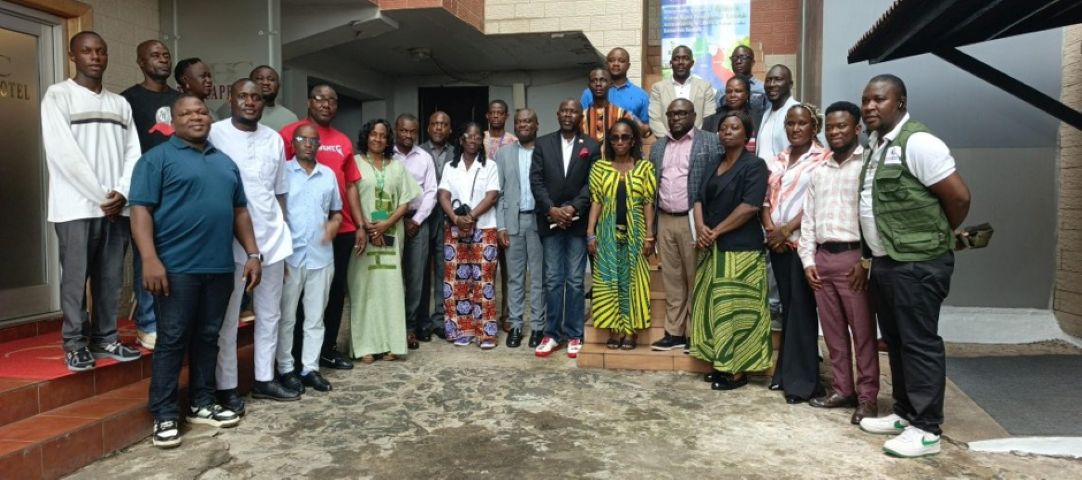
The one-day technical capacity-building training, held Friday, Sept. 25, forms part of a 24-month project titled, “Strengthening Inclusive Participation, Human Rights Protection and Corporate Accountability in Liberia’s Forestry and Extractive Sector.”
The initiative seeks to deepen stakeholders’ understanding of business and human rights principles, strengthen monitoring of corporate activities and improve grievance and remedy mechanisms in sectors that contribute significantly to Liberia’s economy but can also have major impacts on workers, communities, land and the environment.
Opening the training, Integrity Watch Liberia Executive Director Harold M. Aidoo said businesses are critical to Liberia’s economic survival but stressed that economic activities must respect and protect fundamental human rights.
“Our economy cannot survive in the absence of businesses,” Aidoo said, noting the role companies play in employment, government revenue and broader economic activities through taxes, royalties, commerce, extraction and manufacturing.
Aidoo thanked the EU for supporting the project, which he said is built around three major pillars targeting civil society, the private sector and government.
Under the civil society component, Integrity Watch is working with organizations in four counties to improve their understanding of the United Nations Guiding Principles on Business and Human Rights and Liberia’s national framework.
Participating organizations are expected to monitor human rights concerns and alleged abuses associated with business activities and generate information that can support the Independent National Commission on Human Rights, Ministry of Justice and other relevant institutions.
For the private sector, the project seeks to encourage companies to establish mechanisms through which workers and affected communities can report violations and seek remedies. Where those mechanisms do not exist, Aidoo said the project will support companies in developing them.
The government component is intended to ensure that monitoring findings are communicated to relevant authorities for appropriate action.
Speaking on behalf of Justice Minister and Attorney General Cllr. Betty Lamin-Blamo, Deputy Minister for Administration and Public Safety Cllr. Cora Konuwa formally launched the training and emphasized the need for responsible business practices in Liberia’s resource-rich economy.
Konuwa said forestry and extractive activities contribute to employment, government revenue, infrastructure and livelihoods but can also affect land, labor rights, communities and the environment.
“It is therefore imperative that economic development and human rights protection advance together,” Konuwa said.
She said government must provide effective laws, policies and remedies, while businesses have a responsibility to operate responsibly and civil society must continue its monitoring, advocacy and community engagement.
National Civil Society Council Chairman W. Lawrence Yealue challenged civil society organizations to strengthen their technical, legal and advocacy capacities and move beyond relying primarily on public campaigns to address corporate accountability issues.
“Try to influence policy,” Yealue said, urging organizations to engage government institutions directly and use advocacy to shape policies governing business and human rights.
He called for stronger community engagement and legal clinics to help residents understand their rights, available grievance mechanisms and avenues for redress.
Yealue also encouraged civil society organizations to develop transnational networks and engage international institutions when dealing with multinational corporations.
He advocated greater use of strategic litigation where companies are accused of violating community rights, while acknowledging the financial and jurisdictional difficulties such cases can present.
Yealue also cautioned journalists and civil society advocates to carefully assess security risks when investigating or campaigning against powerful corporate interests.
“There is no story worth dying for,” he said.
He disclosed that Liberia’s business and human rights policy is currently before the Cabinet and expressed hope that it would be approved.
Acting INCHR Chairperson Cllr. Mohammed E. Fahnbulleh called for stronger institutional systems to prevent violations, investigate allegations and provide remedies.
He said Liberia’s efforts to attract investment in mining, agriculture, forestry, fisheries and other sectors must be accompanied by safeguards protecting the dignity, livelihoods, health and safety of workers and communities.
“Corporate accountability should not be viewed as an impediment to investment,” Fahnbulleh said, arguing that clear standards, transparency and effective grievance mechanisms can instead help create a more predictable business environment.
He urged companies to establish human rights due diligence systems, transparent reporting mechanisms, worker protection procedures and effective frameworks for engaging communities.
Fahnbulleh also called for greater attention to Liberia’s fisheries sector, saying coastal communities and workers throughout the fisheries value chain should be included in the national business and human rights conversation.
Christian Mukosa, representative and chief of office of the Office of the United Nations High Commissioner for Human Rights in Liberia, said the training forms part of broader efforts to implement Liberia’s national business and human rights framework.
Mukosa said Liberia became the fourth African country, after Kenya, Uganda and Nigeria, to adopt a National Action Plan on Business and Human Rights, which was launched in August 2024.
He said attention must now shift toward determining how effectively the plan is being implemented.
“We need to see where we are when it comes to the implementation,” Mukosa said, urging stakeholders to use the training to identify existing gaps.
He reaffirmed the United Nations and OHCHR’s support for the National Action Plan and the National Business and Human Rights Steering Committee.
Mukosa also highlighted human rights concerns within both formal and informal economic activities, particularly mining, where he said informal workers often lack adequate legal protections.
He said OHCHR would continue working with government, civil society and other stakeholders to help move Liberia’s business and human rights agenda beyond policy commitments toward practical protections for workers and communities.




Discussion about this post